
I have finished my analysis of Forbidden Knowledge, and must now type up the nearly eleven pages of notes I took. In the mean time I will present two short articles one of my valued couple of readers, Steve, provided in the ever popular Uri Geller post about a number of other investigators' work with nitinol. I think everyone is going to comment there in the future instead of reading anything new.
While reading Forbidden Knowledge I noticed Mr. Couttie's ambivalence toward the subject of dowsing. Dowsing seems to be one of the most widely accepted "paranormal" effects, even among skeptics. This reminded me of a video I saw a few years back about dowsing. For your viewing pleasure, In Search Of... Water Seekers.
Sidenote: Integral Politics is 2,287 words long, nearly twice as long as the next longest post. Even without the long quote near the end it is still 1,994 words long, about 1.6 times as long as number two.
Thursday, January 27, 2011

Tuesday, January 25, 2011
Integral Politics
Ken Wilber answers a question about the possibility of integral politics. Yes, he naively believes that just because Bill Clinton and Karl Rove read his books that they're integral, I've already dealt with that. Please just continue watching anyway. The hardest part to implementing integral politics? Getting integrally developed people elected when their only platform is being integrally developed.
KW does make a prediction (this is 2008) that the Republicans would win the election because it's easier to get Amber (Blue) and Orange to agree than it is to get Orange and Green to agree, meaning it's easier to unite Republicans than Democrats.
Video runs 31 minutes.
On the heels of that I wrote a bunch the other day (one of the best days I've had in a long time) about integral politics after someone informed me of a video about Vermont Senator Bernie Sanders spouting crap about economics. Here is my response:
The top 1% may have made 23% of all income, but they also paid 80% of all income tax. Is it really fair to have the top 1% pay all of the taxes and everyone else pay nothing? The top 1% income earners are the ones driving the economy. The billionaires Sen. Sanders hates so much don't pay income tax. They are not part of the top 1%. Ted Turner and George Soros and Warren Buffet have high priced lawyers who can weasle their way through tax loop holes and set up accounts in foreign banks to protect their billions. Taxing the rich more won't help the middle class, it will just get the people investing in economic growth to spend their money in foreign markets, setting up businesses in India and China, and killing more jobs.
Remember how Kennedy taxed the rich, found it lost federal revenue, then cut taxes for the rich and increased federal revenue? Sanders doesn't know what he's talking about.
The estate tax is disgusting. Getting rid of the estate tax will cost $1trillion in revenue? How about TARP, $700 billion? How about the American Recovery and Reinvestment Act, $787 billion? QE1 and QE 2, $several trillion? Social Security and Medicare have unfunded liabilities of $107 trillion. Deficit spending never has and never will be a viable economic strategy.
Sen. Sanders is making $174,000 a year, just with his Senate salary, not to mention whatever he makes on the side (to get elected you have to be a millionaire). If he's so goddamn opposed to the rich why doesn't he forgoe his salary? He's a hypocrite. He is making an appeal to emotion. There is no substance here.
Correction: The top 1% pay only 50% of all income tax. The top 10% pay 80% of income tax. I had mistaken the two groups.
I then move on to address the issue of a two party system:
The problem is both parties are statist and no one can mount a viable third party opposition. They may disagree on how the government should control everyone's lives, but they both want to control everyone's lives, and most people don't realize this. They see the D's and R's beside someone's name and hate whoever has the opposite letter that they have, so every so many years we switch from one party rule to the other and back again, never solving the underlying problem. It's all just a show. I've been saying this since at least 2003, there is no difference between Democrats and Republicans.
Not as difficult to solve as the first problem. Avarice is one of the two driving forces behind all sin, and simply taxing people won't solve the problem. Avarice can never be eliminated completely, but for the first time in history the tools exist to implement its fall from power. The only way I can see to end the crushing grasp avarice has on the world is through the reintroduction of meaning. Not subjective meaning, like "I give my own life meaning," but absolute meaning. The way to reintroduce meaning is to remove materialism. In a materialistic world meaning is impossible, and people strive only for their own gain. Materialism is subverted by integrating the Truth discovered by the great premodern wisdom traditions with the benefits brought about through modernity. This literally was never possible before because the people never had access to both. There was always someone acting as the gatekeeper (kings, religious leaders, industry magnates, academic figures), preventing the people from knowing the Truth, telling them their stories to hold power. Instantaneous global communication allows for access to the collective knowledge of humanity, allowing the integration to take place if the people are willing to stop playing with their toys and take the steps necessary to free and empower themselves. It's a hard road ahead. Most people are happy with the toys the powers that be have given them. It may take a global economic collapse, or some similarly sized global disaster, to shake people from their complacency. Who knows these things?
What's the problem with the old Left/Right dichotomy?
Many people are still thinking of the old left/right dichotomy, with Democrats (let's call them "Dems") on the left and Republicans ("Pubs") on the right. While this is largely true (there are left-leaning pubs and right-leaning dems), it ignores the fact that there is a vertical axis to the political spectrum as well, leading from anarchism on the bottom to statism at the top. I drew the following graph when I got tired of the single-axis model:

I've placed a few names where I think they should go. Things tend to cluster in places because I got the scale wrong and names are tentatively placed and had to be enlarged to be readable. Names should appear as close to whatever diagonal axis they are next to. For reference I land about 35 down and somewhere between 5 left and 5 right (I seem to migrate), so I am alienated by both parties.
While dems are generally about collective welfare and pubs about personal welfare, as you can see they are both pretty far up the vertical axis. A quick look at the policies of the previous two presidents reveal that Bush and Obama are largely in agreement economically (both enacted legislation to bail out companies, both racked up record deficit spending, record debt), militarily (Although Obama technically ended the Iraq War on 31 August, there will be troops there until at least 31 December 2012, probably longer, and he has ramped up military action in Afghanistan, he has not closed Guantanimo Bay, etc.), globally (same foreign policy, giving US land to foreign governments [trans-Texas corridor, etc.]). They differ in a few areas, but there's not a whole lot of disagreement between the two. I often say that when Obama promised "change" he meant "change in degree from Bush" not "change in kind." While they are both at about 65 on the left/right axis, on the top/bottom axis they are both 65 as well, meaning while they might want to put as much power in the hands of government in different ways, they both want to put as much power in the hands of government as possible.
I hope that clears things up.
Premodern, modern, postmodern?
Premodern is the stuff that came before the Enlightenment. The Romantics called it the "reinchantment of the world," but they weren't right in rejecting all the benefits of modernity that came with the faults.
In all premodern societies there existed absolute Truth. Different cultures tend to interpret that Truth in different ways, but by and large they are in agreement on everything that matters. Moving up from simple animism when the worlds religions started to develop (there is no one single point in time when this happened, Vedic writers such as Yajnavalkya go back to at least 1800BC, Zoroaster around 1600, Moses 1500, a typical set of dates is generally refered to as the Axial Age when most of the world's religions got started or organized) they took the vague depersonalisation of spirit and matter and organized things. No longer was there value just to my particular tribe, but now there was universal law that applied to everyone in all tribes.
Religions have two aspects, an exoteric, the things that we see from the outside, the trappings and language specific to each particular religion, and the esoteric, what is seen from those on the inside of what has always been a very small group of people who have passed on the true meaning behind the rituals, and once we sift through all the exoteric language we can see that the esoteric truths all generally agree (for example, reincarnation was central to Christianity until around AD 500 when Justinian had it removed so he could rule people's one and only life on this earth, and central to Judaism until around 1500 when it was taken out to make European Christians like Jews better - it didn't work). This esoteric core is generally called the Perennial Philosophy, and it seems to exist in nearly every religion across space and time.
This core of Truth is reached through rigorous hard work taken on by mystics of the wisdom traditions within each religion. No one is going to spend three years of hard time getting yelled at and beaten in a Zen monestary just for some hallucinations or temporal lobe epilepsy. Since these all developed prior to modernity (there's not much written on Bahai mysticism, so I don't know anything about it, but if there's anything there there that I don't know about it would be one of the few (only?) wisdom traditions to develop after modernity), they're called the premodern wisdom traditions.
That is probably the longest definition I have ever given.
Getting back to history. Each religion, while it introduced meaning into the world, also came about at a time when there was little, if any, communication between different towns and villaiges. Information was a carefully guarded commodity. People could use that information to gain power. (This is where the Scolastics and the Greek rationalists disagree. The Scolastics came up with the now famous addage "knowledge is power," but the Greeks disagreed. The Greeks said that knowledge is only useful to the extent it can benefit society. I tend to fall more toward the Greek view, but this is a tangent so I'll be moving on.) When modernity came along during the Enlightenment and rejected religion, the idea was to reject the perversion of religion that the people already in power used to gain more power over the people. What they didn't realize was that in rejecting religion they were rejecting the perennial philosophy as well, and with it, meaning. The best summary of this problem I have ever read was written by someone using the name "dmduncan" in September 2010 (Michael Prescott's Blog):
Well that has always been a problem for materialism. Ultimately, it's nihilistic. It can give us no direction whatsoever on how we should live our lives other than because this person or that says so, vs. because there is really some ultimate point to our existence that isn't a matter of any given person's taste and opinion. There is no scientific reason why people ought to want to treat each other nicely or even to live. Sure, an atheist can choose to live as a good person, but he does so in ignorance of the ultimate nihilism behind materialism. If there is no God then there simply is no good and evil apart from what you say it is, and then life becomes a war between competing and arbitrary notions of what constitutes the good. Might makes right. Whoever wins gets to decide. And it doesn't really matter how many people on the opposing side you have to kill to institute your point of view — exactly what communist regimes did throughout the 20th century; sure it will be messy, but where there is no ultimate good or evil, it ultimately does not matter who lives and who dies. Blood dries. Bones turn to dust. The memory of it is lost. Justice is just a scream of some vanquished minority before you make them extinct, and then all is peace and light again.
Sure religions produce evil people. But they also produce saints. Where are all the materialist saints? All I see from them is arrogance, venality, the provincial objective, the self righteousness of one who thinks he is god. All the same evil religion is capable of but without any belief in a right and wrong beyond themselves to mitigate their potential brutality.
A lot of materialists either don't realize this, try to ignore it, or pretend they are okay with it, but at the bottom lies nihilism, plain and simple.
The whole issue of integration is to take the best from everyone and put it together into something that is better than every system that has come before. Premodernity gives us meaning and access to the interiors (wisdom, compassion), modernity gives us tools necessary to work on the exteriors (social, physical, and biological systems) and bring those things we learned from premodernity to everyone and truly act out our wisdom and compassion on a global scale, and postmodernity gives us the idea, really for the first time in history, that everyone can have a piece of the Truth; everyone can be right about something and we need to have mutual understanding if we aren't to pick up our swords (or jet fighters) and start blowing each other to pieces. Integration of what was learned from all the previous stages of human development is what is key to saving the world.
ADDENDUM
Since the original publication a sequel has been written, Integral Politics II. It consists of 31 minutes of video, complete with eight foot notes and seven references. The videos look deeper into the left/right dichotomy, what both sides can learn from one another, what we can learn from the various movements both sides have birthed, the implications of religious and social identity plays in politics, and the foresight of the founders when writing the Constitution.
Originally it was supposed to be due the end of August. It got done the end of October. That's actually a better turn-around time than most of my projects.
KW does make a prediction (this is 2008) that the Republicans would win the election because it's easier to get Amber (Blue) and Orange to agree than it is to get Orange and Green to agree, meaning it's easier to unite Republicans than Democrats.
Video runs 31 minutes.
On the heels of that I wrote a bunch the other day (one of the best days I've had in a long time) about integral politics after someone informed me of a video about Vermont Senator Bernie Sanders spouting crap about economics. Here is my response:
The top 1% may have made 23% of all income, but they also paid 80% of all income tax. Is it really fair to have the top 1% pay all of the taxes and everyone else pay nothing? The top 1% income earners are the ones driving the economy. The billionaires Sen. Sanders hates so much don't pay income tax. They are not part of the top 1%. Ted Turner and George Soros and Warren Buffet have high priced lawyers who can weasle their way through tax loop holes and set up accounts in foreign banks to protect their billions. Taxing the rich more won't help the middle class, it will just get the people investing in economic growth to spend their money in foreign markets, setting up businesses in India and China, and killing more jobs.
Remember how Kennedy taxed the rich, found it lost federal revenue, then cut taxes for the rich and increased federal revenue? Sanders doesn't know what he's talking about.
The estate tax is disgusting. Getting rid of the estate tax will cost $1trillion in revenue? How about TARP, $700 billion? How about the American Recovery and Reinvestment Act, $787 billion? QE1 and QE 2, $several trillion? Social Security and Medicare have unfunded liabilities of $107 trillion. Deficit spending never has and never will be a viable economic strategy.
Sen. Sanders is making $174,000 a year, just with his Senate salary, not to mention whatever he makes on the side (to get elected you have to be a millionaire). If he's so goddamn opposed to the rich why doesn't he forgoe his salary? He's a hypocrite. He is making an appeal to emotion. There is no substance here.
Correction: The top 1% pay only 50% of all income tax. The top 10% pay 80% of income tax. I had mistaken the two groups.
I then move on to address the issue of a two party system:
The problem is both parties are statist and no one can mount a viable third party opposition. They may disagree on how the government should control everyone's lives, but they both want to control everyone's lives, and most people don't realize this. They see the D's and R's beside someone's name and hate whoever has the opposite letter that they have, so every so many years we switch from one party rule to the other and back again, never solving the underlying problem. It's all just a show. I've been saying this since at least 2003, there is no difference between Democrats and Republicans.
Not as difficult to solve as the first problem. Avarice is one of the two driving forces behind all sin, and simply taxing people won't solve the problem. Avarice can never be eliminated completely, but for the first time in history the tools exist to implement its fall from power. The only way I can see to end the crushing grasp avarice has on the world is through the reintroduction of meaning. Not subjective meaning, like "I give my own life meaning," but absolute meaning. The way to reintroduce meaning is to remove materialism. In a materialistic world meaning is impossible, and people strive only for their own gain. Materialism is subverted by integrating the Truth discovered by the great premodern wisdom traditions with the benefits brought about through modernity. This literally was never possible before because the people never had access to both. There was always someone acting as the gatekeeper (kings, religious leaders, industry magnates, academic figures), preventing the people from knowing the Truth, telling them their stories to hold power. Instantaneous global communication allows for access to the collective knowledge of humanity, allowing the integration to take place if the people are willing to stop playing with their toys and take the steps necessary to free and empower themselves. It's a hard road ahead. Most people are happy with the toys the powers that be have given them. It may take a global economic collapse, or some similarly sized global disaster, to shake people from their complacency. Who knows these things?
What's the problem with the old Left/Right dichotomy?
Many people are still thinking of the old left/right dichotomy, with Democrats (let's call them "Dems") on the left and Republicans ("Pubs") on the right. While this is largely true (there are left-leaning pubs and right-leaning dems), it ignores the fact that there is a vertical axis to the political spectrum as well, leading from anarchism on the bottom to statism at the top. I drew the following graph when I got tired of the single-axis model:
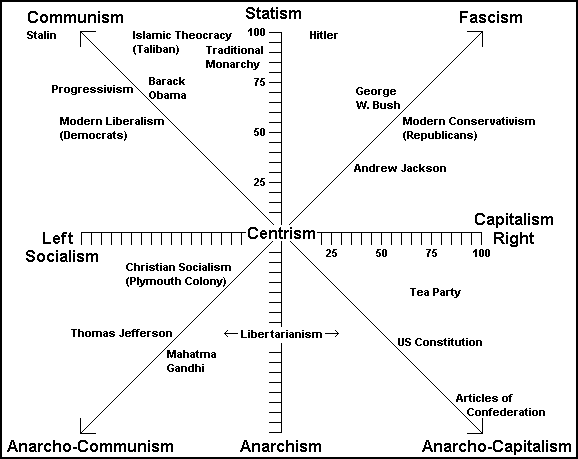
I've placed a few names where I think they should go. Things tend to cluster in places because I got the scale wrong and names are tentatively placed and had to be enlarged to be readable. Names should appear as close to whatever diagonal axis they are next to. For reference I land about 35 down and somewhere between 5 left and 5 right (I seem to migrate), so I am alienated by both parties.
While dems are generally about collective welfare and pubs about personal welfare, as you can see they are both pretty far up the vertical axis. A quick look at the policies of the previous two presidents reveal that Bush and Obama are largely in agreement economically (both enacted legislation to bail out companies, both racked up record deficit spending, record debt), militarily (Although Obama technically ended the Iraq War on 31 August, there will be troops there until at least 31 December 2012, probably longer, and he has ramped up military action in Afghanistan, he has not closed Guantanimo Bay, etc.), globally (same foreign policy, giving US land to foreign governments [trans-Texas corridor, etc.]). They differ in a few areas, but there's not a whole lot of disagreement between the two. I often say that when Obama promised "change" he meant "change in degree from Bush" not "change in kind." While they are both at about 65 on the left/right axis, on the top/bottom axis they are both 65 as well, meaning while they might want to put as much power in the hands of government in different ways, they both want to put as much power in the hands of government as possible.
I hope that clears things up.
Premodern, modern, postmodern?
Premodern is the stuff that came before the Enlightenment. The Romantics called it the "reinchantment of the world," but they weren't right in rejecting all the benefits of modernity that came with the faults.
In all premodern societies there existed absolute Truth. Different cultures tend to interpret that Truth in different ways, but by and large they are in agreement on everything that matters. Moving up from simple animism when the worlds religions started to develop (there is no one single point in time when this happened, Vedic writers such as Yajnavalkya go back to at least 1800BC, Zoroaster around 1600, Moses 1500, a typical set of dates is generally refered to as the Axial Age when most of the world's religions got started or organized) they took the vague depersonalisation of spirit and matter and organized things. No longer was there value just to my particular tribe, but now there was universal law that applied to everyone in all tribes.
Religions have two aspects, an exoteric, the things that we see from the outside, the trappings and language specific to each particular religion, and the esoteric, what is seen from those on the inside of what has always been a very small group of people who have passed on the true meaning behind the rituals, and once we sift through all the exoteric language we can see that the esoteric truths all generally agree (for example, reincarnation was central to Christianity until around AD 500 when Justinian had it removed so he could rule people's one and only life on this earth, and central to Judaism until around 1500 when it was taken out to make European Christians like Jews better - it didn't work). This esoteric core is generally called the Perennial Philosophy, and it seems to exist in nearly every religion across space and time.
This core of Truth is reached through rigorous hard work taken on by mystics of the wisdom traditions within each religion. No one is going to spend three years of hard time getting yelled at and beaten in a Zen monestary just for some hallucinations or temporal lobe epilepsy. Since these all developed prior to modernity (there's not much written on Bahai mysticism, so I don't know anything about it, but if there's anything there there that I don't know about it would be one of the few (only?) wisdom traditions to develop after modernity), they're called the premodern wisdom traditions.
That is probably the longest definition I have ever given.
Getting back to history. Each religion, while it introduced meaning into the world, also came about at a time when there was little, if any, communication between different towns and villaiges. Information was a carefully guarded commodity. People could use that information to gain power. (This is where the Scolastics and the Greek rationalists disagree. The Scolastics came up with the now famous addage "knowledge is power," but the Greeks disagreed. The Greeks said that knowledge is only useful to the extent it can benefit society. I tend to fall more toward the Greek view, but this is a tangent so I'll be moving on.) When modernity came along during the Enlightenment and rejected religion, the idea was to reject the perversion of religion that the people already in power used to gain more power over the people. What they didn't realize was that in rejecting religion they were rejecting the perennial philosophy as well, and with it, meaning. The best summary of this problem I have ever read was written by someone using the name "dmduncan" in September 2010 (Michael Prescott's Blog):
Well that has always been a problem for materialism. Ultimately, it's nihilistic. It can give us no direction whatsoever on how we should live our lives other than because this person or that says so, vs. because there is really some ultimate point to our existence that isn't a matter of any given person's taste and opinion. There is no scientific reason why people ought to want to treat each other nicely or even to live. Sure, an atheist can choose to live as a good person, but he does so in ignorance of the ultimate nihilism behind materialism. If there is no God then there simply is no good and evil apart from what you say it is, and then life becomes a war between competing and arbitrary notions of what constitutes the good. Might makes right. Whoever wins gets to decide. And it doesn't really matter how many people on the opposing side you have to kill to institute your point of view — exactly what communist regimes did throughout the 20th century; sure it will be messy, but where there is no ultimate good or evil, it ultimately does not matter who lives and who dies. Blood dries. Bones turn to dust. The memory of it is lost. Justice is just a scream of some vanquished minority before you make them extinct, and then all is peace and light again.
Sure religions produce evil people. But they also produce saints. Where are all the materialist saints? All I see from them is arrogance, venality, the provincial objective, the self righteousness of one who thinks he is god. All the same evil religion is capable of but without any belief in a right and wrong beyond themselves to mitigate their potential brutality.
A lot of materialists either don't realize this, try to ignore it, or pretend they are okay with it, but at the bottom lies nihilism, plain and simple.
The whole issue of integration is to take the best from everyone and put it together into something that is better than every system that has come before. Premodernity gives us meaning and access to the interiors (wisdom, compassion), modernity gives us tools necessary to work on the exteriors (social, physical, and biological systems) and bring those things we learned from premodernity to everyone and truly act out our wisdom and compassion on a global scale, and postmodernity gives us the idea, really for the first time in history, that everyone can have a piece of the Truth; everyone can be right about something and we need to have mutual understanding if we aren't to pick up our swords (or jet fighters) and start blowing each other to pieces. Integration of what was learned from all the previous stages of human development is what is key to saving the world.
ADDENDUM
Since the original publication a sequel has been written, Integral Politics II. It consists of 31 minutes of video, complete with eight foot notes and seven references. The videos look deeper into the left/right dichotomy, what both sides can learn from one another, what we can learn from the various movements both sides have birthed, the implications of religious and social identity plays in politics, and the foresight of the founders when writing the Constitution.
Originally it was supposed to be due the end of August. It got done the end of October. That's actually a better turn-around time than most of my projects.
Thursday, January 20, 2011
The Evils of Socialism
Yan Bielek lived under the iron grip of the socialist government of Czechoslovakia for 30 years. Now he goes around the world to warn others of the most pernicious evil in all of history. Here is an interview with him from AirMaria.com.
Thursday, January 13, 2011
Alan Watts' God Complex
An hour long talk by Alan Watts on psychology, psychiatry, western thought, mysticism, and knowing you are God. Wonderful question and answer session at the end.
The President's Speech
The President gave a nice speech yesterday on the Tucson tragedy. There will be no analysis. Let the man speak for himself.
Sunday, January 9, 2011
8 January 2011
I have no witty one-liner titles. All I have is condemnation for the recent acts of violence against government officials, the letter bombs in Maryland, and now the shooting spree in Arizona. According to the other wiki:
"Eighteen (18) people were shot, six (6) murdered, during a U.S. congresswoman's constituency meeting held in a Safeway supermarket parking lot near Tucson, Arizona, United States. The dead include a nine year old girl, a congressional aide and John Roll, the chief judge for the United States District Court for the District of Arizona. U.S. Representative for Arizona's 8th congressional district Gabrielle Giffords was shot in the head at close range and is in critical condition. Authorities have said Giffords was the the target of the attack."
The "suspect" shooter, Jared Loughner, is an evil man. Whoever sent the bombs are evil. Political disagreement does not make people turn to acts of terrorism, evil and cowardice do. Neither myself, The Urban Mystic, or anyone at Irked-Confusion Studios condone such behaviour. In fact, we condemn it.
Our prayers go out to the victims and their families.
"Eighteen (18) people were shot, six (6) murdered, during a U.S. congresswoman's constituency meeting held in a Safeway supermarket parking lot near Tucson, Arizona, United States. The dead include a nine year old girl, a congressional aide and John Roll, the chief judge for the United States District Court for the District of Arizona. U.S. Representative for Arizona's 8th congressional district Gabrielle Giffords was shot in the head at close range and is in critical condition. Authorities have said Giffords was the the target of the attack."
The "suspect" shooter, Jared Loughner, is an evil man. Whoever sent the bombs are evil. Political disagreement does not make people turn to acts of terrorism, evil and cowardice do. Neither myself, The Urban Mystic, or anyone at Irked-Confusion Studios condone such behaviour. In fact, we condemn it.
Our prayers go out to the victims and their families.
Wednesday, January 5, 2011
It's Just Like Watching The Detectives
Last night I watched a program on the new Oprah Winfrey channel, OWN, called "Miracle Detectives," and I must say, this is one program that disappoints on every page. First I should say that I don't watch Oprah's program (although as a boy I did, on rare occasions), but I had just finished three solid hours of research into the history of psychiatry and needed to relax so I turned on the seed (a term that has been used to refer to the television in my family for years) and was met with a rather anemic selection. I came across something called "Miracle Detectives" and read the synopsis. A man was cut in half by a train and survived (actually, he just had his legs cut off, but it was still a very serious injury), and a house drips holy oil. I decided to watch it and had to write notes out of disappointment.
The program features a man, Randall Sullivan, who owns exactly one outfit, and a woman, Indre Viskontas, who changes her clothes at least ten times an episode. Randy, if I can call him that, was in a war or something and he saw purple lightning and now he believes everything is a miracle and testing God is a sin. Indre claims to be some sort of doctor, I guess, and she believes nothing is a miracle and will latch on to any explanation no matter how unlikely or asinine it may be.
They go around investigating miracles to see, well, if they really are miracles, or at least that's the premise of the show. The truth is anything but.
On tonight's show, they go to investigate a woman who went to Lourdes in France (loading the page will resize your browser) and got some of the water. She brought it back and put it in a font in her house. When she woke up she discovered the water had turned into perfumed oil. Some time later she turned her house into a shrine, filled to capacity with icons, each of which exudes holy oil, along with the walls of the room as well. Now, I have a shrine in my house, millions of people do, but this is bordering on psychotic. There are more icons in her house, which is really tiny too, than in any church I've ever been to, even those huge old ones in the big cities that they turned into museums.
The oil has been associated with many healings. People have been healed of cancer and blindness, among other illnesses not mentioned in the program. The team goes to investigate. They visit one woman who was losing her vision due to a macular hole. Her friend gave her a cotton ball dipped in the oil, and she rubbed it on her eye every day for a week and when she went to the doctor he said the hole was gone. Randy was totally convinced. He threw his hands in the air and said "It's a miracle!" Indre said that the woman is very sad and she is using her faith as a crutch. Randy takes some of the oil to the world's leading expert on holy oil in Utah or somewhere and he smells it and says if it's real it can't contain any synthetic chemicals. Indre goes to some random eye doctor and asks about the woman's condition. He said that in 20 years of practice he has only seen two "spontaneous" healings in which a macular hole sealed up. Indre takes this to mean that the woman's case is the result of the atheist's supreme god of chance, not questioning about the two other "spontaneous" cases, which themselves might have been miracles, or, if not, were at least fantastically unlikely events and may have nothing at all to do with this woman and the oil. There might have been any number of other factors involved in those other cases, but she's not skeptical of her own skepticism, so it doesn't matter. She doesn't have to disprove the miracle, she just has to come up with any cock and balls story that might in some distant planet explain it away, and she did and was satisfied.
She brings in a building contractor who gives a very quick lookie loo of the room and says that because of the way the plaster on the walls is he can tell the room has not been tampered with, no hoses have been put in the walls to pour the oil out. He says it looks like someone splattered the oil on the walls, then he leaves.
She then calls in Joe Nickell, the skep-dick who found no evidence of anything paranormal, ever, so we know he's biased. She has an orgasm or two describing how he "debunks" things, meaning she's not interested in objectivity or science, since "debunking" is not part of the scientific method and no scientist ever has debunked anything. Science is open ended. Despite being a smug bastard he is the only one in the team with any sense and he sets up two tests. He has a camera watching a few statues for 24 hours, to see if oil spontaneously appears or someone puts it on it when no one is looking, and he takes a sample of oil to get a chemical analysis. The results are in. After one day no new oil appeared. Well, not exactly. A little oil did appear in the font, but he said it was just residue, so it didn't count, not surprisingly. He declaired it a fake and left after smelling his own farts. Randy interjected, the owner of the house says the oil comes out mostly on feast days, and only very little appears at other times in the year, and since the test was not on a feast day then it's not surprising only a little oil appeared. He just leaves. Joe just leaves. Now, if it was me I would have run a six month study on the house, not content to make pronouncements after only one night, but hey, we're not interested in science here.
The results of the chemical analysis? The oil is mostly vegetable oil with a glycol in it, most likely* propylene glycol, a synthetic chemical used in perfumes (and has it's own website, not many chemicals I know of can say that!). Randy is willing to admit he is very disappointed but falls short of saying it's not a miracle, even though according to that guy he visited when he went skiing in Utah, God doesn't use synthetic chemicals because synthetic chemicals don't know how your body works and natural chemicals do, somehow. The show ends with them looking at each other, him sad she indifferent. The camera holds on them for forth seconds with no audio.
Now Oprah is always talking about miracles. She believes President Zero is a miracle, and Deepak Chopra said on her show he was a product of "the all knowing quantum field," the kind that comes around once every thousand years. I was surprised that the Oprah channel had a show that seemed openly antagonistic to the idea of miracles. The chick on the show is a stereotypical skep-dick debunker, and the guy is extremely gullible and antagonistic to science. This is exactly how NOT to perform science and how NOT to investigate miracles. I won't be watching this program again.
-Dee
*I forgot, so this is just a guess.
P.S. At 1,252 words this is officially the new longest post on The Urban Mystic!
The program features a man, Randall Sullivan, who owns exactly one outfit, and a woman, Indre Viskontas, who changes her clothes at least ten times an episode. Randy, if I can call him that, was in a war or something and he saw purple lightning and now he believes everything is a miracle and testing God is a sin. Indre claims to be some sort of doctor, I guess, and she believes nothing is a miracle and will latch on to any explanation no matter how unlikely or asinine it may be.
They go around investigating miracles to see, well, if they really are miracles, or at least that's the premise of the show. The truth is anything but.
On tonight's show, they go to investigate a woman who went to Lourdes in France (loading the page will resize your browser) and got some of the water. She brought it back and put it in a font in her house. When she woke up she discovered the water had turned into perfumed oil. Some time later she turned her house into a shrine, filled to capacity with icons, each of which exudes holy oil, along with the walls of the room as well. Now, I have a shrine in my house, millions of people do, but this is bordering on psychotic. There are more icons in her house, which is really tiny too, than in any church I've ever been to, even those huge old ones in the big cities that they turned into museums.
The oil has been associated with many healings. People have been healed of cancer and blindness, among other illnesses not mentioned in the program. The team goes to investigate. They visit one woman who was losing her vision due to a macular hole. Her friend gave her a cotton ball dipped in the oil, and she rubbed it on her eye every day for a week and when she went to the doctor he said the hole was gone. Randy was totally convinced. He threw his hands in the air and said "It's a miracle!" Indre said that the woman is very sad and she is using her faith as a crutch. Randy takes some of the oil to the world's leading expert on holy oil in Utah or somewhere and he smells it and says if it's real it can't contain any synthetic chemicals. Indre goes to some random eye doctor and asks about the woman's condition. He said that in 20 years of practice he has only seen two "spontaneous" healings in which a macular hole sealed up. Indre takes this to mean that the woman's case is the result of the atheist's supreme god of chance, not questioning about the two other "spontaneous" cases, which themselves might have been miracles, or, if not, were at least fantastically unlikely events and may have nothing at all to do with this woman and the oil. There might have been any number of other factors involved in those other cases, but she's not skeptical of her own skepticism, so it doesn't matter. She doesn't have to disprove the miracle, she just has to come up with any cock and balls story that might in some distant planet explain it away, and she did and was satisfied.
She brings in a building contractor who gives a very quick lookie loo of the room and says that because of the way the plaster on the walls is he can tell the room has not been tampered with, no hoses have been put in the walls to pour the oil out. He says it looks like someone splattered the oil on the walls, then he leaves.
She then calls in Joe Nickell, the skep-dick who found no evidence of anything paranormal, ever, so we know he's biased. She has an orgasm or two describing how he "debunks" things, meaning she's not interested in objectivity or science, since "debunking" is not part of the scientific method and no scientist ever has debunked anything. Science is open ended. Despite being a smug bastard he is the only one in the team with any sense and he sets up two tests. He has a camera watching a few statues for 24 hours, to see if oil spontaneously appears or someone puts it on it when no one is looking, and he takes a sample of oil to get a chemical analysis. The results are in. After one day no new oil appeared. Well, not exactly. A little oil did appear in the font, but he said it was just residue, so it didn't count, not surprisingly. He declaired it a fake and left after smelling his own farts. Randy interjected, the owner of the house says the oil comes out mostly on feast days, and only very little appears at other times in the year, and since the test was not on a feast day then it's not surprising only a little oil appeared. He just leaves. Joe just leaves. Now, if it was me I would have run a six month study on the house, not content to make pronouncements after only one night, but hey, we're not interested in science here.
The results of the chemical analysis? The oil is mostly vegetable oil with a glycol in it, most likely* propylene glycol, a synthetic chemical used in perfumes (and has it's own website, not many chemicals I know of can say that!). Randy is willing to admit he is very disappointed but falls short of saying it's not a miracle, even though according to that guy he visited when he went skiing in Utah, God doesn't use synthetic chemicals because synthetic chemicals don't know how your body works and natural chemicals do, somehow. The show ends with them looking at each other, him sad she indifferent. The camera holds on them for forth seconds with no audio.
Now Oprah is always talking about miracles. She believes President Zero is a miracle, and Deepak Chopra said on her show he was a product of "the all knowing quantum field," the kind that comes around once every thousand years. I was surprised that the Oprah channel had a show that seemed openly antagonistic to the idea of miracles. The chick on the show is a stereotypical skep-dick debunker, and the guy is extremely gullible and antagonistic to science. This is exactly how NOT to perform science and how NOT to investigate miracles. I won't be watching this program again.
-Dee
*I forgot, so this is just a guess.
P.S. At 1,252 words this is officially the new longest post on The Urban Mystic!
Subscribe to:
Posts (Atom)