"Black people invented John Malkovich" - Economic Invincibility
Nihilism is the disease of the modern age. The structure of society feeds nihilism and depression. There's not much we can do at first as individuals to change society, but we can make changes in our own lives and in the lives of the people we care about that will improve our quality of life tremendously. And, at the end of the day, that will make all the difference.
Friedrich Nietzsche: The Anti-Nihilist. "I am Superman. Look at my muscles."
Nihilism is garbage. If you are a nihilist you are a nobody, a non-entity, a loser, and a defeatist.
I am intimately familiar with suffering. Injuries, disease, constant pain, years of unemployment and a string of dead-end jobs that offer no fulfillment. I know it all, and I'll admit to becoming a little bitter over the years, though I do think it has helped me advance philosophically.
People like to blame God, or speculate on how a life full of suffering is devoid of all meaning. The modern world feeds this mentality. It is designed from on high to make us feel inadequate. Anti-social media want us to feel like all of our frienimies are doing so much better than us when they are often just as miserable. Advertising wants us to be miserable so that we buy more crap we don't need or want. The media live off of suffering: "If it bleeds, it leads." Add to this the armies of Internet "black pills" and doomsayers who sell ebooks and subscriptions to even more doom online, and you have a recipe for nihilism, which Friedrich Nietzsche and personal experience in the world will tell you is currently the dominant philosophy of the West. Once we got rid of Christianity, when we killed God, we now find ourselves in this nightmare world where life is devoid of meaning.
God is dead. God remains dead. And we have killed him. How shall we, murderers of all murderers, console ourselves? That which was the holiest and mightiest of all that the world has yet possessed has bled to death under our knives. Who will wipe this blood off us? With what water could we purify ourselves? What festivals of atonement, what sacred games shall we need to invent? Is not the greatness of this deed too great for us? Must we not ourselves become gods simply to be worthy of it? There has never been a greater deed; and whosoever shall be born after us - for the sake of this deed he shall be part of a higher history than all history hitherto."
From Nietzsche's The Gay Science
Nietzsche recognized that with the advent of the nihilism brought on by the new scientific materialism of modernity (and the full-on celebration of meaninglessness that has come about in post-modernism), we would face an existential crisis. The idea of God is so central to giving meaning to our lives that without it we are no better than ants, toiling day and night for jobs we hate just to keep our heads above water while we fill the pockets of Mammon worshipers who have managed to take the reigns of civilization, all without meaning or purpose.
God is dead, and we have killed him, and we are woefully incapable of filling the void in our current condition. It is one thing to feel at conflict with society and man's laws, but it is quite another to feel at conflict with the Source of all life and morality itself. Eliminating God leads to the enshrinement of the State, as the vacant throne of the Absolute cannot remain vacant in the mind of man for long. Whether the natural sciences or the all-powerful State, something man-made must take the role left vacant by the crucifixion of God. This has led to the worst totalitarianism, as, while God's laws are immutable, there is no limit to His mercy. However, the State has no mercy; it has no room for forgiveness of 'sins' against political correctness, as the State recognizes no authority outside itself. This is why the authoritarian Godless State has led to the worst atrocities in history: the murder of hundreds of millions with industrial sterility and efficiency.
When you no longer believe in God then you will believe in anything, and everything becomes permissible. If God is not your master than you are a slave to your senses. You are like the addict, the drunkard who cannot control how he drinks, but is controlled by his drinking. When you are free to do anything then you lose all of your freedom, because you are no longer in control of your body, but your body is in control of you. And when your body controls you then you are open to being controlled by the powers that be to fuel their endless lust for more power.
The reverse of nihilism, of "If it bleeds, it leads," is the philosophy of Major Dutch Schaefer: "If it bleeds, we can kill it."
The movie Predator shows us that no matter how powerful the adversary, no matter how hopeless the situation, our enemies are no less mortal than we are, and our troubles can be overcome. We just have to become the best possible version of ourselves. We have to become better than we thought we could be. Dutch didn't win because he was stronger than the Predator, or because he was necessarily smarter either. The Predators are thousands of years ahead of humans, having fully developed interstellar travel, cloaking devices, universal translators, and super medicine that allows for rapid healing of what would otherwise be incapacitating wounds. Dutch was able to win because he was able to exploit the weaknesses of his opponent to his advantage. He may not be smarter, but he can think on his feet and is more adaptable.
This is the philosophy of existentialism. Yes, life is full of suffering, but it is also full of joy, and you're hurting yourself to focus on the suffering while ignoring the joy. There are simple steps to reclaiming your joy and to once again find meaning and purpose in your life. Like everything it all begins with a choice. You have to take control of your own life and reclaim your birthright. You can take your life back because you choose to.
Dr. Bernard Haisch, astrophysicist and UFO enthusiast, author of The God Theory and The Purpose-Guided Universe, talks about God, physics, the anthropic principle, and the meeting of science and religion. This talk is a little dated, as the Higgs boson has since been discovered (or, more accurately a Higgs boson has been discovered, there might be more than one), but it is still very good. Runs 2 hours.
Fitting in with what I've written two weeks ago about reincarnation, I'll talk here about the meaning of life.
Michael Prescott has some speculations about why there is suffering in the world where an intelligent but not omniscient God created the world to gain life experience. Here's what I left as a comment.
I don't like the idea of God creating the universe to experience things. That seems like a cosmic version of the TV show Jackass. "Wouldn't it be cool to see what it would be like to get burned alive in a car crash? Maybe I could get out before getting killed? Wouldn't that be fun to see if I could?" It's a bit of an oversimplification, but it seems to reduce God or Spirit or even individual souls to adrenaline junkies, or at the very least people who are extremely bored with too much free time. Seeking experience for the sake of experience seems so very underwhelming to me. In its absolute worst form, as seen in some versions of "new age" literature, souls plan their lives beforehand in minute details, so you end up with a scenario where souls are basically masochists. A group of souls floating around planning their next life together when one soul says to the others "I'll be the child and you'll be my parents. At age five, no four and a half, I'll get cancer and die and break your hearts. Then, fifty years of misery later, you'll die and we'll meet up back here and I'll point and laugh and say 'fooled ya!' Then, the next go around I'll be the parent and you two can be the children who die. It will be rousing great fun!"
There are two explanations for this world of suffering that I see merit to. They both say primarily that our purpose here is to escape the world and only really differ in explaining how we got stuck here in the first place, to a degree.
In the perennial traditions and in A Course in Miracles, we individual souls exist because God needed someone to love. It's not loneliness in the everyday sense, because God lacks nothing. This is a higher level need based on over-abundance. God is so overflowing with love that it wanted someone to share it with. The world itself is seen as illusory, but even if it's not there need be no problem with suffering at all.
"Natural suffering" like volcanoes and asteroids and having to kill other creatures to survive is an easy one. The world is pretty close to as optimal as one can get. The photoreceptors in the eye can detect single photons, so they can't get any better, for example. There are trade-offs to everything because of the physical constraints of the world (which need to be unimaginably precise to permit the universe and life to exist). Humans have easily injured backs and knees, and narrow hips make childbirth painful, but those are offset by the greater benefits that are gotten through walking upright. So natural suffering can be explained through utilitarianism. Certain unpleasant situations must exist to permit much greater benefits.
The much bigger problem is human caused suffering, like rape and murder and war. That is traditionally explained through the free will defense. God wants us to share in the divine love voluntarily. Forcing us to love would be a form of metaphysical rape.
Even if the world is to an extent "real", more good is wrought through the way the world is than the bad caused by the suffering. We can share in love in more ways, even if we choose not to. Suffering then is no longer God's problem, it is a problem of our own refusal to be moral and treat one another as we should.
Of course, if the world is illusory, then we are tricking ourselves into thinking this suffering exists and our goal is to realize this and get out and back to the perfection into which we were created.
A Course in Miracles explains this wonderfully. God did not create the world, we did, and suffering exists because of our fear and guilt. Unsatisfied with the equal love God was giving to all of us in perfection, we (who find ourselves in this universe) demanded special love. We wanted to be loved more. When God refused to give in to our egoistic demands we then imagined this world up where we could be special. The dream of suffering and death "prove" we are more powerful than the God who refused us the special status we "deserve". Knowing we can't really hurt ourselves, God permits us to sulk in the corner until we get over our upset. At the same time God descended into the dream to remind us that we are dreaming and can wake up at any time when we are ready to return to the perfection into which we were created.
It makes sense because real people do this all the time. There is nothing new that we can't test about what may or may not be the motivations of spirits who want to experience horrible things just to see what it's like. The psychology of the Course is real world human psychology and can be seen in child development all over the world. Children sulk. Adults sulk. We project our emotions and delusions onto the world. We punish ourselves unnecessarily out of misplaced guilt. It makes sense to suppose that if we do this on Earth than we would do the same on a grander scale in some higher dimension. There's nothing in it that resembles speculation about what stunts Superman would pull to see if he could jump off the Empire State Building or whatever.
Suffering acts also as a motivation to escape the world. It acts as a motivation to do good to others so that we can grow in wisdom and compassion. So we move up the evolutionary ladder from plants to animals on to humans, and while the capacity for suffering increases so too do the benefits increase at a much faster rate. So a plant suffers less than a cow but it gets less out of life than the cow, and the cow suffers less than a human but it gets less out of life than the human. And this continues until we realize that the world is illusory and then we can either leave it forever or we can take the path of the bodhisattva and deliberately return to the world and choose to suffer more to alleviate the suffering of others. We can grow into perfect expressions of morality rather than just being bored and bouncing around the universe to see what it's like.
And as I've written over a thousand words by now I'll end here.
Think about the purpose of reproduction. Nobody cares about it anymore, as evident in declining birthrates and three hundred million aborted Chinese babies (just let than number sink in for a minute, it's more than the deaths from every war fought in the Twentieth Century combined). Reproduction is old hat. In fact, it's so old hat people get offended if you even bring it up. But think of the purpose of biological life for a moment and you'll see it all comes down to reproduction, but what's the point of that? This goes beyond asking why sex exists at all, why did bacteria divide long before sex existed?
It's real simple, but it may come as a surprise. Reproduction is an attempt to cheat death. It's a clever gambit that's been going on for billions of years. At least they tell us it has. There's no real way to tell just how long life's been going on, as I mentioned earlier in "Dreaming of Genesis" and "Dating Anything". It's based on a misperception, that just because something seems old does not mean it really is, but we're talking about appearances here. The truth may be we're in the Matrix and everything is only a hundred years old, or however old the oldest human is. However far back living memory goes there's no way to tell if it ever went back any further, but that's a different topic for a different day.
Let's just say it's billions of years old because that's what convention says. It doesn't really change how you live your life either way. Over time a cell accumulates damage that it cannot repair, mostly from free oxygen, but also from cosmic rays and other environmental hazards. At this point the cell can do one of two things, either it can die or it can divide and give half its damage to each new cell. Now, these new cells can never be as immaculate as the original cell, which started out with zero damage, so over time this whole thing is winding down unless the cells can get smart enough to find a way to repair all the damage. That's the whole point of reproduction: the cells are trying to cheat death long enough to find a way to defeat death for good. Reproduction delays the inevitable.
And somewhere along the line complex forms develop (or don't, but that's another topic), and now they can't well divide in two because there's a brain here and a heart there and to split all the cells in half and restructure everything would be too difficult, so sex has to be invented. Special cells have to be produced that can divide trillions of times and form a whole new body. And you need to bring two members of the same species together for the same reason that bacteria swap genes (plasmids: special bits of DNA that can deliver genes between different bacteria), because otherwise you keep producing copies of the same exact thing and if something comes along and knocks one off then all of the others will be susceptible too. That's why you need diversity.
Now, why there has to be two different specialised units coming together rather than have every individual be a hermaphrodite I can't really say. That part doesn't make sense to me. Maybe it's a trick. Some designer set it up to trick males and females, who aren't all that alike, to come together out of some sadistic joy in seeing if they can get along long enough to reproduce, who knows. These bacteria not only became smart they became psychopathic too, maybe.
Whatever the reason, now you have a system in place where these cells can keep at it, keep multiplying, keep cheating death just a little longer. All in the hope that one day one individual will become smart enough to find a way to repair the damage and then the whole business of reproduction will be over. There will be no reason to make new cells because the old ones are now immortal, or at least until a black hole destroys them. They'll keep making new cells until they figure out how to get rid of the black holes too.
Think about it. You're a door. Through you energy is transmuted to make more people, themselves destined to suffer, reproduce, and die, to keep this race going until either death or the cells get the upper hand. For each individual it doesn't much matter, does it? Unless you're on a farm and you need lots of kids to help plough the fields and milk the cattle, but for city dwellers, for individuals there's no real purpose for any of this, is there? For society yes, for life, yes, but what is the individual supposed to do?
Well, that depends on the individual. Where do you place your faith, in your own abilities or in some promise of a future where descendants you may never see get to live in a paradise on Earth that may never come to pass?
Ken Wilber answers a question about the possibility of integral politics. Yes, he naively believes that just because Bill Clinton and Karl Rove read his books that they're integral, I've already dealt with that. Please just continue watching anyway. The hardest part to implementing integral politics? Getting integrally developed people elected when their only platform is being integrally developed.
KW does make a prediction (this is 2008) that the Republicans would win the election because it's easier to get Amber (Blue) and Orange to agree than it is to get Orange and Green to agree, meaning it's easier to unite Republicans than Democrats.
Video runs 31 minutes.
On the heels of that I wrote a bunch the other day (one of the best days I've had in a long time) about integral politics after someone informed me of a video about Vermont Senator Bernie Sanders spouting crap about economics. Here is my response:
The top 1% may have made 23% of all income, but they also paid 80% of all income tax. Is it really fair to have the top 1% pay all of the taxes and everyone else pay nothing? The top 1% income earners are the ones driving the economy. The billionaires Sen. Sanders hates so much don't pay income tax. They are not part of the top 1%. Ted Turner and George Soros and Warren Buffet have high priced lawyers who can weasle their way through tax loop holes and set up accounts in foreign banks to protect their billions. Taxing the rich more won't help the middle class, it will just get the people investing in economic growth to spend their money in foreign markets, setting up businesses in India and China, and killing more jobs.
Remember how Kennedy taxed the rich, found it lost federal revenue, then cut taxes for the rich and increased federal revenue? Sanders doesn't know what he's talking about.
The estate tax is disgusting. Getting rid of the estate tax will cost $1trillion in revenue? How about TARP, $700 billion? How about the American Recovery and Reinvestment Act, $787 billion? QE1 and QE 2, $several trillion? Social Security and Medicare have unfunded liabilities of $107 trillion. Deficit spending never has and never will be a viable economic strategy.
Sen. Sanders is making $174,000 a year, just with his Senate salary, not to mention whatever he makes on the side (to get elected you have to be a millionaire). If he's so goddamn opposed to the rich why doesn't he forgoe his salary? He's a hypocrite. He is making an appeal to emotion. There is no substance here.
Correction: The top 1% pay only 50% of all income tax. The top 10% pay 80% of income tax. I had mistaken the two groups.
I then move on to address the issue of a two party system:
The problem is both parties are statist and no one can mount a viable third party opposition. They may disagree on how the government should control everyone's lives, but they both want to control everyone's lives, and most people don't realize this. They see the D's and R's beside someone's name and hate whoever has the opposite letter that they have, so every so many years we switch from one party rule to the other and back again, never solving the underlying problem. It's all just a show. I've been saying this since at least 2003, there is no difference between Democrats and Republicans.
Not as difficult to solve as the first problem. Avarice is one of the two driving forces behind all sin, and simply taxing people won't solve the problem. Avarice can never be eliminated completely, but for the first time in history the tools exist to implement its fall from power. The only way I can see to end the crushing grasp avarice has on the world is through the reintroduction of meaning. Not subjective meaning, like "I give my own life meaning," but absolute meaning. The way to reintroduce meaning is to remove materialism. In a materialistic world meaning is impossible, and people strive only for their own gain. Materialism is subverted by integrating the Truth discovered by the great premodern wisdom traditions with the benefits brought about through modernity. This literally was never possible before because the people never had access to both. There was always someone acting as the gatekeeper (kings, religious leaders, industry magnates, academic figures), preventing the people from knowing the Truth, telling them their stories to hold power. Instantaneous global communication allows for access to the collective knowledge of humanity, allowing the integration to take place if the people are willing to stop playing with their toys and take the steps necessary to free and empower themselves. It's a hard road ahead. Most people are happy with the toys the powers that be have given them. It may take a global economic collapse, or some similarly sized global disaster, to shake people from their complacency. Who knows these things?
What's the problem with the old Left/Right dichotomy?
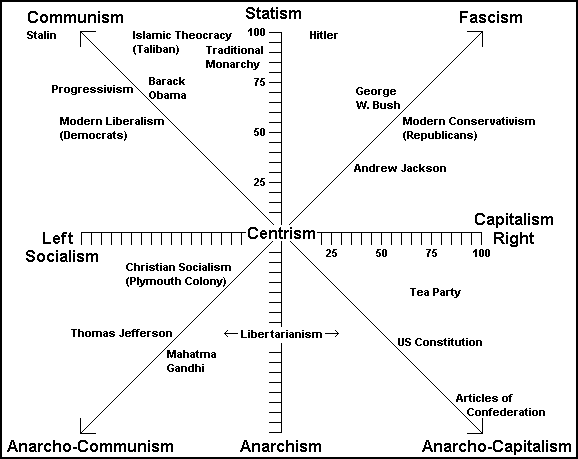
Many people are still thinking of the old left/right dichotomy, with Democrats (let's call them "Dems") on the left and Republicans ("Pubs") on the right. While this is largely true (there are left-leaning pubs and right-leaning dems), it ignores the fact that there is a vertical axis to the political spectrum as well, leading from anarchism on the bottom to statism at the top. I drew the following graph when I got tired of the single-axis model:
I've placed a few names where I think they should go. Things tend to cluster in places because I got the scale wrong and names are tentatively placed and had to be enlarged to be readable. Names should appear as close to whatever diagonal axis they are next to. For reference I land about 35 down and somewhere between 5 left and 5 right (I seem to migrate), so I am alienated by both parties.
While dems are generally about collective welfare and pubs about personal welfare, as you can see they are both pretty far up the vertical axis. A quick look at the policies of the previous two presidents reveal that Bush and Obama are largely in agreement economically (both enacted legislation to bail out companies, both racked up record deficit spending, record debt), militarily (Although Obama technically ended the Iraq War on 31 August, there will be troops there until at least 31 December 2012, probably longer, and he has ramped up military action in Afghanistan, he has not closed Guantanimo Bay, etc.), globally (same foreign policy, giving US land to foreign governments [trans-Texas corridor, etc.]). They differ in a few areas, but there's not a whole lot of disagreement between the two. I often say that when Obama promised "change" he meant "change in degree from Bush" not "change in kind." While they are both at about 65 on the left/right axis, on the top/bottom axis they are both 65 as well, meaning while they might want to put as much power in the hands of government in different ways, they both want to put as much power in the hands of government as possible.
I hope that clears things up.
Premodern, modern, postmodern?
Premodern is the stuff that came before the Enlightenment. The Romantics called it the "reinchantment of the world," but they weren't right in rejecting all the benefits of modernity that came with the faults.
In all premodern societies there existed absolute Truth. Different cultures tend to interpret that Truth in different ways, but by and large they are in agreement on everything that matters. Moving up from simple animism when the worlds religions started to develop (there is no one single point in time when this happened, Vedic writers such as Yajnavalkya go back to at least 1800BC, Zoroaster around 1600, Moses 1500, a typical set of dates is generally refered to as the Axial Age when most of the world's religions got started or organized) they took the vague depersonalisation of spirit and matter and organized things. No longer was there value just to my particular tribe, but now there was universal law that applied to everyone in all tribes.
Religions have two aspects, an exoteric, the things that we see from the outside, the trappings and language specific to each particular religion, and the esoteric, what is seen from those on the inside of what has always been a very small group of people who have passed on the true meaning behind the rituals, and once we sift through all the exoteric language we can see that the esoteric truths all generally agree (for example, reincarnation was central to Christianity until around AD 500 when Justinian had it removed so he could rule people's one and only life on this earth, and central to Judaism until around 1500 when it was taken out to make European Christians like Jews better - it didn't work). This esoteric core is generally called the Perennial Philosophy, and it seems to exist in nearly every religion across space and time.
This core of Truth is reached through rigorous hard work taken on by mystics of the wisdom traditions within each religion. No one is going to spend three years of hard time getting yelled at and beaten in a Zen monestary just for some hallucinations or temporal lobe epilepsy. Since these all developed prior to modernity (there's not much written on Bahai mysticism, so I don't know anything about it, but if there's anything there there that I don't know about it would be one of the few (only?) wisdom traditions to develop after modernity), they're called the premodern wisdom traditions.
That is probably the longest definition I have ever given.
Getting back to history. Each religion, while it introduced meaning into the world, also came about at a time when there was little, if any, communication between different towns and villaiges. Information was a carefully guarded commodity. People could use that information to gain power. (This is where the Scolastics and the Greek rationalists disagree. The Scolastics came up with the now famous addage "knowledge is power," but the Greeks disagreed. The Greeks said that knowledge is only useful to the extent it can benefit society. I tend to fall more toward the Greek view, but this is a tangent so I'll be moving on.) When modernity came along during the Enlightenment and rejected religion, the idea was to reject the perversion of religion that the people already in power used to gain more power over the people. What they didn't realize was that in rejecting religion they were rejecting the perennial philosophy as well, and with it, meaning. The best summary of this problem I have ever read was written by someone using the name "dmduncan" in September 2010 (Michael Prescott's Blog):
Well that has always been a problem for materialism. Ultimately, it's nihilistic. It can give us no direction whatsoever on how we should live our lives other than because this person or that says so, vs. because there is really some ultimate point to our existence that isn't a matter of any given person's taste and opinion. There is no scientific reason why people ought to want to treat each other nicely or even to live. Sure, an atheist can choose to live as a good person, but he does so in ignorance of the ultimate nihilism behind materialism. If there is no God then there simply is no good and evil apart from what you say it is, and then life becomes a war between competing and arbitrary notions of what constitutes the good. Might makes right. Whoever wins gets to decide. And it doesn't really matter how many people on the opposing side you have to kill to institute your point of view — exactly what communist regimes did throughout the 20th century; sure it will be messy, but where there is no ultimate good or evil, it ultimately does not matter who lives and who dies. Blood dries. Bones turn to dust. The memory of it is lost. Justice is just a scream of some vanquished minority before you make them extinct, and then all is peace and light again.
Sure religions produce evil people. But they also produce saints. Where are all the materialist saints? All I see from them is arrogance, venality, the provincial objective, the self righteousness of one who thinks he is god. All the same evil religion is capable of but without any belief in a right and wrong beyond themselves to mitigate their potential brutality.
A lot of materialists either don't realize this, try to ignore it, or pretend they are okay with it, but at the bottom lies nihilism, plain and simple.
The whole issue of integration is to take the best from everyone and put it together into something that is better than every system that has come before. Premodernity gives us meaning and access to the interiors (wisdom, compassion), modernity gives us tools necessary to work on the exteriors (social, physical, and biological systems) and bring those things we learned from premodernity to everyone and truly act out our wisdom and compassion on a global scale, and postmodernity gives us the idea, really for the first time in history, that everyone can have a piece of the Truth; everyone can be right about something and we need to have mutual understanding if we aren't to pick up our swords (or jet fighters) and start blowing each other to pieces. Integration of what was learned from all the previous stages of human development is what is key to saving the world.
ADDENDUM
Since the original publication a sequel has been written, Integral Politics II. It consists of 31 minutes of video, complete with eight foot notes and seven references. The videos look deeper into the left/right dichotomy, what both sides can learn from one another, what we can learn from the various movements both sides have birthed, the implications of religious and social identity plays in politics, and the foresight of the founders when writing the Constitution.
Originally it was supposed to be due the end of August. It got done the end of October. That's actually a better turn-around time than most of my projects.
Do we want the Truth or do we want to be "educated"? There is a tendency of people in control, whether in universities or in governments, to want to "educate". Not for the Truth, but for the convenience of the moment, thinking they are the prophets of the zeitgeist, and by their manipulation of the public mind they will bring people around to the "right" direction.
- Richard Rose
Like the Tao, any description of this thing (I don't know what to call it) would limit what it is, and what it is is limitless, so it cannot be described. Even saying this is limiting it. Go figure.