
There's been a recent push to change the definition of "big bang", just as with changing the definition of countless other words to suit the will of dialectical materialism. This past month I've come across a new video† by a very popular youtube channel and an article on a popular website talk about "what happened before the big bang" and "why the big bang wasn't the start of everything".
Just as "nothing" no longer means absolutely nothing, it means "the ground state of the quantum vacuum", now the "big bang" isn't what it always has meant, when time, space, matter, and energy all came into existence from absolutely nothing, now it means "inflation", which happened 10^-32 seconds AFTER what was previously defined as the big bang. This is a devious little reach around to claim that "stuff happened before the big bang", just like calling "the ground state of the quantum vacuum" "nothing" allows you to say that ""science" (dialectical materialism) can explain how the universe was created from nothing without God."
Eternal inflation, the idea that the inflation that sped up the expansion of the early universe didnt' stop, it still continues in other regions of space beyond our cosmic horizon, spawning new bubble universes forever, was the first to go. Some thought inflation was eternal into the past too, but in 2003 Vilenkin and Alan Guth ran the calculations on Hubble's Constant and found that it doesn't work. Inflation may continue forever into the future, but it had to have a beginning in the past.
Next came the big bounce, the idea that after a long time, a trillion years or so, expansion slows and stops, eventually reversing until everything flys back into a single point called the Big Crunch. Then the shock of impact of everything on everything starts a new Big Bang, and the cycle continues forever. Unfortunately, disorder increases with time, so each new universe must be more disordered than the one that birthed it. If the cycle had been going on forever disorder would be infinite and the universe would be completely featureless. Since there's stuff in the universe the cycles couldn't have gone on forever. Some people then suggested that the universe just gets bigger with each bounce, so the disorder spreads out more so no one notices it (like in the M-Brane ekpyrotic model and possibly whatever the hell Penrose's new idea is - no one seems to understand his Aeons of time model, within the physics community or anywhere). But if the whole thing is getting bigger it had to start somewhere really really small, maximally small, and that means a finite beginning.
There's also an idea from the 1930s called the cosmic egg or primeval atom, where yes, there was a Big Bang 13.7 billion years ago, but the thing that banged was an uber-dense subatomic thing that existed forever until it got tired of existing as a tiny little particle and exploded. However, Vilenkin and a graduate student Audrey Mithani showed that quantum instability would have led to the egg's collapse after a finite time. The crack (the Big Bang) had to happen before the egg collapsed into oblivion so it couldn't have existed forever, even if it existed for a really, really long time before the Big Bang.
Here are several prior pieces I've written on why inflation cannot be past eternal:
Balking Hawking Part 1
Balking Hawking Part 2
Georg Cantor's Infinities (Part Two)
Balking Someone
Balking Hawking Part 3: In The Beginning
Make no mistake, when people say "science says" they mean "dialectical materialism says". Science does not say anything, science does not prove anything, individual scientists may say things, but science is not a catalogue of facts, science is a process.
I've made a video many years ago back when I used to make videos called "First Principle Anecdota"* that everything you know, and every conceivable system for attaining knowledge (that is, all forms of epistemology) necessarily relies on what are called "axioms" or "first principles", which are assumptions which must be taken as given but can never be proven true. At its base you can NEVER know anything about the world with absolute certainty. Everything must be based on things which you assume to be true but can never prove. Based on those assumptions you can create a system to demonstrate facts with arbitrary certainty, but the certainty of those facts is always arbitrary and is based entirely on your assumptions.
I've probably talked to hundreds of people about this and no one seems to get it. Not the "praise science" crowd who believe in dialectical materialism. It's like people can get arbitrarily smart, but their smartness is always asymptotic to the level of intelligence needed to realize that all knowledge is built upon unprovable assumptions.
Ordinary people, who are just smart enough to be dangerous, are easy to trick by these linguistic gymnastics like redefining words. You redefine "big bang" and "nothing" and get disaffected teenagers into becoming atheists. That's how they get you. Meanwhile the geniuses (technically the plural is genii), the real hard-nosed intellectual atheists who really look into the subjects like Anthony Flew, turn to belief in God because they realize that the universe and life are far too complex to be explainable by any series of coincidences.
I said a few years ago, somewhat tongue-in-cheek, "How do you change a cow into a horse? You redefine the word "horse" to include cows."
That's really what we've been seeing this past decade go into overdrive as the Fabian socialists who run the West have taken to redefining words as a form of mind control and behavior modification.
----------------------------------------
*By the way, my videos tend to have very specific titles, and if you search that in quotes mine will appear as the first result. I know Google has algoreithms that skew results to be more in line with previous searches, but I've never searched for that video before, so it's as close to neutral as you can get.
†That video that claimed inflation is the big bang is predicated on a lie. Most people do not watch videos to the end, and at the very end they admitted that inflation does not explain the initial state of the universe (what has always been referred to as the big bang). The video admitted at the very end that everything was a lie knowing almost no one will watch to the end.
This is just like how the New York Times will deliberately publish articles with provocative titles and then in paragraph 6 they will give the truth knowing no one will read that far into the article. An article may be titled "Trump Hates Brown People" and the article may have nothing to do with Trump except at the very end there might be a quote from some race baiter which says "Ralph Sharpman said in interview that "Trump hates brown people."" The NYT will run with that quote, and put it in quotations, but not tell you it's a quote from someone else or tell you the article is about Ralph Sharpman until the very end.
This is how they can technically not be lying outright but still be lying by saying something true in a misleading way. It's lying because it omits the context of the original statement.
Showing posts with label Fundamaterialism. Show all posts
Showing posts with label Fundamaterialism. Show all posts
Monday, September 2, 2019

Friday, May 24, 2019
Nihilism is Garbage

Friedrich Nietzsche: The Anti-Nihilist.
"I am Superman. Look at my muscles."
Nihilism is garbage. If you are a nihilist you are a nobody, a non-entity, a loser, and a defeatist.
I am intimately familiar with suffering. Injuries, disease, constant pain, years of unemployment and a string of dead-end jobs that offer no fulfillment. I know it all, and I'll admit to becoming a little bitter over the years, though I do think it has helped me advance philosophically.
People like to blame God, or speculate on how a life full of suffering is devoid of all meaning. The modern world feeds this mentality. It is designed from on high to make us feel inadequate. Anti-social media want us to feel like all of our frienimies are doing so much better than us when they are often just as miserable. Advertising wants us to be miserable so that we buy more crap we don't need or want. The media live off of suffering: "If it bleeds, it leads." Add to this the armies of Internet "black pills" and doomsayers who sell ebooks and subscriptions to even more doom online, and you have a recipe for nihilism, which Friedrich Nietzsche and personal experience in the world will tell you is currently the dominant philosophy of the West. Once we got rid of Christianity, when we killed God, we now find ourselves in this nightmare world where life is devoid of meaning.

God is dead. God remains dead. And we have killed him. How shall we, murderers of all murderers, console ourselves? That which was the holiest and mightiest of all that the world has yet possessed has bled to death under our knives. Who will wipe this blood off us? With what water could we purify ourselves? What festivals of atonement, what sacred games shall we need to invent? Is not the greatness of this deed too great for us? Must we not ourselves become gods simply to be worthy of it? There has never been a greater deed; and whosoever shall be born after us - for the sake of this deed he shall be part of a higher history than all history hitherto."Nietzsche recognized that with the advent of the nihilism brought on by the new scientific materialism of modernity (and the full-on celebration of meaninglessness that has come about in post-modernism), we would face an existential crisis. The idea of God is so central to giving meaning to our lives that without it we are no better than ants, toiling day and night for jobs we hate just to keep our heads above water while we fill the pockets of Mammon worshipers who have managed to take the reigns of civilization, all without meaning or purpose.
From Nietzsche's The Gay Science
God is dead, and we have killed him, and we are woefully incapable of filling the void in our current condition. It is one thing to feel at conflict with society and man's laws, but it is quite another to feel at conflict with the Source of all life and morality itself. Eliminating God leads to the enshrinement of the State, as the vacant throne of the Absolute cannot remain vacant in the mind of man for long. Whether the natural sciences or the all-powerful State, something man-made must take the role left vacant by the crucifixion of God. This has led to the worst totalitarianism, as, while God's laws are immutable, there is no limit to His mercy. However, the State has no mercy; it has no room for forgiveness of 'sins' against political correctness, as the State recognizes no authority outside itself. This is why the authoritarian Godless State has led to the worst atrocities in history: the murder of hundreds of millions with industrial sterility and efficiency.
When you no longer believe in God then you will believe in anything, and everything becomes permissible. If God is not your master than you are a slave to your senses. You are like the addict, the drunkard who cannot control how he drinks, but is controlled by his drinking. When you are free to do anything then you lose all of your freedom, because you are no longer in control of your body, but your body is in control of you. And when your body controls you then you are open to being controlled by the powers that be to fuel their endless lust for more power.
The reverse of nihilism, of "If it bleeds, it leads," is the philosophy of Major Dutch Schaefer: "If it bleeds, we can kill it."
The movie Predator shows us that no matter how powerful the adversary, no matter how hopeless the situation, our enemies are no less mortal than we are, and our troubles can be overcome. We just have to become the best possible version of ourselves. We have to become better than we thought we could be. Dutch didn't win because he was stronger than the Predator, or because he was necessarily smarter either. The Predators are thousands of years ahead of humans, having fully developed interstellar travel, cloaking devices, universal translators, and super medicine that allows for rapid healing of what would otherwise be incapacitating wounds. Dutch was able to win because he was able to exploit the weaknesses of his opponent to his advantage. He may not be smarter, but he can think on his feet and is more adaptable.
This is the philosophy of existentialism. Yes, life is full of suffering, but it is also full of joy, and you're hurting yourself to focus on the suffering while ignoring the joy. There are simple steps to reclaiming your joy and to once again find meaning and purpose in your life. Like everything it all begins with a choice. You have to take control of your own life and reclaim your birthright. You can take your life back because you choose to.
Monday, October 23, 2017
The Sign and the Shroud: Part One: The Hypothesis
I'm reading the book "The Sign" by Thomas de Wesselow, and man this guy is a teenage edgelord douchebag, isn't he? He has to attack Christians and Christianity on every single page. I dare him to make a book mocking Islam.
I have a tendency to skip ahead, to read the author's conclusion first so I know what I'm getting into. Just like I don't like to pay to see a movie until after it's released and people on the Internet reveal the ending, because I'm not going to pay to see a movie with an ending I hate.
This guy writes a near 500 page book about the Shroud of Turin and the resurrection, so naturally I figure about 200 of those pages are filler and another 200 are details, so if I skim just 100 pages I'll get all the relevant details. It saves a lot of time reading multiple books. Here's his conclusions, that could have been shortened to a 20 page paper, not a 500 page book:
*The Shroud of Turin is the authentic burial shroud of Jesus. We can accurately trace its provenance back to AD 600, well before anyone had the technology or the know-how to make a forgery, so that means it's highly probable that the shroud is authentic.
*The Shroud was created by a Maillard reaction (the way bread browns when you bake it) caused by the unusually rapid decomposition of Jesus' body. We know this because the only other possible explanation is a miracle, and fuck off miracles, we're all atheists now.
*The image on the Shroud is the resurrection, even though you can't see it in normal light, and you don't notice that there's a face unless you're standing at least ten feet away from it, and the huge smoking gun of the still rotting body inside the tomb! All the "appearances" of Jesus after the "resurrection" were public displays of the Shroud.
*First century Jews had a different understanding of life after death and resurrection than we do today. They didn't believe in such childish notions, they were atheists too. They knew dead is dead, but seeing that image gave them courage to go to spread the Gospel and to face without fear the most horrific deaths anyone has had to suffer in human history.
That's his hypothesis. And except for the first part, the part actually based on history, it's total horseshit.
And if we remove the childish invective and the second half of the book that's a retelling of the New Testament with the Shroud inserted into the place of Jesus, we can trim this down to a nice scientific paper and submit it for peer review. But it's not. He has to go on and on and on for 470 more pages (the pictures are all beautiful, but as the citation page in the front of the book attests, none of them are the author's own work).
I tried to read the first page and it took about 30 minutes because every other sentence I had to stop to write a refutation, not of the author's opinions on religion, he can believe what he wants, but the blatant historical lies he tells. On the very first page, in one sentence, he tells two blatant lies about early Christianity:
*The author states that Constantine made Christianity the state religion of Rome in 325. That's false. Theodosius made Christianity the state religion of Rome in 380, 43 years after Constantine had died. Theodosius also never made it state policy to destroy pagan temples, although he didn't stop anyone who did destroy them.
*The author states that a Christian mob burnt down the Library of Alexandria because it was pagan, condemning the West to centuries of ignorance. That's not even false, that's a lie. The Library of Alexandria burnt down centuries before the reign of Theodosius (or Constantine, who the author conflates with Theodosius), possibly by Julius Caesar in 48 BC. Under the reign of Theodosius the Serapeum of Alexandria, a temple that had a collection of books, as temples often do, was burnt down by a political mob, that just so happened to be composed mostly of Christians, for political reasons. Alexandria was a hotbed of mob violence. Two political factions were going at it, the losing side sought refuge in the Serapeum, and the winning side burnt it down because it was a convenient way to eliminate their rivals.
This man has a PhD in art history, mind you. One would think (hope) that such a degree would require passing at least one actual history course. Anyone who has taken an introductory course in the late Roman Empire or early modern Europe knows these statements are false, so the only way a PhD history scholar could get these facts wrong is by deliberately telling lies.
Two pages later the author has to take yet another shot at Christianity and all other forms of belief other than atheistic materialism:
Here's an accurate artistic depiction of the author:

The author, a couple paragraphs later, talks about how the works of Celsus and Porphyry were destroyed in great book burnings by evil Christians who did things for the evulz.
No. Pretend to be the historian your degree says you are. Books are made of paper, papyrus, parchment, and other perishable materials. 99% of everything that has ever been written has rotted away to dust and is lost. Some roving mob of evil Christians didn't have to go around burning books, those books are lost all on their own because of the ravages of time. We don't have any first hand accounts of the life of Alexander the Great, only third hand commentaries by people living 400 years later, not because someone was trying to erase him from history, but because books rot. If you want a book to survive it has to consistently be a best seller (or its pre-modern equivalent) for millennia. The only way books survive is because enough people thought they were interesting or significant enough to make copies, and then generations later people made copies of the copies, and that's why we have the works of Aristotle and Homer and the Gospels, because enough people thought they were interesting or important enough to preserve. Most books were not copied down because most books are crap to begin with. If, in 1,000 years, Thomas de Edgelord's masterpiece has been lost to history it's not because evil Christians burnt all his books, it's because his books are just crap and no one saw it necessary to print new copies. It's as simple as that. There's no need to resort to malice as an explanation when laziness will suffice.
De Wesslow's treatment of the Shroud from an artistic point of view is tremendous. He points out why the image on the Shroud is inartistic. No artist would have made an image like the image on the Shroud, putting the blood on the cloth first and then putting the image on top, using multiple different perspectives on the front and the back, depicting anatomy the way it would have been totally unknown by medieval and Renaissance artists, creating an image so faint that no one can see it up close in normal lighting and that only takes on its true greatness in photographic negative. The Shroud betrays itself as anything other than an artistic work. Pointing out why the Shroud cannot be a forgery de Wesslow's work is very good. The problem comes when he tries to mischaracterise Christianity. It's just like Richard Dawkins. Dawkins might be a brilliant biologist, but he's a piss-poor philosopher who does nothing but rehash arguments that have been refuted millennia ago.
I've written about this before when talking about the religious views of ancient people. Ancient people were not stupid. Ancient people were not stupid. Did the Greeks really believe the gods were people who sat on Mount Olympos doing all the crazy stuff in the myths? Probably very few did, but most were smart enough to see the truth of the stories. They were written as a way to get a point across about very complicated subjects in way that was easy to assimilate and remember. The gods are so obviously anthropomorphized versions of abstract qualities. Aries is unchecked rage and Athena is the rational mind that takes over in warfare, the two primary ways in which people fight. These are psychological qualities that are represented as people as a form of shorthand.
Ancient people knew a dead body is dead. They knew that better than we do, isolated as we are from the reality of death. First century Jews would not see a stain on a cloth and believe that the rotting dead body right next to that stain had miraculously risen and was immortal, and believe it so strongly that they were willing to be crucified, beheaded, tortured, burnt alive. No one is so stupid to believe in a risen Christ when they can see the rotting corpse just because they found a stain on a cloth.
And the author arrives at this conclusion by cherry picking the Gospels, which he will decry as unhistorical in one breath and then a sentence later quote mine for his retelling of history. Which is it? Are the Gospels unreliable or are they the very corner stone of his thesis? Both can't be true. De Wesslow spends two thirds of the book rewriting the Gospels in contortionist fashion to insert the Shroud in the place of the risen Christ, because we're all atheists now, we know miracles are fake.
Coming soon: Part Two: The Science
I have a tendency to skip ahead, to read the author's conclusion first so I know what I'm getting into. Just like I don't like to pay to see a movie until after it's released and people on the Internet reveal the ending, because I'm not going to pay to see a movie with an ending I hate.
This guy writes a near 500 page book about the Shroud of Turin and the resurrection, so naturally I figure about 200 of those pages are filler and another 200 are details, so if I skim just 100 pages I'll get all the relevant details. It saves a lot of time reading multiple books. Here's his conclusions, that could have been shortened to a 20 page paper, not a 500 page book:
*The Shroud of Turin is the authentic burial shroud of Jesus. We can accurately trace its provenance back to AD 600, well before anyone had the technology or the know-how to make a forgery, so that means it's highly probable that the shroud is authentic.
*The Shroud was created by a Maillard reaction (the way bread browns when you bake it) caused by the unusually rapid decomposition of Jesus' body. We know this because the only other possible explanation is a miracle, and fuck off miracles, we're all atheists now.
*The image on the Shroud is the resurrection, even though you can't see it in normal light, and you don't notice that there's a face unless you're standing at least ten feet away from it, and the huge smoking gun of the still rotting body inside the tomb! All the "appearances" of Jesus after the "resurrection" were public displays of the Shroud.
*First century Jews had a different understanding of life after death and resurrection than we do today. They didn't believe in such childish notions, they were atheists too. They knew dead is dead, but seeing that image gave them courage to go to spread the Gospel and to face without fear the most horrific deaths anyone has had to suffer in human history.
That's his hypothesis. And except for the first part, the part actually based on history, it's total horseshit.
And if we remove the childish invective and the second half of the book that's a retelling of the New Testament with the Shroud inserted into the place of Jesus, we can trim this down to a nice scientific paper and submit it for peer review. But it's not. He has to go on and on and on for 470 more pages (the pictures are all beautiful, but as the citation page in the front of the book attests, none of them are the author's own work).
I tried to read the first page and it took about 30 minutes because every other sentence I had to stop to write a refutation, not of the author's opinions on religion, he can believe what he wants, but the blatant historical lies he tells. On the very first page, in one sentence, he tells two blatant lies about early Christianity:
*The author states that Constantine made Christianity the state religion of Rome in 325. That's false. Theodosius made Christianity the state religion of Rome in 380, 43 years after Constantine had died. Theodosius also never made it state policy to destroy pagan temples, although he didn't stop anyone who did destroy them.
*The author states that a Christian mob burnt down the Library of Alexandria because it was pagan, condemning the West to centuries of ignorance. That's not even false, that's a lie. The Library of Alexandria burnt down centuries before the reign of Theodosius (or Constantine, who the author conflates with Theodosius), possibly by Julius Caesar in 48 BC. Under the reign of Theodosius the Serapeum of Alexandria, a temple that had a collection of books, as temples often do, was burnt down by a political mob, that just so happened to be composed mostly of Christians, for political reasons. Alexandria was a hotbed of mob violence. Two political factions were going at it, the losing side sought refuge in the Serapeum, and the winning side burnt it down because it was a convenient way to eliminate their rivals.
This man has a PhD in art history, mind you. One would think (hope) that such a degree would require passing at least one actual history course. Anyone who has taken an introductory course in the late Roman Empire or early modern Europe knows these statements are false, so the only way a PhD history scholar could get these facts wrong is by deliberately telling lies.
Two pages later the author has to take yet another shot at Christianity and all other forms of belief other than atheistic materialism:
"The traditional notion of a flesh-and-blood resurrection remained unquestioned in Christendom for more than a millennium and a half. In retrospect, it is rather astonishing that such an improbable dogma could have dominated the minds of so many for such a long time. It stands as testimony to the imperialistic power of the Church and its sustained stranglehold on intellectual endeavor, a grip that only began to loosen during the period of the Renaissance and the Reformation. Even then, it was another 200 years before religious skeptics began to challenge the very basis of Christian faith, reviving voices that had been silenced since antiquity." (pages 5-6)
Here's an accurate artistic depiction of the author:
The author, a couple paragraphs later, talks about how the works of Celsus and Porphyry were destroyed in great book burnings by evil Christians who did things for the evulz.
No. Pretend to be the historian your degree says you are. Books are made of paper, papyrus, parchment, and other perishable materials. 99% of everything that has ever been written has rotted away to dust and is lost. Some roving mob of evil Christians didn't have to go around burning books, those books are lost all on their own because of the ravages of time. We don't have any first hand accounts of the life of Alexander the Great, only third hand commentaries by people living 400 years later, not because someone was trying to erase him from history, but because books rot. If you want a book to survive it has to consistently be a best seller (or its pre-modern equivalent) for millennia. The only way books survive is because enough people thought they were interesting or significant enough to make copies, and then generations later people made copies of the copies, and that's why we have the works of Aristotle and Homer and the Gospels, because enough people thought they were interesting or important enough to preserve. Most books were not copied down because most books are crap to begin with. If, in 1,000 years, Thomas de Edgelord's masterpiece has been lost to history it's not because evil Christians burnt all his books, it's because his books are just crap and no one saw it necessary to print new copies. It's as simple as that. There's no need to resort to malice as an explanation when laziness will suffice.
De Wesslow's treatment of the Shroud from an artistic point of view is tremendous. He points out why the image on the Shroud is inartistic. No artist would have made an image like the image on the Shroud, putting the blood on the cloth first and then putting the image on top, using multiple different perspectives on the front and the back, depicting anatomy the way it would have been totally unknown by medieval and Renaissance artists, creating an image so faint that no one can see it up close in normal lighting and that only takes on its true greatness in photographic negative. The Shroud betrays itself as anything other than an artistic work. Pointing out why the Shroud cannot be a forgery de Wesslow's work is very good. The problem comes when he tries to mischaracterise Christianity. It's just like Richard Dawkins. Dawkins might be a brilliant biologist, but he's a piss-poor philosopher who does nothing but rehash arguments that have been refuted millennia ago.
I've written about this before when talking about the religious views of ancient people. Ancient people were not stupid. Ancient people were not stupid. Did the Greeks really believe the gods were people who sat on Mount Olympos doing all the crazy stuff in the myths? Probably very few did, but most were smart enough to see the truth of the stories. They were written as a way to get a point across about very complicated subjects in way that was easy to assimilate and remember. The gods are so obviously anthropomorphized versions of abstract qualities. Aries is unchecked rage and Athena is the rational mind that takes over in warfare, the two primary ways in which people fight. These are psychological qualities that are represented as people as a form of shorthand.
Ancient people knew a dead body is dead. They knew that better than we do, isolated as we are from the reality of death. First century Jews would not see a stain on a cloth and believe that the rotting dead body right next to that stain had miraculously risen and was immortal, and believe it so strongly that they were willing to be crucified, beheaded, tortured, burnt alive. No one is so stupid to believe in a risen Christ when they can see the rotting corpse just because they found a stain on a cloth.
And the author arrives at this conclusion by cherry picking the Gospels, which he will decry as unhistorical in one breath and then a sentence later quote mine for his retelling of history. Which is it? Are the Gospels unreliable or are they the very corner stone of his thesis? Both can't be true. De Wesslow spends two thirds of the book rewriting the Gospels in contortionist fashion to insert the Shroud in the place of the risen Christ, because we're all atheists now, we know miracles are fake.
Coming soon: Part Two: The Science
Thursday, February 23, 2017
The Cult of Darwin
Evolution is why I originally went to school, specifically to study human evolution. That lasted about a year before I realised that it was simultaneously boring and a cult. It's not occult, it is a cult. It is a materialist quasi-religion with very little evidence. Occasionally you will find a transitional form here or there, but you need about 50,000 transitions between species and maybe you find 2 or 3, which doesn't really prove anything.
Evolution is based on the logical fallacy post hoc ergo propter hoc. Because fossil B looks similar to fossil A and appears in later strata that means species B evolved from species A.
There's no way logically to draw that conclusion. Just because B appears after A does not mean A is the cause of B.
First of all, with fossils we're basing phylogeny on morphology. That's wrong. You can't do that. If you were to try that with living organisms you would get nonsense. A hippopotamus looks a lot like a pig, but genetically they're nothing alike. Ants and termites are both eusocial insects that live underground, but genetically they're nothing alike. Birds and bats both have similar skeletal structures that are necessary for flight, but genetically they're nothing alike. You can't base phylogeny on morphology because it doesn't work. Phylogeny needs to be based on genetics if on anything.
And yet all fossils are organised based on morphology even though that technique fails when it is tried on living species. Fossils themselves provide no evidence other than the sudden appearance and disappearance of certain species.
At the same time, every experiment that has ever been conducted to test evolution has also failed.
40,000 years of selective breeding has not turned dogs into a separate species. Dogs can still breed with wolves, and can still breed with coyotes and other canines. That makes them the same species, doesn't it? (That's a separate side issue: we don't even know what a species is.) Furthermore, as Tom Bethell points out in the video below, all these different dog breeds are allowed to mate in the wild and the offspring, over just a couple generations, return to the same morphology of the wild dog. 40,000 years of being separate from wolves and when returned to the wild dogs will revert back to wolves in a couple of generations. Nothing has changed except gossamer cosmetic features.
Another example is Richard Lenski's E. coli. 80,000 generations and nothing has changed. The longest laboratory experiment in evolution ever conducted and nothing has changed but cosmetics. The bacteria are plumper, because they are kept in a hypertonic solution, but if released into the wild they immediately return to their normal shape, and the rate of expression of a single pre-existing gene has increased, allowing for the digestion of citrate. That gene already existed, it was just turned off, and now it's turned on because the bacteria are placed in an environment that has a high concentration of citrate. In 80,000 generations nothing has happened.
And yet we are supposed to believe that in 80,000 generations humans went from Australopithecus to us. It's impossible. You couldn't do it in 8 million generations.
And that's just with natural selection (which, as Karl Popper correctly pointed out, isn't testable and is not a scientific theory). Abiogenesis is a whole other Pandora's can of worms unto itself.
Estimates place the odds of all the correct chemical reactions taking place, forming all the right amino acids, assembling into the right proteins, all in the correct sequence to form the first cell at 1:10^80. Anything beyond 1:10^50 is statistically impossible. It would require more time than the entire expected lifespan of the universe. Deep time is deep, but it's not bottomless. The ONLY recourse to this problem is the multiverse. There needs to be a minimum of 10^500 random parallel universes in order for our one to have life. That's metaphysics; that's religion, not science. It's impossible, even in theory, to verify the existence of these other universes.
Neodarwinism is not science, it's a materialistic religion based on multiple unfalsifiable assumptions. It polices speech and behaviour like any religion, it has dogma like any religion, it's deeply in bed with government like a religion, and it gets tithes (government grants) like a religion. It has a holy book, a prophet, and it has worship service (new atheist revival meetings and undergraduate courses). It absolves its believers of guilt (if you're just an animal and when you die you rot you can justify literally anything and need feel bad about nothing), and it provides believers with a sense of belonging to a community.
Evolution is a religion.
And that's why I quit. I wanted the truth, I didn't want to replace one set of beliefs for another.
At the same time I think it's important to state that I have no alternative. I'm not a supporter of any alternative hypothesis. I don't believe God created all the species all at once, I don't believe ancient aliens visited the Earth and killed off the dinosaurs so they could create humans to mine gold, I don't believe backward causation from some future omega point is pulling life toward an ultimate goal, and that's kind of it, those are really the three hypotheses that people have put forth over the centuries. Within the fossil record some species just appear at one time and die out at another, and we have absolutely no idea why. Within our own experience in the field we find species going extinct (often because we extinct them), and we find new species, but those species were just in inaccessible places, we've never observed a new species evolve.
The only honest, philosophically defensible position, I think, is agnosticism. Species appear and disappear and we have absolutely no clue as to why. Any other position is metaphysics, not science.
Evolution is based on the logical fallacy post hoc ergo propter hoc. Because fossil B looks similar to fossil A and appears in later strata that means species B evolved from species A.
There's no way logically to draw that conclusion. Just because B appears after A does not mean A is the cause of B.
First of all, with fossils we're basing phylogeny on morphology. That's wrong. You can't do that. If you were to try that with living organisms you would get nonsense. A hippopotamus looks a lot like a pig, but genetically they're nothing alike. Ants and termites are both eusocial insects that live underground, but genetically they're nothing alike. Birds and bats both have similar skeletal structures that are necessary for flight, but genetically they're nothing alike. You can't base phylogeny on morphology because it doesn't work. Phylogeny needs to be based on genetics if on anything.
And yet all fossils are organised based on morphology even though that technique fails when it is tried on living species. Fossils themselves provide no evidence other than the sudden appearance and disappearance of certain species.
At the same time, every experiment that has ever been conducted to test evolution has also failed.
40,000 years of selective breeding has not turned dogs into a separate species. Dogs can still breed with wolves, and can still breed with coyotes and other canines. That makes them the same species, doesn't it? (That's a separate side issue: we don't even know what a species is.) Furthermore, as Tom Bethell points out in the video below, all these different dog breeds are allowed to mate in the wild and the offspring, over just a couple generations, return to the same morphology of the wild dog. 40,000 years of being separate from wolves and when returned to the wild dogs will revert back to wolves in a couple of generations. Nothing has changed except gossamer cosmetic features.
Another example is Richard Lenski's E. coli. 80,000 generations and nothing has changed. The longest laboratory experiment in evolution ever conducted and nothing has changed but cosmetics. The bacteria are plumper, because they are kept in a hypertonic solution, but if released into the wild they immediately return to their normal shape, and the rate of expression of a single pre-existing gene has increased, allowing for the digestion of citrate. That gene already existed, it was just turned off, and now it's turned on because the bacteria are placed in an environment that has a high concentration of citrate. In 80,000 generations nothing has happened.
And yet we are supposed to believe that in 80,000 generations humans went from Australopithecus to us. It's impossible. You couldn't do it in 8 million generations.
And that's just with natural selection (which, as Karl Popper correctly pointed out, isn't testable and is not a scientific theory). Abiogenesis is a whole other Pandora's can of worms unto itself.
Estimates place the odds of all the correct chemical reactions taking place, forming all the right amino acids, assembling into the right proteins, all in the correct sequence to form the first cell at 1:10^80. Anything beyond 1:10^50 is statistically impossible. It would require more time than the entire expected lifespan of the universe. Deep time is deep, but it's not bottomless. The ONLY recourse to this problem is the multiverse. There needs to be a minimum of 10^500 random parallel universes in order for our one to have life. That's metaphysics; that's religion, not science. It's impossible, even in theory, to verify the existence of these other universes.
Neodarwinism is not science, it's a materialistic religion based on multiple unfalsifiable assumptions. It polices speech and behaviour like any religion, it has dogma like any religion, it's deeply in bed with government like a religion, and it gets tithes (government grants) like a religion. It has a holy book, a prophet, and it has worship service (new atheist revival meetings and undergraduate courses). It absolves its believers of guilt (if you're just an animal and when you die you rot you can justify literally anything and need feel bad about nothing), and it provides believers with a sense of belonging to a community.
Evolution is a religion.
And that's why I quit. I wanted the truth, I didn't want to replace one set of beliefs for another.
At the same time I think it's important to state that I have no alternative. I'm not a supporter of any alternative hypothesis. I don't believe God created all the species all at once, I don't believe ancient aliens visited the Earth and killed off the dinosaurs so they could create humans to mine gold, I don't believe backward causation from some future omega point is pulling life toward an ultimate goal, and that's kind of it, those are really the three hypotheses that people have put forth over the centuries. Within the fossil record some species just appear at one time and die out at another, and we have absolutely no idea why. Within our own experience in the field we find species going extinct (often because we extinct them), and we find new species, but those species were just in inaccessible places, we've never observed a new species evolve.
The only honest, philosophically defensible position, I think, is agnosticism. Species appear and disappear and we have absolutely no clue as to why. Any other position is metaphysics, not science.
Saturday, December 24, 2016
Blood Miracle Forecasts Bad Omen
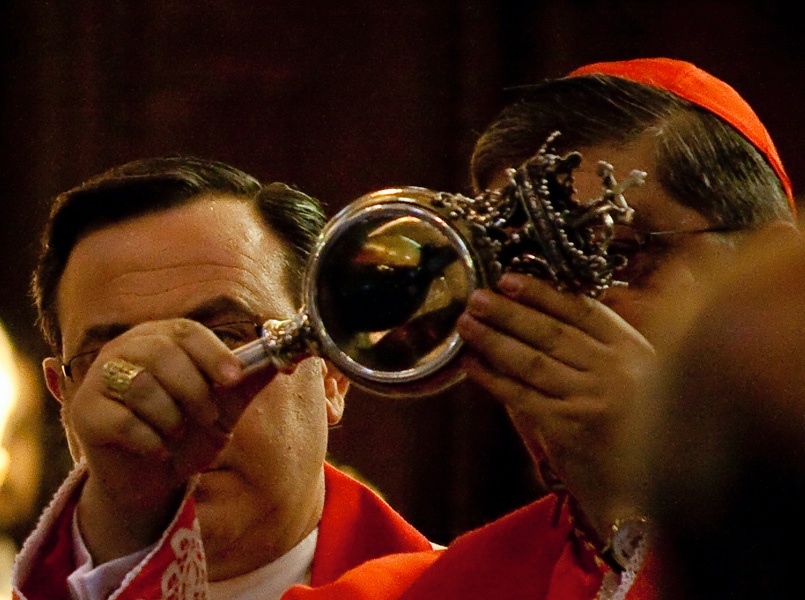
Cardinal Crescenzio Sepeial holding the vial containing Saint Januarius' blood.
Photo Credit:
Paola Magni
The vial containing the blood of Saint Januarius failed to liquefy. Just who is Saint Januarius, and why is this issue with his blood important? Here's the story, from Michael Talbot's Holographic Universe (p. 119-120):
"Every year in September and May a huge crowd gathers at the Duomo San Gennaro, the principal cathedral of Naples, to witness a miracle. The miracle involves a small vial containing a brown crusty substance alleged to be the blood of San Gennaro, or St. Januarius, who was beheaded by the Roman emperor Diocletian in A.D. 305. According to legend, after the saint was martyred a serving woman collected some of his blood as a relic. No one knows precisely what happened after that, save that the blood didn't turn up again until the end of the thirteenth century when it was ensconced in a silver reliquary in the cathedral.
"The miracle is that twice yearly, when the crowd shouts at the vial, the brown crusty substance changes into a bubbling, bright red liquid. There is little doubt that the liquid is real blood. in 1902 a group of scientists from the University of Naples made a spectroscopic analysis of the liquid by passing a beam of light through it, verifying that it was blood. Unfortunately, because the reliquary containing the blood is so old and fragile, the church will not allow it to be cracked open so that other tests can be done, and so the phenomenon has never been thoroughly studied.
"But there is further evidence that the transformation is a more than ordinary event. Occasionally throughout history (the first written account of the public performance of the miracle dates back to 1389) when the vial is brought out, the blood refuses to liquefy. Although rare, this is considered a very bad omen by the citizens of Naples. In the past, the failure of the miracle has directly preceded the eruption of Vesuvius and the Napoleonic invasion of Naples. More recently, in 1976 and 1978, it presaged the worst earthquake in Italian history and the election of a communist city government in Naples, respectively.
"Is the liquefaction of San Gennaro's blood a miracle? It appears to be, at least in the sense that it seems impossible to explain by known scientific laws." [emphasis added]
Skep-dicks have claimed the substance in the vial is a thixotropic gel containing iron oxide. Of course, they've produced bullshit stunts where they've created a similar substance that liquefies when shaken, but that's not proof of anything. A ventriloquist can reproduce the effect of voices coming out of a radio but that doesn't mean that radios are fake. Just because an effect can be reproduced through other means doesn't in any way indicate that those are the only means of producing the effect. There are many ways to produce powered flight, and there are many different types of light bulb, and all sorts of other phenomena can be produced in different ways. Magicians reproducing psychic phenomena does not in the least prove, or even provide evidence that psychic phenomena are fake. It's a confidence trick designed to subvert the rational mind.
From Live Science:
"The blood did not liquefy in 1939, when World War II broke out, nor in
1943, the year the Nazi occupied Italy, nor in 1973, remembered for a
bout of cholera in Naples. Most recently, it failed to liquefy in 1980,
when a devastating earthquake struck Irpinia, some 30 miles east of
Naples, leaving more than 2,400 people dead.
"According to the website storiacity.it,
over the centuries the failed miracle coincided with 22 epidemics, 11
revolutions, three droughts, 14 archbishops death (within a 30-day
period), nine dead popes (over a period of a few weeks), four wars, 19
earthquakes, and three religious persecutions."
The blood failed to liquefy again on the 16th of December this year. Every time the blood has failed to liquefy there has been some disaster.
That could mean one of two things:
1. The liquefaction of the blood is a genuine miracle and failure to liquefy really does portend bad omens.
2a. The liquefaction of the blood is a psychic phenomena involving the collective consciousness of the people of Naples to see into the future and predict when calamities are about to occur.
2b. The blood is fake but unconscious precognition is still involved. Either the priests and other church officials psychically sense the future and purposefully do some trick to keep the fake substance a solid to warn the public, or the collective consciousness of the people of Naples keeps the fake substance a solid because of unconscious precognition.
The skep-dicks have no legs to stand on. The failure of the substance to liquefy has always coincided with disasters. It doesn't matter what is in the vial, blood or iron oxide gel, either a miracle or psychic powers are involved, because no matter what's in the vial, the substance itself or the people around it are still able to predict the future, something materialism says is impossible.
What does that mean for 2017? Let me just say that if I had any travel plans for Naples I would cancel them.
Tuesday, April 5, 2016
My Problems with Spiritualists
I usually have two problems with most spiritualists. First to clarify, when I say "spiritualist" I categorically DO NOT mean people who say they are "spiritual but not religious." I've already written at length my distaste for those people. Spiritualism is the belief that spirit exists distinct from matter (or within some realm of more rarefied subtle matter or etheric or astral matter) and can be contacted through mediums. And this has been tested scientifically and there are really only two possible options to explain the data:
1. The Survival Hypothesis. The minds and personalities of people survive death of the body in pretty much the same state as when they were alive and they can communicate, at least at a rudimentary level, with the living.
or
2. The Super-ESP Hypothesis. The minds of certain living people are capable of extraordinary feats of ESP bordering on omniscience, whereby they can access information about the deceased by reading the minds of multiple living people all over the world simultaneously and access other information through remote viewing of locked drawers, diaries, or other varied sources, often coming up with information that is not known to the bereaved person or persons and not verified until much later, all this coupled with a subconscious dissociative personality disorder that the medium believes with absolute conviction is a real deceased individual they are communicating with.
And that's it. And after 150 years of testing no one has devised an experiment to distinguish between the two conclusively for the unfortunate reason that all the scientists working on the problem are stuck trying to convince die-hard atheist materialists who serve as the gatekeepers of what is and is not officially sanctioned science that real information is being attained through psychic means.
You might think that's a false dilemma and decide to take the third option, but, to be honest, if you take the third option I question your intelligence and would be surprised you would even know what a false dilemma is or that you had the capacity to fully comprehend the issue.
3. The Demon-Haunted World. A class of non-physical (or astral) beings called demons exist and they are omniscient, or at least as intelligent as necessary to trick humans that they are deceased humans because God is an asshole and filled the universe with billions of demons who trick people because God is an asshole and wants to send 99.999% of people to suffer in Hell forever.
If you accept options 1 or 2 you are a rational person who has examined the evidence. If you accept option 3 you are a moron. If you reject them all and accept option 4, that it's all deliberate trickery from often Nobel Prize winning scientists who want to ruin their reputations by studying ghosts, you're either ignorant of the data or a cynical asshole and most likely never even bothered looking at the data because you reject it a priori.
As a side note, we can get into metaphysics, with astral and etheric and subtle energies and all that stuff some other time, and I know Ken Wilber has talked down the issue and has promoted his "Integral Post-Metaphysics" and Kant's critique of metaphysics, but if you read Excerpt G (page 46), Ken does admit to true metaphysics within his model:
" The fact that the subtle (and causal) bodymind can transmigrate the gross bodymind is indeed metaphysical; but the fact that these subtle energies are postulated as real, concrete, detectable, often measurable—if subtler—energies, stops the whole conception from spinning off into the vaporware of pure metaphysics. If you read hypothesis #4 in conjunction with the first three hypotheses, I think you will see that they are at least consistent with each other; and thus I believe that an integral theory of subtle energies can accommodate the existence of transmigration, if we decide, on other grounds, that there is enough evidence to conclude that transmigration occurs."
It's a good read, but if you're in a hurry you can watch this video.
Getting back to the central issue of what my problems with spiritualists are.
The first problem is the denial of the good that other religions (specifically Christianity and to a lesser extent Buddhism) have and continue to bring to humanity. I wouldn't say this is the hatred of religion, as we see in the "spiritual but not religious" people (except Islam, which they adore), and it probably is not cultural relativism either that says "all religions are equal" or some such nonsense. It might be a sort of spiritual myopia. They are so invested in the truth claims of their own beliefs – the messages delivered by spirits – that they reject out of hand the truth claims of opposing beliefs. So, for example, if spirits say reincarnation does not exist they will believe it without hesitation even though the spirit they are communicating with might be lying or ignorant or both. A second possibility is similar to when you're a teenager and you're embarrassed by what you did as a child, which is basically how climbing the developmental ladder works all through first tier. First tier stages (archaic, magic, mythic, rational, pluralistic, or egocentric, ethnocentric, worldcentric, or any other conceptions) are all exclusive in their thinking. Someone who is ethnocentric looks down on someone who is egocentric (and on someone who is worldcentric), just as someone who is worldcentric looks down on someone who is egocentric and someone who is ethnocentric, even though they themselves necessarily had to pass through all the lower stages to get to where they are. This continues, quite naturally, until one reaches second tier – integral – and can appreciate that all levels have truth and utility appropriate for people at that level.
So, someone who is a spiritualist would reject the truth and utility of organised religion even though for the vast majority of people who have ever lived organised religion is the only thing keeping them from stealing and killing and raping. Religion not only serves as a social glue, it serves as the only affective social glue that has ever been discovered. And since everyone starts out at square one when they are born and has to learn reason and morality, eliminating religion is a particularly bad idea because until people mature to the level where they can apply reason to appreciate natural law and morality (which for most people is never), religion is necessary to keep people from becoming monsters.
Sometimes, yes, religions do influence people to become monsters, particularly lower level religions, but certainly Christianity has had its reformation and the worst Christians you will ever likely encounter are assholes who protest soldiers' funerals.
Aside from legitimacy, religion provides the only affective means of bringing people enlightenment. This ties into the second problem I have with most spiritualists, which is something I'll call subtle reductionism, what Ken Wilber calls the Vishnu Complex. I'll get to that in a minute.
One of the central beliefs of spiritualists is the extreme gradualist approach to development, that spirits develop astronomically slowly, though inexorably, over gazillions of years to reach ultimate perfection. If I could spend fifty trillion eons in an astral heaven where my thoughts instantly manifest my desires I'd say that's a pretty good deal. The general idea is that it gets boring after a time and then you decide to progress. And I'll admit, after the hell and hardship of this life I might look forward to some downtime.
The classic counter to this, which makes sense to me, is the argument of reincarnationists that once your merit is worn out you have to come back here, so the astral worlds are temporary. The only way out of the cycle is enlightenment. The idea of progression through infinitely more rarefied realms does have somewhat of a parallel with the idea of a pure land in Buddhism or Sri Yukteswar's Hiranyaloka from Autobiography of a Yogi. You can progress to a special astral world where the infinite merit and compassion of an enlightened being permits you to progress spiritually without the need to reincarnate.
Now you might not want to believe in reincarnation, and I think most spiritualists don't, for the pretty thoughtless reason "Who would want to come back?!" Very few people, I suspect, would want to come back, but the traditions maintain that it's more like jumping off a cliff. Once you jump you don't get to choose whether you fall down or not, gravity will take over automatically. You don't get to choose whether you reincarnate or not, unless you're already enlightened, your spiritual gravity pulls you unconsciously where you are most suited, and for most people that's back here on Earth. Even if you don't believe in reincarnation, and I think it makes a certain degree of sense, there's still one more reason to see the gradualist approach as not all that's great.
The gradualist approach really does not solve the problem of suffering in this life, it defers it to the next. There is a bit of an inherent laziness to it. "If I'm going to get there anyway I might as well take my time." That is very similar to the traditional religious approach of suffering through life with the knowledge of a reward in the afterlife. The idea of a metaphysical safety net is certainly comforting and has served humanity very well for millennia, but it does not bring about true transpersonal development. Even in an astral heaven there is still self and other, there is still separation, and where there is separation there is suffering. That is why spirits choose to leave the lower astral heavens, often called "Summerland", where thoughts manifest instantly, because it gets boring after a while. The types of suffering in astral worlds are radically different than in the physical world (and in the astral hells are much worse), but as long as separation exists suffering necessarily exists. Enlightenment is the only way out, and religion provides the only door to enlightenment.
That brings us to my second objection, subtle reductionism, which is nothing other than the denial of the causal. Subtle reductionism is nowhere near as disastrous as the gross reductionism of fundamaterialists, it is definitely a step in the right direction, but in denying the existence of the causal one is also denying the ultimate end of suffering.
Basically the subtle realms work like psychotherapy. One reaches an end of psychotherapy when one realises that one can go on forever. The subtle realms are like that. You ascend higher and higher, into ever more subtle planes of illumination and bliss, and it just doesn't stop. There is no upward limit, there is no ultimate end. In meditation people can spend a lifetime just getting to more rarefied states and just bliss-out and as soon as they come down and have to go to work they are the same jerk as they were from day one. You can certainly gain psychic powers through forms of meditation, but if you just keep ascending through all the essential lights and sounds you will not reach enlightenment. This inertial desire to keep ascending through the subtle is what Ken Wilber calls the Vishnu Complex. You are so enamored with God you don't want to seek your true identity. And since you have to stop meditating eventually you will suffer when it ends. As long as separation exists suffering necessarily exists. And that's all the gradualist approach of most spiritualists promises, ever higher states of lights and sounds.
This denial of the causal is wonderfully presented in Greg Stone's book Under the Tree. It's a pretty obscure book, so I'll explain it a little. This man with a punny name encounters ice on the highway and runs his car off a cliff and goes into a coma. He has a near death experience that spends a great many pages just trying to convince him he really is dead, since he doesn't believe in an afterlife, and then it goes off into explaining how the universe works.
Mr. Pun's spirit guide explains to him why all the religions are wrong when they say that we are all one. You see, we really are all separate, but when you incarnate on the Earth you have to pass through a filter, and that filter only lets one soul through at a time, and since we all have to squeeze through that filter we think, "Oh, only one can fit, so there must be only one of us," but that's just faulty logic.
Except that's not what any religion says at all. Remember, you do not automatically become enlightened upon death. If you did there would be absolutely no point to life here on Earth at all. It would all be a waste of time and you could be a child rapist or an axe murderer and it wouldn't matter because we all go up into light and bliss when we die anyway. That's exactly the same horrible belief as the materialists who say you die and rot, just in the opposite direction. If nothing you do in this life has any impact on the next, and we're all just here to learn lessons, or to experience suffering, or because it's rousing good fun, then life truly is meaningless and you might as well just shoot heroin all day, because it won't make one bit of difference. If Hitler and his victims go to the same place after death then the universe is completely lacking in justice or compassion and was created and run by Satan.
Since you do not become enlightened upon death (and we know this because spirits coming through mediums admit to it; they admit to not knowing everything), then anything you hear from spirits about anything other than their particular state of being is just their own guess. If spirits tell you they enjoy coffee and cigars and fine velvet arm chairs on the other side, then you can believe them. If spirits tell you what is happening at the ultimate level, and that they know with absolute certainty how everything works and the mechanisms of reincarnation or whatever, they're either outright lying or they are guessing. Since the personality remains intact then a liar on the Earth is a liar in the afterlife, and subconscious biases and fears still cloud one's thinking.
One group of people we can believe are enlightened individuals on this Earth, because they all say the same exact thing. There is no guessing with enlightenment, there is just experience, or more accurately lack of experience. In the causal there is nothing arising. There are no separate things, just consciousness as such. Nothing bad arises to torture you and leave, nothing good arises to torture you when it leaves, there are no others, there is no you, there just is. And they all say this, for the past 3000 years, they all say this. No one is guessing since this is not speculation of what is happening at higher levels because all levels have been left behind. You step off the ride completely.
Ramakrishna explains this beautifully. He was a life-long devote of Kali, and he would go into spontaneous ecstasy and be engrossed in her image. When he met the naked swami Totapuri and tried to learn Advaita he kept seeing Kali when he meditated. Furious, Totapuri stuck a piece of broken glass between Ramakrishna's eyes and admonished him to meditate on that spot. The next time Ramakrishna meditated he says "As soon as the gracious form of the Divine Mother appeared before me, I used my discrimination as a sword and with it clove Her in two. The last barrier fell. My spirit at once soared beyond the relative plane. I lost myself in samadhi." (The Gospel of Sri Ramakrishna, page 49)
You can see a wonderful depiction of this from the 1955 Bengali film biography of Ramakrishna.
And it's like that for everyone. Ramana Maharshi, Richard Rose, Ken Wilber, everyone. You too can check it out for yourself. I did. You do not need to take anyone's word for it, you need accept no beliefs handed to you from spirits, you can meditate for a really long time and see for yourself if enlightenment is all it's cracked up to be. You don't need to consult mediums, you don't need to wait countless eons to ascend higher planes in the afterlife, you can do this right now, in this lifetime, and it is the single most important thing you ever will, or can, do.
There is nothing in the causal. It is completely empty. If ascending higher subtle realms is like climbing stairs to higher and higher floors in a building, then the leap to the causal would be like going from the third to the fourth dimension. It's not higher than the highest floor in the building, it bypasses height all together. It is not getting to the next level in a video game, it's shutting the game off and realising that it was a game all along and not real. It's not that there is no you, there is only me, there's no me either. You step into the causal and no one is home, there is just consciousness as such. There is awareness but it is in no way tied to any identity, and you realise that any identity you held was just a contraction of all that is, no more real than the characters in a movie are to the actors who play them.
All that said, spiritualists are leagues ahead of the average person in the world today, and light years ahead of the fundamaterialists who are the elites who run the world and act as gatekeepers to what is and is not science. I would love for all the world to adopt the beliefs of spiritualists, I would love for mediumship to be taken seriously, for psychical studies to become the paramount branch of science. It would solve very nearly all the world's problems. At the same time it is imperative to realise that mediumship can only take one so far, and that we all must take up the discipline and strive toward enlightenment, whether now or in some future life. The comfort value of survival wears off once you survive death. Then a whole new set of challenges arise that you must face. Psychological challenges from all the subconscious baggage you have accumulated over this and possibly other lifetimes. All that needs to be worked through eventually. The choice is yours to deal with it over the next gazillion years or right now, all at once, in this lifetime. Most people can't, but you definitely should try. Try as if your life depended on it.
1. The Survival Hypothesis. The minds and personalities of people survive death of the body in pretty much the same state as when they were alive and they can communicate, at least at a rudimentary level, with the living.
or
2. The Super-ESP Hypothesis. The minds of certain living people are capable of extraordinary feats of ESP bordering on omniscience, whereby they can access information about the deceased by reading the minds of multiple living people all over the world simultaneously and access other information through remote viewing of locked drawers, diaries, or other varied sources, often coming up with information that is not known to the bereaved person or persons and not verified until much later, all this coupled with a subconscious dissociative personality disorder that the medium believes with absolute conviction is a real deceased individual they are communicating with.
And that's it. And after 150 years of testing no one has devised an experiment to distinguish between the two conclusively for the unfortunate reason that all the scientists working on the problem are stuck trying to convince die-hard atheist materialists who serve as the gatekeepers of what is and is not officially sanctioned science that real information is being attained through psychic means.
You might think that's a false dilemma and decide to take the third option, but, to be honest, if you take the third option I question your intelligence and would be surprised you would even know what a false dilemma is or that you had the capacity to fully comprehend the issue.
3. The Demon-Haunted World. A class of non-physical (or astral) beings called demons exist and they are omniscient, or at least as intelligent as necessary to trick humans that they are deceased humans because God is an asshole and filled the universe with billions of demons who trick people because God is an asshole and wants to send 99.999% of people to suffer in Hell forever.
If you accept options 1 or 2 you are a rational person who has examined the evidence. If you accept option 3 you are a moron. If you reject them all and accept option 4, that it's all deliberate trickery from often Nobel Prize winning scientists who want to ruin their reputations by studying ghosts, you're either ignorant of the data or a cynical asshole and most likely never even bothered looking at the data because you reject it a priori.
As a side note, we can get into metaphysics, with astral and etheric and subtle energies and all that stuff some other time, and I know Ken Wilber has talked down the issue and has promoted his "Integral Post-Metaphysics" and Kant's critique of metaphysics, but if you read Excerpt G (page 46), Ken does admit to true metaphysics within his model:
" The fact that the subtle (and causal) bodymind can transmigrate the gross bodymind is indeed metaphysical; but the fact that these subtle energies are postulated as real, concrete, detectable, often measurable—if subtler—energies, stops the whole conception from spinning off into the vaporware of pure metaphysics. If you read hypothesis #4 in conjunction with the first three hypotheses, I think you will see that they are at least consistent with each other; and thus I believe that an integral theory of subtle energies can accommodate the existence of transmigration, if we decide, on other grounds, that there is enough evidence to conclude that transmigration occurs."
It's a good read, but if you're in a hurry you can watch this video.
Getting back to the central issue of what my problems with spiritualists are.
The first problem is the denial of the good that other religions (specifically Christianity and to a lesser extent Buddhism) have and continue to bring to humanity. I wouldn't say this is the hatred of religion, as we see in the "spiritual but not religious" people (except Islam, which they adore), and it probably is not cultural relativism either that says "all religions are equal" or some such nonsense. It might be a sort of spiritual myopia. They are so invested in the truth claims of their own beliefs – the messages delivered by spirits – that they reject out of hand the truth claims of opposing beliefs. So, for example, if spirits say reincarnation does not exist they will believe it without hesitation even though the spirit they are communicating with might be lying or ignorant or both. A second possibility is similar to when you're a teenager and you're embarrassed by what you did as a child, which is basically how climbing the developmental ladder works all through first tier. First tier stages (archaic, magic, mythic, rational, pluralistic, or egocentric, ethnocentric, worldcentric, or any other conceptions) are all exclusive in their thinking. Someone who is ethnocentric looks down on someone who is egocentric (and on someone who is worldcentric), just as someone who is worldcentric looks down on someone who is egocentric and someone who is ethnocentric, even though they themselves necessarily had to pass through all the lower stages to get to where they are. This continues, quite naturally, until one reaches second tier – integral – and can appreciate that all levels have truth and utility appropriate for people at that level.
So, someone who is a spiritualist would reject the truth and utility of organised religion even though for the vast majority of people who have ever lived organised religion is the only thing keeping them from stealing and killing and raping. Religion not only serves as a social glue, it serves as the only affective social glue that has ever been discovered. And since everyone starts out at square one when they are born and has to learn reason and morality, eliminating religion is a particularly bad idea because until people mature to the level where they can apply reason to appreciate natural law and morality (which for most people is never), religion is necessary to keep people from becoming monsters.
Sometimes, yes, religions do influence people to become monsters, particularly lower level religions, but certainly Christianity has had its reformation and the worst Christians you will ever likely encounter are assholes who protest soldiers' funerals.
Aside from legitimacy, religion provides the only affective means of bringing people enlightenment. This ties into the second problem I have with most spiritualists, which is something I'll call subtle reductionism, what Ken Wilber calls the Vishnu Complex. I'll get to that in a minute.
One of the central beliefs of spiritualists is the extreme gradualist approach to development, that spirits develop astronomically slowly, though inexorably, over gazillions of years to reach ultimate perfection. If I could spend fifty trillion eons in an astral heaven where my thoughts instantly manifest my desires I'd say that's a pretty good deal. The general idea is that it gets boring after a time and then you decide to progress. And I'll admit, after the hell and hardship of this life I might look forward to some downtime.
The classic counter to this, which makes sense to me, is the argument of reincarnationists that once your merit is worn out you have to come back here, so the astral worlds are temporary. The only way out of the cycle is enlightenment. The idea of progression through infinitely more rarefied realms does have somewhat of a parallel with the idea of a pure land in Buddhism or Sri Yukteswar's Hiranyaloka from Autobiography of a Yogi. You can progress to a special astral world where the infinite merit and compassion of an enlightened being permits you to progress spiritually without the need to reincarnate.
Now you might not want to believe in reincarnation, and I think most spiritualists don't, for the pretty thoughtless reason "Who would want to come back?!" Very few people, I suspect, would want to come back, but the traditions maintain that it's more like jumping off a cliff. Once you jump you don't get to choose whether you fall down or not, gravity will take over automatically. You don't get to choose whether you reincarnate or not, unless you're already enlightened, your spiritual gravity pulls you unconsciously where you are most suited, and for most people that's back here on Earth. Even if you don't believe in reincarnation, and I think it makes a certain degree of sense, there's still one more reason to see the gradualist approach as not all that's great.
The gradualist approach really does not solve the problem of suffering in this life, it defers it to the next. There is a bit of an inherent laziness to it. "If I'm going to get there anyway I might as well take my time." That is very similar to the traditional religious approach of suffering through life with the knowledge of a reward in the afterlife. The idea of a metaphysical safety net is certainly comforting and has served humanity very well for millennia, but it does not bring about true transpersonal development. Even in an astral heaven there is still self and other, there is still separation, and where there is separation there is suffering. That is why spirits choose to leave the lower astral heavens, often called "Summerland", where thoughts manifest instantly, because it gets boring after a while. The types of suffering in astral worlds are radically different than in the physical world (and in the astral hells are much worse), but as long as separation exists suffering necessarily exists. Enlightenment is the only way out, and religion provides the only door to enlightenment.
That brings us to my second objection, subtle reductionism, which is nothing other than the denial of the causal. Subtle reductionism is nowhere near as disastrous as the gross reductionism of fundamaterialists, it is definitely a step in the right direction, but in denying the existence of the causal one is also denying the ultimate end of suffering.
Basically the subtle realms work like psychotherapy. One reaches an end of psychotherapy when one realises that one can go on forever. The subtle realms are like that. You ascend higher and higher, into ever more subtle planes of illumination and bliss, and it just doesn't stop. There is no upward limit, there is no ultimate end. In meditation people can spend a lifetime just getting to more rarefied states and just bliss-out and as soon as they come down and have to go to work they are the same jerk as they were from day one. You can certainly gain psychic powers through forms of meditation, but if you just keep ascending through all the essential lights and sounds you will not reach enlightenment. This inertial desire to keep ascending through the subtle is what Ken Wilber calls the Vishnu Complex. You are so enamored with God you don't want to seek your true identity. And since you have to stop meditating eventually you will suffer when it ends. As long as separation exists suffering necessarily exists. And that's all the gradualist approach of most spiritualists promises, ever higher states of lights and sounds.
This denial of the causal is wonderfully presented in Greg Stone's book Under the Tree. It's a pretty obscure book, so I'll explain it a little. This man with a punny name encounters ice on the highway and runs his car off a cliff and goes into a coma. He has a near death experience that spends a great many pages just trying to convince him he really is dead, since he doesn't believe in an afterlife, and then it goes off into explaining how the universe works.
Mr. Pun's spirit guide explains to him why all the religions are wrong when they say that we are all one. You see, we really are all separate, but when you incarnate on the Earth you have to pass through a filter, and that filter only lets one soul through at a time, and since we all have to squeeze through that filter we think, "Oh, only one can fit, so there must be only one of us," but that's just faulty logic.
Except that's not what any religion says at all. Remember, you do not automatically become enlightened upon death. If you did there would be absolutely no point to life here on Earth at all. It would all be a waste of time and you could be a child rapist or an axe murderer and it wouldn't matter because we all go up into light and bliss when we die anyway. That's exactly the same horrible belief as the materialists who say you die and rot, just in the opposite direction. If nothing you do in this life has any impact on the next, and we're all just here to learn lessons, or to experience suffering, or because it's rousing good fun, then life truly is meaningless and you might as well just shoot heroin all day, because it won't make one bit of difference. If Hitler and his victims go to the same place after death then the universe is completely lacking in justice or compassion and was created and run by Satan.
Since you do not become enlightened upon death (and we know this because spirits coming through mediums admit to it; they admit to not knowing everything), then anything you hear from spirits about anything other than their particular state of being is just their own guess. If spirits tell you they enjoy coffee and cigars and fine velvet arm chairs on the other side, then you can believe them. If spirits tell you what is happening at the ultimate level, and that they know with absolute certainty how everything works and the mechanisms of reincarnation or whatever, they're either outright lying or they are guessing. Since the personality remains intact then a liar on the Earth is a liar in the afterlife, and subconscious biases and fears still cloud one's thinking.
One group of people we can believe are enlightened individuals on this Earth, because they all say the same exact thing. There is no guessing with enlightenment, there is just experience, or more accurately lack of experience. In the causal there is nothing arising. There are no separate things, just consciousness as such. Nothing bad arises to torture you and leave, nothing good arises to torture you when it leaves, there are no others, there is no you, there just is. And they all say this, for the past 3000 years, they all say this. No one is guessing since this is not speculation of what is happening at higher levels because all levels have been left behind. You step off the ride completely.
Ramakrishna explains this beautifully. He was a life-long devote of Kali, and he would go into spontaneous ecstasy and be engrossed in her image. When he met the naked swami Totapuri and tried to learn Advaita he kept seeing Kali when he meditated. Furious, Totapuri stuck a piece of broken glass between Ramakrishna's eyes and admonished him to meditate on that spot. The next time Ramakrishna meditated he says "As soon as the gracious form of the Divine Mother appeared before me, I used my discrimination as a sword and with it clove Her in two. The last barrier fell. My spirit at once soared beyond the relative plane. I lost myself in samadhi." (The Gospel of Sri Ramakrishna, page 49)
You can see a wonderful depiction of this from the 1955 Bengali film biography of Ramakrishna.
And it's like that for everyone. Ramana Maharshi, Richard Rose, Ken Wilber, everyone. You too can check it out for yourself. I did. You do not need to take anyone's word for it, you need accept no beliefs handed to you from spirits, you can meditate for a really long time and see for yourself if enlightenment is all it's cracked up to be. You don't need to consult mediums, you don't need to wait countless eons to ascend higher planes in the afterlife, you can do this right now, in this lifetime, and it is the single most important thing you ever will, or can, do.
There is nothing in the causal. It is completely empty. If ascending higher subtle realms is like climbing stairs to higher and higher floors in a building, then the leap to the causal would be like going from the third to the fourth dimension. It's not higher than the highest floor in the building, it bypasses height all together. It is not getting to the next level in a video game, it's shutting the game off and realising that it was a game all along and not real. It's not that there is no you, there is only me, there's no me either. You step into the causal and no one is home, there is just consciousness as such. There is awareness but it is in no way tied to any identity, and you realise that any identity you held was just a contraction of all that is, no more real than the characters in a movie are to the actors who play them.
All that said, spiritualists are leagues ahead of the average person in the world today, and light years ahead of the fundamaterialists who are the elites who run the world and act as gatekeepers to what is and is not science. I would love for all the world to adopt the beliefs of spiritualists, I would love for mediumship to be taken seriously, for psychical studies to become the paramount branch of science. It would solve very nearly all the world's problems. At the same time it is imperative to realise that mediumship can only take one so far, and that we all must take up the discipline and strive toward enlightenment, whether now or in some future life. The comfort value of survival wears off once you survive death. Then a whole new set of challenges arise that you must face. Psychological challenges from all the subconscious baggage you have accumulated over this and possibly other lifetimes. All that needs to be worked through eventually. The choice is yours to deal with it over the next gazillion years or right now, all at once, in this lifetime. Most people can't, but you definitely should try. Try as if your life depended on it.
Saturday, March 19, 2016
Spirituality in 2016
Ken Wilber talks about the "spiritual but not religious" people in one of the footnote videos and there's points of agreement and disagreement I have with his assessment. I've written about this topic at least twice before. Just taking his numbers as given, 20% of Americans are "spiritual but not religious." Ken says they don't want the mythic elements of organised religion, they want direct access to genuine transpersonal realities. And I think there's definitely some of that. In the back of everyone's mind there's the drive to return to the Source, but I don't think that's the main reason people are checking out of religion, and I say that because people don't seem any more "spiritual" today than 50 years ago. People today seem much less likely to accept non-physical realities, and they also seem far less moral and far more materialistic. I think the main push is that people don't want guilt. People reject absolute morality so they can have, mostly, guilt-free sex, along with guilt-free gluttony (1/3 of Americans are obese), guilt-free envy, celebrity worship, and just all around hedonism. That's why drug addiction is so high, because people know they are living crappy lives and even though they have rejected religion they still know that buying $400 of shit and wondering why you bought it is wrong, people know this Weimar cabaret lifestyle of nights of heroin use and anonymous sex with 50 people followed by mornings of detoxing with green coffee enemas is wrong, and it's causing massive anxiety and massive depression. I do not see this as an ascent to Integral spirituality, I see this as a descent into egocentric hedonism.
He also mentions the mindset of terrorists, that I've written about here. He does a good deal of equivocating, "Southern Baptists bombing abortion clinics"? When was the last time that happened? "Buddhists releasing sarin gas in the Tokyo subway"? Aum Shinrikyo are not Buddhist, they are an apocalyptic cult led by a blind man who believes he is the reincarnation of Jesus Christ as prophesied by Edgar Cayce. That's not Buddhism, nor is it Christianity, it's worship of a charismatic figure by nihilists. And he lumps these people in with Al Qaeda (and radical Islam by extension). He says the reason these terrorists exist is because modernity has no place for their ancient religions, so they will destroy modernity completely. Well, if that were the case why are so many terrorists highly successful, highly educated Westerners? These people very clearly don't reject modernity because they are mostly educated professionals. Saudi Arabia, the largest state sponsor of terrorism, the place where Salafism was invented, exists only because of modern technology! These people do not reject modernity, they reject the meaninglessness of post-modern boomeritis.
I'm not saying very bad Christians don't exist, just that the worst of them tend to be assholes who disrupt solder's funerals. The very small handful who turn to violence can be easily handled (and are easily handled) by the police. They are such a tiny minority that they can be dismissed as mentally deranged. The only two groups of people who have a very large number of very violent terrorists are radical leftists and radical Islam. All, or very nearly all the mass shootings of the past decade have been perpetrated by radical leftists who were on psychiatric medication, the other groups causing trouble, the Black Lives Matter people who burnt Ferguson and Baltimore to the ground, they are opportunistic nihilistic leftists. I have yet to see a prototypical far right group like the KKK or Neo-Nazis kill a lot of people in the US in the past two decades. And there is no small minority of Muslims who support terror. In every majority Muslim country surveyed the majority of the populations, while not terrorists themselves, support terrorism, or at the very least a strict interpretation of Shariah that says infidels have no rights, women are property, gays should be murdered, and Christians and Jews should be second-class citizen dhimis. Religions do not need to get with the program and integrate modernity, not to eliminate terrorism, cultural Marxism and radical Islam need to stop seeing terrorism as a means to achieve political ends.
He also mentions the mindset of terrorists, that I've written about here. He does a good deal of equivocating, "Southern Baptists bombing abortion clinics"? When was the last time that happened? "Buddhists releasing sarin gas in the Tokyo subway"? Aum Shinrikyo are not Buddhist, they are an apocalyptic cult led by a blind man who believes he is the reincarnation of Jesus Christ as prophesied by Edgar Cayce. That's not Buddhism, nor is it Christianity, it's worship of a charismatic figure by nihilists. And he lumps these people in with Al Qaeda (and radical Islam by extension). He says the reason these terrorists exist is because modernity has no place for their ancient religions, so they will destroy modernity completely. Well, if that were the case why are so many terrorists highly successful, highly educated Westerners? These people very clearly don't reject modernity because they are mostly educated professionals. Saudi Arabia, the largest state sponsor of terrorism, the place where Salafism was invented, exists only because of modern technology! These people do not reject modernity, they reject the meaninglessness of post-modern boomeritis.
I'm not saying very bad Christians don't exist, just that the worst of them tend to be assholes who disrupt solder's funerals. The very small handful who turn to violence can be easily handled (and are easily handled) by the police. They are such a tiny minority that they can be dismissed as mentally deranged. The only two groups of people who have a very large number of very violent terrorists are radical leftists and radical Islam. All, or very nearly all the mass shootings of the past decade have been perpetrated by radical leftists who were on psychiatric medication, the other groups causing trouble, the Black Lives Matter people who burnt Ferguson and Baltimore to the ground, they are opportunistic nihilistic leftists. I have yet to see a prototypical far right group like the KKK or Neo-Nazis kill a lot of people in the US in the past two decades. And there is no small minority of Muslims who support terror. In every majority Muslim country surveyed the majority of the populations, while not terrorists themselves, support terrorism, or at the very least a strict interpretation of Shariah that says infidels have no rights, women are property, gays should be murdered, and Christians and Jews should be second-class citizen dhimis. Religions do not need to get with the program and integrate modernity, not to eliminate terrorism, cultural Marxism and radical Islam need to stop seeing terrorism as a means to achieve political ends.
Thursday, March 17, 2016
The Joe Rogan Experience with Graham Hancock
Joe Rogan talks with Graham Hancock about ancient civilisations, the ice age, psychadelics, the war on drugs, and why the power elite don't want us asking questions about deep antiquity. Runs 2 hours.
Saturday, January 3, 2015
Richard Rose: Zen and Death
Do we want the Truth or do we want to be "educated"? There is a tendency of people in control, whether in universities or in governments, to want to "educate". Not for the Truth, but for the convenience of the moment, thinking they are the prophets of the zeitgeist, and by their manipulation of the public mind the will bring people around to the "right" direction.
- Richard Rose
Richard Rose talks on everything. He talks about the four categories of mystical experiences, how society conditions us to believe lies regarding who we are and what death is, the near death experience, and the importance of finding the Truth and who we really are. We exist before we are born and continue to exist after we die. The purpose of life is finding this Truth out for ourselves through direct experience. Runs 1 hour 10 minutes.
- Richard Rose
Richard Rose talks on everything. He talks about the four categories of mystical experiences, how society conditions us to believe lies regarding who we are and what death is, the near death experience, and the importance of finding the Truth and who we really are. We exist before we are born and continue to exist after we die. The purpose of life is finding this Truth out for ourselves through direct experience. Runs 1 hour 10 minutes.
Sunday, December 28, 2014
What Drives Radical Islam?
Why do all these really hardcore jihadis come from the West? "Jihadi John", the man in all those beheading videos, is from Britain, all the 9/11 terrorists were educated in Western universities. Why? All of a sudden, in a flash of insight, it makes sense. The West is so empty of meaning, so narcissistic, so apathetic, so materialistic, suffused with extreme relativism and leftism that despises religion, despises family, despises community, worships sin. When I see Westerners practice other religions – Hinduism, Buddhism – about 90% seem to me to be fake, empty. Most Christians seem fake, most Jews seem fake, but there are still millions of Westerners who are authentic Christians and Jews, but when they practice other religions it comes across as nothing but feel-good-ism. These people hate Christianity and authentic Western values, the values that led to a few backwater kingdoms in Europe to dominate the entire world in a couple of centuries, to rise above everything all other empires had created, to develop modern science, to develop industry, to delve into the depths of space and microscopic physics, these people hate the values that built all that. They want to get together, to practice "religion" with no strings attached: no sin, no morality aside from progressivism. They're all hippie leftists. Occasionally you'll get a Westerner to adopt religion fully, like Muho Noelke, the German man who became a Zen abbot, but most are just cafeteria style "spiritual but not religious" leftists. Disgusted by the lack of values, the lack of true religion in the West, the men who become jihadis latch onto the one system that promises them the rigor and authenticity they seek: radical Islam. It reaches its hand out to them, beckoning them to kill the Western world that has embraced everything they despise. Ken Wilber says that these people reject modernity, but they don't, they reject boomeritis, they reject the diseased version of modernity, not the healthy version of modernity that existed up until the 1950s. To defeat Jihad we need a rebirth of religion in the West. No military solution will do. Bombing jihadis will solve the problem for now, but they'll always keep coming back, just like the tumor that you cut out will keep growing back. Jihad is a disease of the mind, and no pill, no surgery can cure the mind, only right thinking can cure the mind. The only cure for bad religion is good religion.
Thursday, August 2, 2012
The Bible Code - McKay Strikes Back
Remember the documentary where Brendan McKay claims to have discovered the assassinations of famous people in Moby-Dick? An analysis from a Bible code website breaks down in detail why McKay's stunt is not a refutation of the existence of the Bible code, and does not answer Michael Drosnin's challenge, which was: "When my critics find a message about the assassination of a prime minister encrypted in Moby-Dick I'll believe them."
The unnamed author of the piece points out that all correct codes found in the Torah must meet at least three criteria:
1. they must use a priori key words that are logically and historically related to the event being searched, meaning the key words must be chosen before the search is conducted in order for a code to be valid;
2. the a priori key words must have a relatively compact arrangement of ELS (equidistant letter skips) within the code cylinder;
3. one or more of the a priori key words must have a low rank skip ELS.
Every one of McKay's codes do not meet one or more of the criteria for the Bible code, meaning McKay did not find similar code in Moby-Dick and he did not refute the existence of the Bible code.
The first example given is of India's Prime Minister Indira Gandhi, who was assassinated 31 October 1984. The following is an example of the code table, or matrix, McKay found regarding the assassination (there are many such tables in the piece, this one is used here as a reference):

What McKay did, according to the article, was search for every instance of "IGANDHI" in the text of Moby-Dick and searched all of them for words related to killing. The one example he did find was "THEBLOODYDEED". This does not meet the first criteria for a valid code. The article goes on to say: "The second problem is that the ELS for bloody deed is not a low rank skip ELS. Its rank is about 200, meaning there are about 200 ELSs of I. Ghandi in Moby Dick
having smaller absolute skip than the one shown in the McKay table. Low
rank skip for a primary key word generally means a rank smaller than
about 30."
A similar method is used for the deaths of other prominent people. Lebanese President Rene Moawad crosses the entire phrase "ANEXPLODINGBOMB", a rather complex phrase that one would not use as an a priori key word (just as you wouldn't search for the entire phrase "SHOTINTHEHEAD" when looking for the Kennedy assassination, you would use words like "SHOT" and "DALLAS"). Leon Trotsky is found with the word "EXECUTED", when he was murdered by a criminal while exiled in Mexico, not killed in an official execution. The other codes found by McKay either display odd complete phrases, indicating cheating, or are not statistically significant (McKay's code for JFK has a probability of 34.5 in 100, whereas the probability of the results of the original rabbi's experiment he said was fake had a probability of 1 in 10 million).
The conclusion is clear: Brendan McKay did not perform an experiment. He used no experimental protocal, certainly not the rigorous one used in the original experiment he was criticising. McKay performed a debunking exercise where he cheated at every chance he could, searching the text for anything he thought would look good, and put on a show to purpousfully deceive the uneducated reader. His whole purpose was to discredit genuine code researchers because he has an a priori metaphysical objection to the existence of codes, not a real scientific objection.
The unnamed author of the piece points out that all correct codes found in the Torah must meet at least three criteria:
1. they must use a priori key words that are logically and historically related to the event being searched, meaning the key words must be chosen before the search is conducted in order for a code to be valid;
2. the a priori key words must have a relatively compact arrangement of ELS (equidistant letter skips) within the code cylinder;
3. one or more of the a priori key words must have a low rank skip ELS.
Every one of McKay's codes do not meet one or more of the criteria for the Bible code, meaning McKay did not find similar code in Moby-Dick and he did not refute the existence of the Bible code.
The first example given is of India's Prime Minister Indira Gandhi, who was assassinated 31 October 1984. The following is an example of the code table, or matrix, McKay found regarding the assassination (there are many such tables in the piece, this one is used here as a reference):
What McKay did, according to the article, was search for every instance of "IGANDHI" in the text of Moby-Dick and searched all of them for words related to killing. The one example he did find was "THEBLOODYDEED". This does not meet the first criteria for a valid code. The article goes on to say: "The second problem is that the ELS for bloody deed is not a low rank skip ELS. Its rank is about 200, meaning there are about 200 ELSs of I. Ghandi in Moby Dick
having smaller absolute skip than the one shown in the McKay table. Low
rank skip for a primary key word generally means a rank smaller than
about 30."
A similar method is used for the deaths of other prominent people. Lebanese President Rene Moawad crosses the entire phrase "ANEXPLODINGBOMB", a rather complex phrase that one would not use as an a priori key word (just as you wouldn't search for the entire phrase "SHOTINTHEHEAD" when looking for the Kennedy assassination, you would use words like "SHOT" and "DALLAS"). Leon Trotsky is found with the word "EXECUTED", when he was murdered by a criminal while exiled in Mexico, not killed in an official execution. The other codes found by McKay either display odd complete phrases, indicating cheating, or are not statistically significant (McKay's code for JFK has a probability of 34.5 in 100, whereas the probability of the results of the original rabbi's experiment he said was fake had a probability of 1 in 10 million).
The conclusion is clear: Brendan McKay did not perform an experiment. He used no experimental protocal, certainly not the rigorous one used in the original experiment he was criticising. McKay performed a debunking exercise where he cheated at every chance he could, searching the text for anything he thought would look good, and put on a show to purpousfully deceive the uneducated reader. His whole purpose was to discredit genuine code researchers because he has an a priori metaphysical objection to the existence of codes, not a real scientific objection.
Monday, January 16, 2012
Balking Hawking Part 3: In The Beginning
Ever since the idea of the Big Bang was conceived cosmologists who hated God looked for a way around creation. The universe couldn't have a beginning; it would ruin the perfect harmony of an eternal universe. No beginning, no need for an explanation, right? To celebrate Hawking's 70th birthday here is a third installment in the series on him, his cosmology, and his theology.
See Also Balking Hawking Part 1, Part 2, and Georg Cantor's Infinities Part 2.
From NewScientist:
"Many physicists have been fighting a rearguard action against [the Big Bang] for decades, largely because of its theological overtones. If you have an instant of creation, don't you need a creator?
Cosmologists thought they had a workaround. Over the years, they have tried on several different models of the universe that dodge the need for a beginning while still requiring a big bang. But recent research has shot them full of holes (see "Why physicists can't avoid a creation event"). It now seems certain that the universe did have a beginning."
Lawrence Krauss in his new book A Universe From Nothing tries to deal a knock-out blow to the deity by replacing one metaphysical system with another. God is given up for the multiverse, a cacophony of quantum randomness belching out universes like Our Idiot Brother.
It is in vogue now to redefine "nothing" to mean "the quantum vacuum that has always existed," but in an interview on Coast to Coast AM, Krauss does his fellow metaphysicists one better. He admitted that you don't even need a quantum vacuum or quantum laws, as NewScientist explains:
"However, the laws of physics can't be conjured from nothing. In the end, the best answer is that they arise from our existence within a multiverse, where all the universes have their own laws - ours being just so for no particular reason.
Krauss contends that the multiverse makes the question of what determined our laws of nature "less significant". Truthfully, it just puts the question beyond science - for now, at least. That (together with the frustratingly opaque origins of a multiverse) means Krauss can't quite knock out those who think there must ultimately be a prime mover. Not that this matters too much: the juvenile asides that litter the first third of the book (for example, "I am tempted to retort here that theologians are expert at nothing") mean that, by the time we get to the fascinating core of his argument, Krauss will be preaching only to the converted."
[emphasis mine]
The multiverse: the great unknown and unknowable. A meta-space that is beyond our space-time and thus forever beyond our ability to test it. Being untestable the multiverse must surrender its claim to the title "science" and accept that it is now, and forever, metaphysics. To do away with the idea of a creation, an absolute beginning of the universe, Krauss throws science away and invents an untestable story. Even the Bible contains historical details that can be tested, the multiverse is just "bullshit metaphysics".
Metaphysicists have tried to propose systems where the universe (or multiverse) is eternal into the past, but Alexander Vilenkin of Tufts University has shot holes in all of them (even though he still believes in the multiverse, it had to have a beginning in the finite past).
Eternal inflation, the idea that the inflation that sped up the expansion of the early universe didnt' stop, it still continues in other regions of space beyond our cosmic horizon, spawning new bubble universes forever, was the first to go. Some thought inflation was eternal into the past too, but in 2003 Vilenkin and Alan Guth ran the calculations on Hubble's Constant and found that it doesn't work. Inflation may continue forever into the future, but it had to have a beginning in the past.
Next came the big bounce, the idea that after a long time, a trillion years or so, expansion slows and stops, eventually reversing until everything flys back into a single point called the Big Crunch. Then the shock of impact of everything on everything starts a new Big Bang, and the cycle continues forever. Unfortunately, disorder increases with time, so each new universe must be more disordered than the one that birthed it. If the cycle had been going on forever disorder would be infinite and the universe would be completely featureless. Since there's stuff in the universe the cycles couldn't have gone on forever. Some people then suggested that the universe just gets bigger with each bounce, so the disorder spreads out more so no one notices it (like in the M-Brane ekpyrotic model and possibly whatever the hell Penrose's new idea is - no one seems to understand his Aeons of time model, within the physics community or anywhere). But if the whole thing is getting bigger it had to start somewhere really really small, maximally small, and that means a finite beginning.
There's also an idea from the 1930s called the cosmic egg or primeval atom, where yes, there was a Big Bang 13.7 billion years ago, but the thing that banged was an uber-dense subatomic thing that existed forever until it got tired of existing as a tiny little particle and exploded. However, Vilenkin and a graduate student Audrey Mithani showed that quantum instability would have led to the egg's collapse after a finite time. The crack (the Big Bang) had to happen before the egg collapsed into oblivion so it couldn't have existed forever, even if it existed for a really, really long time before the Big Bang.
Vilenkin concludes[:] "All the evidence we have says that the universe had a beginning."
V.J. Torley of UD comments on the implications of a universe requiring a beginning. He reasons (muses, really), in line with William Lane Craig, that the cause of the universe, which cannot be within the universe itself, must be personal. Scientific and mathematic laws are just descriptions of observations. They are not Platonic furniture of reality, and they are causally inert. Only a person, an agent, can bring about the creation of the universe, acting for some reason. The evidence from fine tuning (not only of the universe, but if you read Georg Cantor's Infinities Part 2 and other links provided in the UD article, you'll see that the multiverse too must be fine tuned) is suggestive of a highly mathematical and aesthetic mind behind the constants of the universe.
There you have it, a birthday present, albeit a very bad one, from Alexander Vilenkin to Stephen Hawking: a universe with a definite beginning in the finite past.
See Also Balking Hawking Part 1, Part 2, and Georg Cantor's Infinities Part 2.
From NewScientist:
"Many physicists have been fighting a rearguard action against [the Big Bang] for decades, largely because of its theological overtones. If you have an instant of creation, don't you need a creator?
Cosmologists thought they had a workaround. Over the years, they have tried on several different models of the universe that dodge the need for a beginning while still requiring a big bang. But recent research has shot them full of holes (see "Why physicists can't avoid a creation event"). It now seems certain that the universe did have a beginning."
Lawrence Krauss in his new book A Universe From Nothing tries to deal a knock-out blow to the deity by replacing one metaphysical system with another. God is given up for the multiverse, a cacophony of quantum randomness belching out universes like Our Idiot Brother.
It is in vogue now to redefine "nothing" to mean "the quantum vacuum that has always existed," but in an interview on Coast to Coast AM, Krauss does his fellow metaphysicists one better. He admitted that you don't even need a quantum vacuum or quantum laws, as NewScientist explains:
"However, the laws of physics can't be conjured from nothing. In the end, the best answer is that they arise from our existence within a multiverse, where all the universes have their own laws - ours being just so for no particular reason.
Krauss contends that the multiverse makes the question of what determined our laws of nature "less significant". Truthfully, it just puts the question beyond science - for now, at least. That (together with the frustratingly opaque origins of a multiverse) means Krauss can't quite knock out those who think there must ultimately be a prime mover. Not that this matters too much: the juvenile asides that litter the first third of the book (for example, "I am tempted to retort here that theologians are expert at nothing") mean that, by the time we get to the fascinating core of his argument, Krauss will be preaching only to the converted."
[emphasis mine]
The multiverse: the great unknown and unknowable. A meta-space that is beyond our space-time and thus forever beyond our ability to test it. Being untestable the multiverse must surrender its claim to the title "science" and accept that it is now, and forever, metaphysics. To do away with the idea of a creation, an absolute beginning of the universe, Krauss throws science away and invents an untestable story. Even the Bible contains historical details that can be tested, the multiverse is just "bullshit metaphysics".
Metaphysicists have tried to propose systems where the universe (or multiverse) is eternal into the past, but Alexander Vilenkin of Tufts University has shot holes in all of them (even though he still believes in the multiverse, it had to have a beginning in the finite past).
Eternal inflation, the idea that the inflation that sped up the expansion of the early universe didnt' stop, it still continues in other regions of space beyond our cosmic horizon, spawning new bubble universes forever, was the first to go. Some thought inflation was eternal into the past too, but in 2003 Vilenkin and Alan Guth ran the calculations on Hubble's Constant and found that it doesn't work. Inflation may continue forever into the future, but it had to have a beginning in the past.
Next came the big bounce, the idea that after a long time, a trillion years or so, expansion slows and stops, eventually reversing until everything flys back into a single point called the Big Crunch. Then the shock of impact of everything on everything starts a new Big Bang, and the cycle continues forever. Unfortunately, disorder increases with time, so each new universe must be more disordered than the one that birthed it. If the cycle had been going on forever disorder would be infinite and the universe would be completely featureless. Since there's stuff in the universe the cycles couldn't have gone on forever. Some people then suggested that the universe just gets bigger with each bounce, so the disorder spreads out more so no one notices it (like in the M-Brane ekpyrotic model and possibly whatever the hell Penrose's new idea is - no one seems to understand his Aeons of time model, within the physics community or anywhere). But if the whole thing is getting bigger it had to start somewhere really really small, maximally small, and that means a finite beginning.
There's also an idea from the 1930s called the cosmic egg or primeval atom, where yes, there was a Big Bang 13.7 billion years ago, but the thing that banged was an uber-dense subatomic thing that existed forever until it got tired of existing as a tiny little particle and exploded. However, Vilenkin and a graduate student Audrey Mithani showed that quantum instability would have led to the egg's collapse after a finite time. The crack (the Big Bang) had to happen before the egg collapsed into oblivion so it couldn't have existed forever, even if it existed for a really, really long time before the Big Bang.
Vilenkin concludes[:] "All the evidence we have says that the universe had a beginning."
V.J. Torley of UD comments on the implications of a universe requiring a beginning. He reasons (muses, really), in line with William Lane Craig, that the cause of the universe, which cannot be within the universe itself, must be personal. Scientific and mathematic laws are just descriptions of observations. They are not Platonic furniture of reality, and they are causally inert. Only a person, an agent, can bring about the creation of the universe, acting for some reason. The evidence from fine tuning (not only of the universe, but if you read Georg Cantor's Infinities Part 2 and other links provided in the UD article, you'll see that the multiverse too must be fine tuned) is suggestive of a highly mathematical and aesthetic mind behind the constants of the universe.
There you have it, a birthday present, albeit a very bad one, from Alexander Vilenkin to Stephen Hawking: a universe with a definite beginning in the finite past.
Tuesday, January 10, 2012
An Exercise In Debunking Documentaries
A program called "5th Dimension" does an hour show on debunking reincarnation. It includes a case study of Shanti Devi, a girl born in India in 1926 who was tested by Gandhi and Ian Stevenson and became a media sensation in her time. Next is a segment with Stevenson's research, followed by a story from Pueblo, USA, of Bridey Murphy. It ends with a segment about the Dalai Lama.
Of course people like the head of the Indian (ir-)Rationalist Association Sanal Edamaruku like to say it's all fake (he actually does say that). He says that belief in reincarnation was created to explain the caste system, and, by extension, "takes away the sense of enterprise in people." Does it? Untouchable (Dalit) K. R. Narayana became President of India, and fellow untouchable K. G. Balakrishnan became Chief Justice of India. That's about as far from having their sense of enterprise taken away as you can get. Pandit Jawaharlal Nehru, the highest level Brahmin, strove to destroy the caste system, as did Gandhi, another Brahmin. If the lowest of the low and the highest of the high can work together, both achieving great things, how is it that belief in reincarnation destroys their desire to strive and better their lives? In light of that it is safe to say that Edamaruku's criticism falls apart.
As a side note, the term "rationalist" means someone who believes true knowledge cannot be attained through the senses, only through the rational mind. This is in sharp contrast with people like Edamaruku who believes that the mind doesn't exist, that everything is dead matter, and that knowledge can only come from the senses. Fundamaterialist skep-dick debunkers like to hijack the word "rationalist" and "rational" to mean its opposite, just like they like to hijack the word "nothing" to mean "the quantum vacuum that has existed forever into the past".
There's also Prof. Phillip Sharp (or Shar or something, the narrator has a thick accent and no spelling is given and none of the people interviewed are acknowledged in the credits!), a white guy who uses a version of Bob Couttie's argument against Devi's case (see page 14 in my Forbidden Knowledge). Couttie said that just because a record of a chemical plant's bad safety existed somewhere several hours before the plant exploded (the report was filed on the same day it exploded) coupled with fear of chemical plants that a housewife some distance away having a premonition of the explosion can be explained away by cryptamnesia of her hearing about this report. Even though there's no evidence that the housewife or indeed anyone in the town in which she lived or anyone she knew had any knowledge of this report, and no evidence that even existence of this report got out before the accident, Couttie says that the mere existence of the report justifies the extreme likelihood of a Rube Goldberg nonpsychic explanation for how the housewife had the premonition. Similarly Prof. Sharp says that just because Devi's husband in a former life visited her neighborhood in Delhi to do business means that Devi likely overheard the man and that's how she got the idea of her past life, and correctly identified people she never met, and made a great deal of correct statements of a city she never went to. For skep-dicks as long as a non-psychic explanation is not impossible that means there is at least a 99.999% chance that the non-psychic explanation is the correct one. Actual scientists, on the other hand, like Ian Stevenson, conduct huge amounts of actual research to produce cases suggestive of reincarnation.
Archskep-dick Chris French chimes in, saying children with past life memories are all cultural dependent, which conveniently ignores children with past life memories who come from cultures that are neutral or hostile to belief in reincarnation. If pressed he would come up with some bullshit response.
Overall if a student gave me this to grade I would give it a D+, maybe a C- but only because of the stuff at the end with the Dalai Lama and Robert Thurman. This should serve as an example of how NOT to do a documentary.
Of course people like the head of the Indian (ir-)Rationalist Association Sanal Edamaruku like to say it's all fake (he actually does say that). He says that belief in reincarnation was created to explain the caste system, and, by extension, "takes away the sense of enterprise in people." Does it? Untouchable (Dalit) K. R. Narayana became President of India, and fellow untouchable K. G. Balakrishnan became Chief Justice of India. That's about as far from having their sense of enterprise taken away as you can get. Pandit Jawaharlal Nehru, the highest level Brahmin, strove to destroy the caste system, as did Gandhi, another Brahmin. If the lowest of the low and the highest of the high can work together, both achieving great things, how is it that belief in reincarnation destroys their desire to strive and better their lives? In light of that it is safe to say that Edamaruku's criticism falls apart.
As a side note, the term "rationalist" means someone who believes true knowledge cannot be attained through the senses, only through the rational mind. This is in sharp contrast with people like Edamaruku who believes that the mind doesn't exist, that everything is dead matter, and that knowledge can only come from the senses. Fundamaterialist skep-dick debunkers like to hijack the word "rationalist" and "rational" to mean its opposite, just like they like to hijack the word "nothing" to mean "the quantum vacuum that has existed forever into the past".
There's also Prof. Phillip Sharp (or Shar or something, the narrator has a thick accent and no spelling is given and none of the people interviewed are acknowledged in the credits!), a white guy who uses a version of Bob Couttie's argument against Devi's case (see page 14 in my Forbidden Knowledge). Couttie said that just because a record of a chemical plant's bad safety existed somewhere several hours before the plant exploded (the report was filed on the same day it exploded) coupled with fear of chemical plants that a housewife some distance away having a premonition of the explosion can be explained away by cryptamnesia of her hearing about this report. Even though there's no evidence that the housewife or indeed anyone in the town in which she lived or anyone she knew had any knowledge of this report, and no evidence that even existence of this report got out before the accident, Couttie says that the mere existence of the report justifies the extreme likelihood of a Rube Goldberg nonpsychic explanation for how the housewife had the premonition. Similarly Prof. Sharp says that just because Devi's husband in a former life visited her neighborhood in Delhi to do business means that Devi likely overheard the man and that's how she got the idea of her past life, and correctly identified people she never met, and made a great deal of correct statements of a city she never went to. For skep-dicks as long as a non-psychic explanation is not impossible that means there is at least a 99.999% chance that the non-psychic explanation is the correct one. Actual scientists, on the other hand, like Ian Stevenson, conduct huge amounts of actual research to produce cases suggestive of reincarnation.
Archskep-dick Chris French chimes in, saying children with past life memories are all cultural dependent, which conveniently ignores children with past life memories who come from cultures that are neutral or hostile to belief in reincarnation. If pressed he would come up with some bullshit response.
Overall if a student gave me this to grade I would give it a D+, maybe a C- but only because of the stuff at the end with the Dalai Lama and Robert Thurman. This should serve as an example of how NOT to do a documentary.
Tuesday, September 13, 2011
Exploring the Near Death Experience
Someone called TheSurvivalIndex has put out a 15 minute video detailing the cultural phenomena associated with the NDE. He says three main groups of people form the bulk of the popular presentation on the NDE:
1. Fundamentalist Christians,
2. New Age Haberdashers, and
3. Fundamaterialist Skep-Dicks.
Group 1 latches on to the pro-Fundamentalist Christian NDEs as proof of their beliefs and ignores or even denigrates NDEs that are favourable to other religions or to no religions at all (like atheists who have NDEs that tell them part of their life's mission is to be an atheist). Group 2 extrapolates from the NDE to believe all sorts of stuff that most likely is untrue (Loch Ness Monster, Fairies, Vampires, etc.*) and often tries to profit large offering spurious services to unknowledgable people. Group 3 likes to come up with bullshit just-so stories to explain away the NDE because they are committed to materialism, even when those stories blatantly ignore real facts, are based on illogic, and other fundamaterialists disagree and tear apart opposing stories. All three groups are able to thrive because the general populous doesn't actually read the primary material - actual NDE accounts and the reports of NDE investigators. Even though all three groups are contradicted by the evidence that doesn't bother them because as long as the vast majority of people are ignorant of that evidence they can still come off looking like authority figures.
*I'm not necessarily saying things like the Loch Ness Monster and fairies are not real - they may be - but I have looked into the topics and can't really find any good evidence for them. Loch Ness almost certainly can't support a single large creature, let alone a breeding population. There were biosonar signals detected in Lake Champlain though, indicating that, while not a "monster" there has to be a freshwater equivalent of a cetacean, something that has never before been seen. Things like fairies, gnomes, and other little people stretch my credulity a might, but they may have something to do with some spiritual force, I don't know and am open to the possibility. Vampires, either corpses reanimated by evil spirits (as the original vampires were), people infected with a virus that compells them to drink blood, or these psychic vampires who are real people who claim to drain people's energy in some way they never quite explain, are probably one of the least likely of these "paranormal" phenomena. If vampires reproduce like zombies there should have been a "vampire" apocalypse by now. The vampires in the Blade movies kept changing to suit the story and the Underworld vampires were never really explained very well, so I don't know how they stayed in hiding all these centuries. Psychic vampirism appears to be a lifestyle choice, like hippies or bikers other such groups, and probably aren't vampires at all, although they get happiness from playing a role. There are people who are difficult or depressed or assaholic and drain your energy that way, but there's nothing "paranormal" about that.
1. Fundamentalist Christians,
2. New Age Haberdashers, and
3. Fundamaterialist Skep-Dicks.
Group 1 latches on to the pro-Fundamentalist Christian NDEs as proof of their beliefs and ignores or even denigrates NDEs that are favourable to other religions or to no religions at all (like atheists who have NDEs that tell them part of their life's mission is to be an atheist). Group 2 extrapolates from the NDE to believe all sorts of stuff that most likely is untrue (Loch Ness Monster, Fairies, Vampires, etc.*) and often tries to profit large offering spurious services to unknowledgable people. Group 3 likes to come up with bullshit just-so stories to explain away the NDE because they are committed to materialism, even when those stories blatantly ignore real facts, are based on illogic, and other fundamaterialists disagree and tear apart opposing stories. All three groups are able to thrive because the general populous doesn't actually read the primary material - actual NDE accounts and the reports of NDE investigators. Even though all three groups are contradicted by the evidence that doesn't bother them because as long as the vast majority of people are ignorant of that evidence they can still come off looking like authority figures.
*I'm not necessarily saying things like the Loch Ness Monster and fairies are not real - they may be - but I have looked into the topics and can't really find any good evidence for them. Loch Ness almost certainly can't support a single large creature, let alone a breeding population. There were biosonar signals detected in Lake Champlain though, indicating that, while not a "monster" there has to be a freshwater equivalent of a cetacean, something that has never before been seen. Things like fairies, gnomes, and other little people stretch my credulity a might, but they may have something to do with some spiritual force, I don't know and am open to the possibility. Vampires, either corpses reanimated by evil spirits (as the original vampires were), people infected with a virus that compells them to drink blood, or these psychic vampires who are real people who claim to drain people's energy in some way they never quite explain, are probably one of the least likely of these "paranormal" phenomena. If vampires reproduce like zombies there should have been a "vampire" apocalypse by now. The vampires in the Blade movies kept changing to suit the story and the Underworld vampires were never really explained very well, so I don't know how they stayed in hiding all these centuries. Psychic vampirism appears to be a lifestyle choice, like hippies or bikers other such groups, and probably aren't vampires at all, although they get happiness from playing a role. There are people who are difficult or depressed or assaholic and drain your energy that way, but there's nothing "paranormal" about that.
Thursday, July 7, 2011
Richard Dawkins is Right
About one issue in particular. I still disagree with him on practically everything else in the entire universe.
Apparently some broad got propositioned in an elevator at some conference, like that doesn't happen every day everywhere in the world and throughout all of human history and forever into the future (except the elevator part, which wasn't invented until the 19th century, although there were elevator-like transport sysems in place for thousands of years prior). The two most liked comments on that video sum up public, and my own, sentiment pretty well that this is a total load of horseshit and nothing wrong happened at all. As an outspoken atheist she should be flattered that he was (supposedly) just following what Darwin said, because it demonstrates that the cock and balls fairy story of Darwinism is right, or at least can be seen in that light if you choose to believe in that stuff (I don't, but as an outspoken media atheist fundamaterialist spep-dick she has to believe it, so of course she should be happy to see Darwinian principles in action!). After this complete and total non-event Dick-to-the-Dawk-to-the-PhD said this:
The man in the elevator didn't physically touch her, didn't attempt to bar her way out of the elevator, didn't even use foul language at her. He spoke some words to her. Just words. She no doubt replied with words. That was that. Words. Only words, and apparently quite polite words at that....Rebecca's feeling that the man's proposition was 'creepy' was her own interpretation of his behavior, presumably not his. She was probably offended to about the same extent as I am offended if a man gets into an elevator with me chewing gum. But he does me no physical damage and I simply grin and bear it until either I or he gets out of the elevator. It would be different if he physically attacked me.
And with that I finally found something to agree with Dawkins on! Never did I think that would ever happen.
Unfortunately, modern society is run by the New World Order and they are making people kowtow to pussies who are professional victims and it's not politically correct to say "shut up and deal with it," when either someone gets injured through their own stupidity or the laws of nature are percieved to be unfair.
Thank you, Mr. Dawkins, for being the voice of reason in this insane world (about this one issue, although I still think your other claims are asinine).
Apparently some broad got propositioned in an elevator at some conference, like that doesn't happen every day everywhere in the world and throughout all of human history and forever into the future (except the elevator part, which wasn't invented until the 19th century, although there were elevator-like transport sysems in place for thousands of years prior). The two most liked comments on that video sum up public, and my own, sentiment pretty well that this is a total load of horseshit and nothing wrong happened at all. As an outspoken atheist she should be flattered that he was (supposedly) just following what Darwin said, because it demonstrates that the cock and balls fairy story of Darwinism is right, or at least can be seen in that light if you choose to believe in that stuff (I don't, but as an outspoken media atheist fundamaterialist spep-dick she has to believe it, so of course she should be happy to see Darwinian principles in action!). After this complete and total non-event Dick-to-the-Dawk-to-the-PhD said this:
The man in the elevator didn't physically touch her, didn't attempt to bar her way out of the elevator, didn't even use foul language at her. He spoke some words to her. Just words. She no doubt replied with words. That was that. Words. Only words, and apparently quite polite words at that....Rebecca's feeling that the man's proposition was 'creepy' was her own interpretation of his behavior, presumably not his. She was probably offended to about the same extent as I am offended if a man gets into an elevator with me chewing gum. But he does me no physical damage and I simply grin and bear it until either I or he gets out of the elevator. It would be different if he physically attacked me.
And with that I finally found something to agree with Dawkins on! Never did I think that would ever happen.
Unfortunately, modern society is run by the New World Order and they are making people kowtow to pussies who are professional victims and it's not politically correct to say "shut up and deal with it," when either someone gets injured through their own stupidity or the laws of nature are percieved to be unfair.
Thank you, Mr. Dawkins, for being the voice of reason in this insane world (about this one issue, although I still think your other claims are asinine).
Wednesday, June 22, 2011
The Other Wiki's Bias
You know, I know, and every sentient being in the universe knows that the other wiki is biased toward fundamaterialism. This topic has been written about before on the old Urban Mystic, and now it is being written about here.
But first, here's a bit of old news that really reminds me of the other wiki. On 7 February 2011, Muzzammil Syed Hassan, the founder of a Muslim-oriented television network, Bridges TV, behedded his wife inside the tv studio because she wanted a divorce. She filed for a divorce because he liked to beat her. Hassan believed he was in the right, as any good Muslim would beat and behead his wife, but he was convicted of second degree murder and is serving 25 years in prison (meaning he'll be out in 5, 10 tops, for making his bed and cleaning the toilet). The mission of the television network was to counter negative stereotypes of Muslims in the west after the 9/11 attacks.
On to the main story, Daily Grail writer Greg Taylor has posted a short piece on the bias of the other wiki in favor of fundamaterialism.
But first, here's a comment left on UD by someone writing as junkdnaforlife on the other wiki's bias (bold in original):
This is an expert from the talk page of the Shroud of Turin article. The problem here was that too many atheists were complaining that the Shroud article was too “pro-authentic”, and had to be changed. The re-butt to this claim was that all the “pro-authentic” info was from peer reviewed journals, and that if the scientific evidence pointed more towards authentic than not, than that is that. But the atheists would not have it. Scientific evidence is apparently only gospel if it fits with their dogma.
So what did the lead editor have to say about the weight of peer review articles vs. “skeptic websites”?
“Wikipedia does not work that way my friend. If the readers at large feel the article is too pro-authenticity, it does not matter what the academics think. At the moment there
is just one IP complaining, the key is not to get to the point where 20 IPs complain.
Then we will need a rewrite. And I must say the complaints of this IP are not all empty.
He has some valid points. I do not see Joe Nickle as respectable, but he has 1,000 times more readers than all the other academics combined, so he can not be ignored and must be mentioned. Wikipedia is a “public” item, not an academic item.” History2007 (talk) 16:55, 6 November 2010 (UTC)
Again: Wikipedia is a “public” item, not an academic item.”
Remember this is a response to the overwhelming peer reviewed papers that support the Shroud’s authenticity. So to combat the peer reviewed papers, the science and reason police simply state that the academics do not matter more or less than a popular writer. The number of “readers” someone has now apparently holds as much weight than a Phd in the field. Perez Hilton can therefore weigh in on string theory. As long as the evidence goes against their dogma, then any BS is apparently allowed to hold as much water as peer review. And not just allowed but mandatory.
Back on track, Mr. Taylor corrected an article on trance medium Leonora Piper, pointing out flaws in skep-dick Martin Gardner's debunking. These corrections were removed and the original garbage put back up because Taylor's work was "original research":
According to user LuckyLouie, the reason for this was that "Wikipedia has a very clear policy of avoiding primary sources and instead using secondary sources that are at least one step removed from an event", and "On Wikipedia we like our 'informations' to come from reliable sources...rather than an editor doing their own original research and coming to their own original conclusions."
As an historian I can say folks in my field value primary sources over anything else. Historians want to get at primary sources, to know what really happened, rather than rely on what someone wrote later on. I learned about the value of primary sources first hand, so I can say that the other wiki and myself are fundamentally different in our view of what is and is not important in assessing facts (like Indiana Jones said, historians deal with facts, philosophers deal with truth).
Mr. Taylor points out that the other wiki holds up arch-skep-dicks as bastions of information, even when they have not done any relevant research on a topic, whereas any conflicting experts, people who have spent decades doing actual research in a given field, are tossed aside.
Gardner's article should never, ever be cited by anyone as having any authority in the Piper case. This is not based on opinion, or belief in the paranormal - it's based simply on Gardner's inability to provide factual information.
What follows is a list of Gardner's either ignorance of the facts or a deliberate attempt to mislead people.
Michael Prescott gives his take on the issue here. It's also short and a good read.
But first, here's a bit of old news that really reminds me of the other wiki. On 7 February 2011, Muzzammil Syed Hassan, the founder of a Muslim-oriented television network, Bridges TV, behedded his wife inside the tv studio because she wanted a divorce. She filed for a divorce because he liked to beat her. Hassan believed he was in the right, as any good Muslim would beat and behead his wife, but he was convicted of second degree murder and is serving 25 years in prison (meaning he'll be out in 5, 10 tops, for making his bed and cleaning the toilet). The mission of the television network was to counter negative stereotypes of Muslims in the west after the 9/11 attacks.
On to the main story, Daily Grail writer Greg Taylor has posted a short piece on the bias of the other wiki in favor of fundamaterialism.
But first, here's a comment left on UD by someone writing as junkdnaforlife on the other wiki's bias (bold in original):
This is an expert from the talk page of the Shroud of Turin article. The problem here was that too many atheists were complaining that the Shroud article was too “pro-authentic”, and had to be changed. The re-butt to this claim was that all the “pro-authentic” info was from peer reviewed journals, and that if the scientific evidence pointed more towards authentic than not, than that is that. But the atheists would not have it. Scientific evidence is apparently only gospel if it fits with their dogma.
So what did the lead editor have to say about the weight of peer review articles vs. “skeptic websites”?
“Wikipedia does not work that way my friend. If the readers at large feel the article is too pro-authenticity, it does not matter what the academics think. At the moment there
is just one IP complaining, the key is not to get to the point where 20 IPs complain.
Then we will need a rewrite. And I must say the complaints of this IP are not all empty.
He has some valid points. I do not see Joe Nickle as respectable, but he has 1,000 times more readers than all the other academics combined, so he can not be ignored and must be mentioned. Wikipedia is a “public” item, not an academic item.” History2007 (talk) 16:55, 6 November 2010 (UTC)
Again: Wikipedia is a “public” item, not an academic item.”
Remember this is a response to the overwhelming peer reviewed papers that support the Shroud’s authenticity. So to combat the peer reviewed papers, the science and reason police simply state that the academics do not matter more or less than a popular writer. The number of “readers” someone has now apparently holds as much weight than a Phd in the field. Perez Hilton can therefore weigh in on string theory. As long as the evidence goes against their dogma, then any BS is apparently allowed to hold as much water as peer review. And not just allowed but mandatory.
Back on track, Mr. Taylor corrected an article on trance medium Leonora Piper, pointing out flaws in skep-dick Martin Gardner's debunking. These corrections were removed and the original garbage put back up because Taylor's work was "original research":
According to user LuckyLouie, the reason for this was that "Wikipedia has a very clear policy of avoiding primary sources and instead using secondary sources that are at least one step removed from an event", and "On Wikipedia we like our 'informations' to come from reliable sources...rather than an editor doing their own original research and coming to their own original conclusions."
As an historian I can say folks in my field value primary sources over anything else. Historians want to get at primary sources, to know what really happened, rather than rely on what someone wrote later on. I learned about the value of primary sources first hand, so I can say that the other wiki and myself are fundamentally different in our view of what is and is not important in assessing facts (like Indiana Jones said, historians deal with facts, philosophers deal with truth).
Mr. Taylor points out that the other wiki holds up arch-skep-dicks as bastions of information, even when they have not done any relevant research on a topic, whereas any conflicting experts, people who have spent decades doing actual research in a given field, are tossed aside.
Gardner's article should never, ever be cited by anyone as having any authority in the Piper case. This is not based on opinion, or belief in the paranormal - it's based simply on Gardner's inability to provide factual information.
What follows is a list of Gardner's either ignorance of the facts or a deliberate attempt to mislead people.
Michael Prescott gives his take on the issue here. It's also short and a good read.
Wednesday, January 5, 2011
It's Just Like Watching The Detectives
Last night I watched a program on the new Oprah Winfrey channel, OWN, called "Miracle Detectives," and I must say, this is one program that disappoints on every page. First I should say that I don't watch Oprah's program (although as a boy I did, on rare occasions), but I had just finished three solid hours of research into the history of psychiatry and needed to relax so I turned on the seed (a term that has been used to refer to the television in my family for years) and was met with a rather anemic selection. I came across something called "Miracle Detectives" and read the synopsis. A man was cut in half by a train and survived (actually, he just had his legs cut off, but it was still a very serious injury), and a house drips holy oil. I decided to watch it and had to write notes out of disappointment.
The program features a man, Randall Sullivan, who owns exactly one outfit, and a woman, Indre Viskontas, who changes her clothes at least ten times an episode. Randy, if I can call him that, was in a war or something and he saw purple lightning and now he believes everything is a miracle and testing God is a sin. Indre claims to be some sort of doctor, I guess, and she believes nothing is a miracle and will latch on to any explanation no matter how unlikely or asinine it may be.
They go around investigating miracles to see, well, if they really are miracles, or at least that's the premise of the show. The truth is anything but.
On tonight's show, they go to investigate a woman who went to Lourdes in France (loading the page will resize your browser) and got some of the water. She brought it back and put it in a font in her house. When she woke up she discovered the water had turned into perfumed oil. Some time later she turned her house into a shrine, filled to capacity with icons, each of which exudes holy oil, along with the walls of the room as well. Now, I have a shrine in my house, millions of people do, but this is bordering on psychotic. There are more icons in her house, which is really tiny too, than in any church I've ever been to, even those huge old ones in the big cities that they turned into museums.
The oil has been associated with many healings. People have been healed of cancer and blindness, among other illnesses not mentioned in the program. The team goes to investigate. They visit one woman who was losing her vision due to a macular hole. Her friend gave her a cotton ball dipped in the oil, and she rubbed it on her eye every day for a week and when she went to the doctor he said the hole was gone. Randy was totally convinced. He threw his hands in the air and said "It's a miracle!" Indre said that the woman is very sad and she is using her faith as a crutch. Randy takes some of the oil to the world's leading expert on holy oil in Utah or somewhere and he smells it and says if it's real it can't contain any synthetic chemicals. Indre goes to some random eye doctor and asks about the woman's condition. He said that in 20 years of practice he has only seen two "spontaneous" healings in which a macular hole sealed up. Indre takes this to mean that the woman's case is the result of the atheist's supreme god of chance, not questioning about the two other "spontaneous" cases, which themselves might have been miracles, or, if not, were at least fantastically unlikely events and may have nothing at all to do with this woman and the oil. There might have been any number of other factors involved in those other cases, but she's not skeptical of her own skepticism, so it doesn't matter. She doesn't have to disprove the miracle, she just has to come up with any cock and balls story that might in some distant planet explain it away, and she did and was satisfied.
She brings in a building contractor who gives a very quick lookie loo of the room and says that because of the way the plaster on the walls is he can tell the room has not been tampered with, no hoses have been put in the walls to pour the oil out. He says it looks like someone splattered the oil on the walls, then he leaves.
She then calls in Joe Nickell, the skep-dick who found no evidence of anything paranormal, ever, so we know he's biased. She has an orgasm or two describing how he "debunks" things, meaning she's not interested in objectivity or science, since "debunking" is not part of the scientific method and no scientist ever has debunked anything. Science is open ended. Despite being a smug bastard he is the only one in the team with any sense and he sets up two tests. He has a camera watching a few statues for 24 hours, to see if oil spontaneously appears or someone puts it on it when no one is looking, and he takes a sample of oil to get a chemical analysis. The results are in. After one day no new oil appeared. Well, not exactly. A little oil did appear in the font, but he said it was just residue, so it didn't count, not surprisingly. He declaired it a fake and left after smelling his own farts. Randy interjected, the owner of the house says the oil comes out mostly on feast days, and only very little appears at other times in the year, and since the test was not on a feast day then it's not surprising only a little oil appeared. He just leaves. Joe just leaves. Now, if it was me I would have run a six month study on the house, not content to make pronouncements after only one night, but hey, we're not interested in science here.
The results of the chemical analysis? The oil is mostly vegetable oil with a glycol in it, most likely* propylene glycol, a synthetic chemical used in perfumes (and has it's own website, not many chemicals I know of can say that!). Randy is willing to admit he is very disappointed but falls short of saying it's not a miracle, even though according to that guy he visited when he went skiing in Utah, God doesn't use synthetic chemicals because synthetic chemicals don't know how your body works and natural chemicals do, somehow. The show ends with them looking at each other, him sad she indifferent. The camera holds on them for forth seconds with no audio.
Now Oprah is always talking about miracles. She believes President Zero is a miracle, and Deepak Chopra said on her show he was a product of "the all knowing quantum field," the kind that comes around once every thousand years. I was surprised that the Oprah channel had a show that seemed openly antagonistic to the idea of miracles. The chick on the show is a stereotypical skep-dick debunker, and the guy is extremely gullible and antagonistic to science. This is exactly how NOT to perform science and how NOT to investigate miracles. I won't be watching this program again.
-Dee
*I forgot, so this is just a guess.
P.S. At 1,252 words this is officially the new longest post on The Urban Mystic!
The program features a man, Randall Sullivan, who owns exactly one outfit, and a woman, Indre Viskontas, who changes her clothes at least ten times an episode. Randy, if I can call him that, was in a war or something and he saw purple lightning and now he believes everything is a miracle and testing God is a sin. Indre claims to be some sort of doctor, I guess, and she believes nothing is a miracle and will latch on to any explanation no matter how unlikely or asinine it may be.
They go around investigating miracles to see, well, if they really are miracles, or at least that's the premise of the show. The truth is anything but.
On tonight's show, they go to investigate a woman who went to Lourdes in France (loading the page will resize your browser) and got some of the water. She brought it back and put it in a font in her house. When she woke up she discovered the water had turned into perfumed oil. Some time later she turned her house into a shrine, filled to capacity with icons, each of which exudes holy oil, along with the walls of the room as well. Now, I have a shrine in my house, millions of people do, but this is bordering on psychotic. There are more icons in her house, which is really tiny too, than in any church I've ever been to, even those huge old ones in the big cities that they turned into museums.
The oil has been associated with many healings. People have been healed of cancer and blindness, among other illnesses not mentioned in the program. The team goes to investigate. They visit one woman who was losing her vision due to a macular hole. Her friend gave her a cotton ball dipped in the oil, and she rubbed it on her eye every day for a week and when she went to the doctor he said the hole was gone. Randy was totally convinced. He threw his hands in the air and said "It's a miracle!" Indre said that the woman is very sad and she is using her faith as a crutch. Randy takes some of the oil to the world's leading expert on holy oil in Utah or somewhere and he smells it and says if it's real it can't contain any synthetic chemicals. Indre goes to some random eye doctor and asks about the woman's condition. He said that in 20 years of practice he has only seen two "spontaneous" healings in which a macular hole sealed up. Indre takes this to mean that the woman's case is the result of the atheist's supreme god of chance, not questioning about the two other "spontaneous" cases, which themselves might have been miracles, or, if not, were at least fantastically unlikely events and may have nothing at all to do with this woman and the oil. There might have been any number of other factors involved in those other cases, but she's not skeptical of her own skepticism, so it doesn't matter. She doesn't have to disprove the miracle, she just has to come up with any cock and balls story that might in some distant planet explain it away, and she did and was satisfied.
She brings in a building contractor who gives a very quick lookie loo of the room and says that because of the way the plaster on the walls is he can tell the room has not been tampered with, no hoses have been put in the walls to pour the oil out. He says it looks like someone splattered the oil on the walls, then he leaves.
She then calls in Joe Nickell, the skep-dick who found no evidence of anything paranormal, ever, so we know he's biased. She has an orgasm or two describing how he "debunks" things, meaning she's not interested in objectivity or science, since "debunking" is not part of the scientific method and no scientist ever has debunked anything. Science is open ended. Despite being a smug bastard he is the only one in the team with any sense and he sets up two tests. He has a camera watching a few statues for 24 hours, to see if oil spontaneously appears or someone puts it on it when no one is looking, and he takes a sample of oil to get a chemical analysis. The results are in. After one day no new oil appeared. Well, not exactly. A little oil did appear in the font, but he said it was just residue, so it didn't count, not surprisingly. He declaired it a fake and left after smelling his own farts. Randy interjected, the owner of the house says the oil comes out mostly on feast days, and only very little appears at other times in the year, and since the test was not on a feast day then it's not surprising only a little oil appeared. He just leaves. Joe just leaves. Now, if it was me I would have run a six month study on the house, not content to make pronouncements after only one night, but hey, we're not interested in science here.
The results of the chemical analysis? The oil is mostly vegetable oil with a glycol in it, most likely* propylene glycol, a synthetic chemical used in perfumes (and has it's own website, not many chemicals I know of can say that!). Randy is willing to admit he is very disappointed but falls short of saying it's not a miracle, even though according to that guy he visited when he went skiing in Utah, God doesn't use synthetic chemicals because synthetic chemicals don't know how your body works and natural chemicals do, somehow. The show ends with them looking at each other, him sad she indifferent. The camera holds on them for forth seconds with no audio.
Now Oprah is always talking about miracles. She believes President Zero is a miracle, and Deepak Chopra said on her show he was a product of "the all knowing quantum field," the kind that comes around once every thousand years. I was surprised that the Oprah channel had a show that seemed openly antagonistic to the idea of miracles. The chick on the show is a stereotypical skep-dick debunker, and the guy is extremely gullible and antagonistic to science. This is exactly how NOT to perform science and how NOT to investigate miracles. I won't be watching this program again.
-Dee
*I forgot, so this is just a guess.
P.S. At 1,252 words this is officially the new longest post on The Urban Mystic!
Subscribe to:
Posts (Atom)