
Garrett Stevens, host of the Hemi-Sync Podcast, interviews Dean Radin about his new book Real Magic.
Showing posts with label Psi. Show all posts
Showing posts with label Psi. Show all posts
Saturday, April 28, 2018

Saturday, September 23, 2017
The Case of the Gold Leaf Lady with Stephen E. Braude
Stephen Braude presents his research on the case of Katie, the Gold Leaf Lady -- an
individual who experiences a metallic substance, similar to gold leaf,
forming on and around her body. Chemical analysis has shown that the
substance is actually brass. Braude goes into some detail explaining why
he was able to rule out fraud in this puzzling case. He also describes
Katie's other psychic gifts, including trance mediumship, xenoglossy,
and clairvoyance. He also describes the psychodynamics behind the gold
leaf manifestations.
individual who experiences a metallic substance, similar to gold leaf,
forming on and around her body. Chemical analysis has shown that the
substance is actually brass. Braude goes into some detail explaining why
he was able to rule out fraud in this puzzling case. He also describes
Katie's other psychic gifts, including trance mediumship, xenoglossy,
and clairvoyance. He also describes the psychodynamics behind the gold
leaf manifestations.
Friday, September 22, 2017
Table Levitation with Stephen E. Braude
Table levitation has been studied, at times, under quite good conditions, and provides good evidence of rarely seen macro-PK phenomena. Stephen Braude is even performing experiments today using modern scientific apparatus in full-light conditions. Commonly associated with Spiritualism, table levitation does not seem to provide good evidence for spirit interaction, but instead appears to be a psychokinetic effect produced by the living people present.
Friday, June 9, 2017
The Alexandria Project
Has the body of Alexander the Great been discovered in an Egyptian monastery?
Stephan A. Schwartz has used remote viewing to locate many archaeological finds that were believed to have been lost. In one project in Alexandria, Egypt, Prof. Schwartz and his team may have made the discovery of the millennium, the location of the bones of Alexander the Great. He is working on getting permission from the Egyptian government to do DNA tests on the bones, located at the Monastery of Saint Macarius in Wadi El Natrun to see if the skeleton that was discovered using remote viewing is the body.
Stephan A. Schwartz has used remote viewing to locate many archaeological finds that were believed to have been lost. In one project in Alexandria, Egypt, Prof. Schwartz and his team may have made the discovery of the millennium, the location of the bones of Alexander the Great. He is working on getting permission from the Egyptian government to do DNA tests on the bones, located at the Monastery of Saint Macarius in Wadi El Natrun to see if the skeleton that was discovered using remote viewing is the body.
Saturday, May 20, 2017
The Nature of Psi with Vernon Neppe
Thinking Allowed with Jeffrey Mishlove
Dr. Vernon Neppe describes areas of psi research that have all achieved statistical significance at the six sigma level. These include remote viewing, random event generator research, the global consciousness project, the ganzfeld studies, studies on the sense of being stared at, and feeling the future studies based on the work of Daryl Bem, presentiment studies. Neppe also includes some research in the area of survival after death. All of this research shows that human consciousness is capable of interacting with the physical world in ways that bypass the normal sensory and motor systems of the body. Neppe presents a single, multi-dimensional model that could account for psi.
Dr. Vernon Neppe describes areas of psi research that have all achieved statistical significance at the six sigma level. These include remote viewing, random event generator research, the global consciousness project, the ganzfeld studies, studies on the sense of being stared at, and feeling the future studies based on the work of Daryl Bem, presentiment studies. Neppe also includes some research in the area of survival after death. All of this research shows that human consciousness is capable of interacting with the physical world in ways that bypass the normal sensory and motor systems of the body. Neppe presents a single, multi-dimensional model that could account for psi.
Wednesday, April 19, 2017
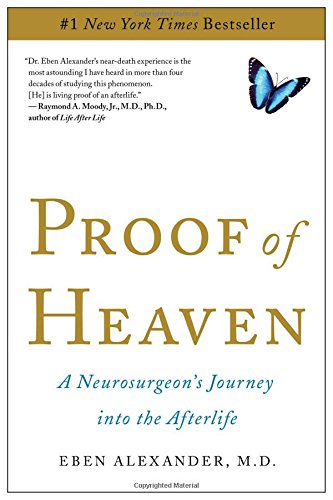
Eben Alexander: A Neurosurgeon's Journey through the Afterlife
Neurosurgeon Eben Alexander talks about his NDE while he had bacterial meningitis. Dr. Alexander has written about his experience in the remarkable book Proof of Heaven (for other similar books check out the Recommended Books page). The incredible rarity and severity of his illness, which wiped out not only his neocortex but brainstem as well, makes Dr. Alexander's experience a very strong case for the independence of consciousness from the physical structure and functioning of the brain. He explains more in this marvelous talk at the Theosophical Society.
Runs 98 minutes.
Runs 98 minutes.
Tuesday, February 14, 2017
The Supernatural with Richard Smoley
Fabulous talk from Thinking Allowed. Easily one of the best of the series.
Richard Smoley is editor of Quest: The Journal of the Theosophical
Society in America. He is also former editor of Gnosis Magazine. His
books include Hidden Wisdom: The Guide to the Western Inner Traditions,
Inner Christianity: The Guide to the Esoteric Tradition, Forbidden
Faith: The Secret History of Gnosticism, The Essential Nostradamus,
Conscious Love: Insights from Mystical Christianity, The Dice Game of
Shiva: How Consciousness Creates the Universe, The Supernatural:
Writings on an Unknown History, The Deal: A Guide to Radical and
Complete Forgiveness, and How God Became God: What Scholars Are Really
Saying About God and the Bible.
Here he notes that many of the
great spiritual teachers of the twentieth century (Blavatsky, Steiner,
Gurdjieff, Jung) had teachers who remain unknown. He suggests that this
reflects the desire of all these individuals to avoid the limelight of
public scrutiny. While describing most channeled material as “banal”, he
praises Jane Roberts’ Seth material as well as A Course in Miracles. He
reviews the history of Satanism and, paradoxically, associates it with
the objectivist philosophy of Ayn Rand. He also comments on the writings
of Aleister Crowley as well as tantra.
Richard Smoley is editor of Quest: The Journal of the Theosophical
Society in America. He is also former editor of Gnosis Magazine. His
books include Hidden Wisdom: The Guide to the Western Inner Traditions,
Inner Christianity: The Guide to the Esoteric Tradition, Forbidden
Faith: The Secret History of Gnosticism, The Essential Nostradamus,
Conscious Love: Insights from Mystical Christianity, The Dice Game of
Shiva: How Consciousness Creates the Universe, The Supernatural:
Writings on an Unknown History, The Deal: A Guide to Radical and
Complete Forgiveness, and How God Became God: What Scholars Are Really
Saying About God and the Bible.
Here he notes that many of the
great spiritual teachers of the twentieth century (Blavatsky, Steiner,
Gurdjieff, Jung) had teachers who remain unknown. He suggests that this
reflects the desire of all these individuals to avoid the limelight of
public scrutiny. While describing most channeled material as “banal”, he
praises Jane Roberts’ Seth material as well as A Course in Miracles. He
reviews the history of Satanism and, paradoxically, associates it with
the objectivist philosophy of Ayn Rand. He also comments on the writings
of Aleister Crowley as well as tantra.
Saturday, December 24, 2016
Blood Miracle Forecasts Bad Omen
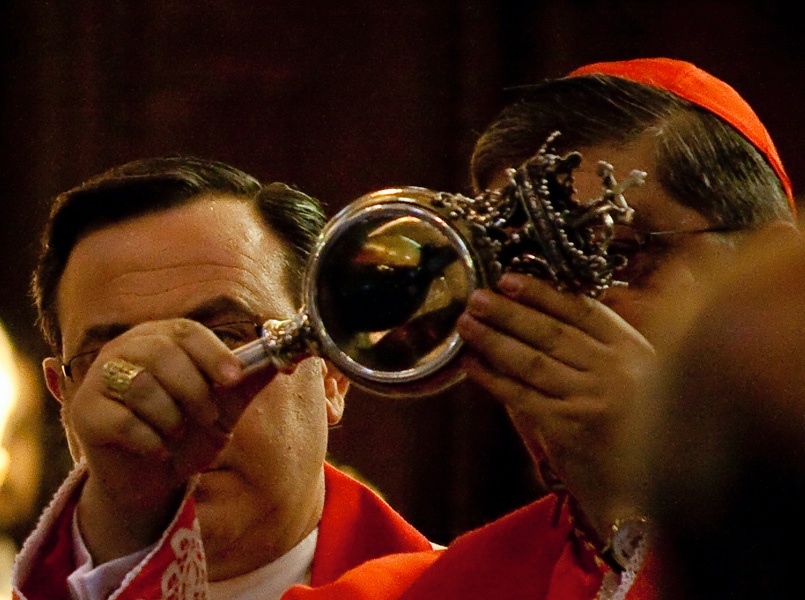
Cardinal Crescenzio Sepeial holding the vial containing Saint Januarius' blood.
Photo Credit:
Paola Magni
The vial containing the blood of Saint Januarius failed to liquefy. Just who is Saint Januarius, and why is this issue with his blood important? Here's the story, from Michael Talbot's Holographic Universe (p. 119-120):
"Every year in September and May a huge crowd gathers at the Duomo San Gennaro, the principal cathedral of Naples, to witness a miracle. The miracle involves a small vial containing a brown crusty substance alleged to be the blood of San Gennaro, or St. Januarius, who was beheaded by the Roman emperor Diocletian in A.D. 305. According to legend, after the saint was martyred a serving woman collected some of his blood as a relic. No one knows precisely what happened after that, save that the blood didn't turn up again until the end of the thirteenth century when it was ensconced in a silver reliquary in the cathedral.
"The miracle is that twice yearly, when the crowd shouts at the vial, the brown crusty substance changes into a bubbling, bright red liquid. There is little doubt that the liquid is real blood. in 1902 a group of scientists from the University of Naples made a spectroscopic analysis of the liquid by passing a beam of light through it, verifying that it was blood. Unfortunately, because the reliquary containing the blood is so old and fragile, the church will not allow it to be cracked open so that other tests can be done, and so the phenomenon has never been thoroughly studied.
"But there is further evidence that the transformation is a more than ordinary event. Occasionally throughout history (the first written account of the public performance of the miracle dates back to 1389) when the vial is brought out, the blood refuses to liquefy. Although rare, this is considered a very bad omen by the citizens of Naples. In the past, the failure of the miracle has directly preceded the eruption of Vesuvius and the Napoleonic invasion of Naples. More recently, in 1976 and 1978, it presaged the worst earthquake in Italian history and the election of a communist city government in Naples, respectively.
"Is the liquefaction of San Gennaro's blood a miracle? It appears to be, at least in the sense that it seems impossible to explain by known scientific laws." [emphasis added]
Skep-dicks have claimed the substance in the vial is a thixotropic gel containing iron oxide. Of course, they've produced bullshit stunts where they've created a similar substance that liquefies when shaken, but that's not proof of anything. A ventriloquist can reproduce the effect of voices coming out of a radio but that doesn't mean that radios are fake. Just because an effect can be reproduced through other means doesn't in any way indicate that those are the only means of producing the effect. There are many ways to produce powered flight, and there are many different types of light bulb, and all sorts of other phenomena can be produced in different ways. Magicians reproducing psychic phenomena does not in the least prove, or even provide evidence that psychic phenomena are fake. It's a confidence trick designed to subvert the rational mind.
From Live Science:
"The blood did not liquefy in 1939, when World War II broke out, nor in
1943, the year the Nazi occupied Italy, nor in 1973, remembered for a
bout of cholera in Naples. Most recently, it failed to liquefy in 1980,
when a devastating earthquake struck Irpinia, some 30 miles east of
Naples, leaving more than 2,400 people dead.
"According to the website storiacity.it,
over the centuries the failed miracle coincided with 22 epidemics, 11
revolutions, three droughts, 14 archbishops death (within a 30-day
period), nine dead popes (over a period of a few weeks), four wars, 19
earthquakes, and three religious persecutions."
The blood failed to liquefy again on the 16th of December this year. Every time the blood has failed to liquefy there has been some disaster.
That could mean one of two things:
1. The liquefaction of the blood is a genuine miracle and failure to liquefy really does portend bad omens.
2a. The liquefaction of the blood is a psychic phenomena involving the collective consciousness of the people of Naples to see into the future and predict when calamities are about to occur.
2b. The blood is fake but unconscious precognition is still involved. Either the priests and other church officials psychically sense the future and purposefully do some trick to keep the fake substance a solid to warn the public, or the collective consciousness of the people of Naples keeps the fake substance a solid because of unconscious precognition.
The skep-dicks have no legs to stand on. The failure of the substance to liquefy has always coincided with disasters. It doesn't matter what is in the vial, blood or iron oxide gel, either a miracle or psychic powers are involved, because no matter what's in the vial, the substance itself or the people around it are still able to predict the future, something materialism says is impossible.
What does that mean for 2017? Let me just say that if I had any travel plans for Naples I would cancel them.
Thursday, October 6, 2016
Evidentiality of Spiritualist Mediumship with Stephen E. Braude
Part two of yesterday's interview. Does mediumship present better evidence for survival or for living agent psi?
Wednesday, October 5, 2016
Philosophy and Post-Mortem Survival with Stephen E. Braude
Stephen Braude discusses philosophical questions related to survival of consciousness. He brings up two interesting points. First, that we're thinking of "super psi" wrong (he prefers to call it "living agent psi"). Most people think of the "super" more like super hero rather than super glue. It is not psi above and beyond anything we have experienced before, it is just really good quality psi (the issue of some remarkably accurate remote viewers was brought up. Check out Joe McMoneagle's Memoirs of a Psychic Spy, now in the convenient book section, for some stories.). Second, survival necessitates super psi, in that deceased persons would need remarkable ESP abilities to communicate with one another and the living, and to know what the living are currently doing, since they lack the five physical senses.
Thursday, June 9, 2016
The Apports of Amyr Amiden with Stanley Krippner
A fantastic discussion with Stanley Krippner and Jeffrey Mishlove.
Stanley Krippner, Ph.D., professor of psychology at Saybrook University,
is a Fellow in five APA divisions, and past-president of two divisions
(30 and 32).
Here he describes his research in Brazil with an unusual spiritist
medium, Amyr Amiden, who had the ability to produce apports. Krippner
describes how his team observed over ninety instances of objects simply
appearing in mid-air and dropping to the ground in front of startled
observers. The objects included semi-precious stones, medallions, and
even jewelry. Many research papers were published regarding these
observations. Furthermore, the research team was able to record various
physiological, and geomagnetic, measurements while the phenomena
occurred. Krippner’s studies are probably the most extensive, scientific
observations of apports on record.
Runs 30 minutes
Stanley Krippner, Ph.D., professor of psychology at Saybrook University,
is a Fellow in five APA divisions, and past-president of two divisions
(30 and 32).
Here he describes his research in Brazil with an unusual spiritist
medium, Amyr Amiden, who had the ability to produce apports. Krippner
describes how his team observed over ninety instances of objects simply
appearing in mid-air and dropping to the ground in front of startled
observers. The objects included semi-precious stones, medallions, and
even jewelry. Many research papers were published regarding these
observations. Furthermore, the research team was able to record various
physiological, and geomagnetic, measurements while the phenomena
occurred. Krippner’s studies are probably the most extensive, scientific
observations of apports on record.
Runs 30 minutes
Tuesday, April 5, 2016
My Problems with Spiritualists
I usually have two problems with most spiritualists. First to clarify, when I say "spiritualist" I categorically DO NOT mean people who say they are "spiritual but not religious." I've already written at length my distaste for those people. Spiritualism is the belief that spirit exists distinct from matter (or within some realm of more rarefied subtle matter or etheric or astral matter) and can be contacted through mediums. And this has been tested scientifically and there are really only two possible options to explain the data:
1. The Survival Hypothesis. The minds and personalities of people survive death of the body in pretty much the same state as when they were alive and they can communicate, at least at a rudimentary level, with the living.
or
2. The Super-ESP Hypothesis. The minds of certain living people are capable of extraordinary feats of ESP bordering on omniscience, whereby they can access information about the deceased by reading the minds of multiple living people all over the world simultaneously and access other information through remote viewing of locked drawers, diaries, or other varied sources, often coming up with information that is not known to the bereaved person or persons and not verified until much later, all this coupled with a subconscious dissociative personality disorder that the medium believes with absolute conviction is a real deceased individual they are communicating with.
And that's it. And after 150 years of testing no one has devised an experiment to distinguish between the two conclusively for the unfortunate reason that all the scientists working on the problem are stuck trying to convince die-hard atheist materialists who serve as the gatekeepers of what is and is not officially sanctioned science that real information is being attained through psychic means.
You might think that's a false dilemma and decide to take the third option, but, to be honest, if you take the third option I question your intelligence and would be surprised you would even know what a false dilemma is or that you had the capacity to fully comprehend the issue.
3. The Demon-Haunted World. A class of non-physical (or astral) beings called demons exist and they are omniscient, or at least as intelligent as necessary to trick humans that they are deceased humans because God is an asshole and filled the universe with billions of demons who trick people because God is an asshole and wants to send 99.999% of people to suffer in Hell forever.
If you accept options 1 or 2 you are a rational person who has examined the evidence. If you accept option 3 you are a moron. If you reject them all and accept option 4, that it's all deliberate trickery from often Nobel Prize winning scientists who want to ruin their reputations by studying ghosts, you're either ignorant of the data or a cynical asshole and most likely never even bothered looking at the data because you reject it a priori.
As a side note, we can get into metaphysics, with astral and etheric and subtle energies and all that stuff some other time, and I know Ken Wilber has talked down the issue and has promoted his "Integral Post-Metaphysics" and Kant's critique of metaphysics, but if you read Excerpt G (page 46), Ken does admit to true metaphysics within his model:
" The fact that the subtle (and causal) bodymind can transmigrate the gross bodymind is indeed metaphysical; but the fact that these subtle energies are postulated as real, concrete, detectable, often measurable—if subtler—energies, stops the whole conception from spinning off into the vaporware of pure metaphysics. If you read hypothesis #4 in conjunction with the first three hypotheses, I think you will see that they are at least consistent with each other; and thus I believe that an integral theory of subtle energies can accommodate the existence of transmigration, if we decide, on other grounds, that there is enough evidence to conclude that transmigration occurs."
It's a good read, but if you're in a hurry you can watch this video.
Getting back to the central issue of what my problems with spiritualists are.
The first problem is the denial of the good that other religions (specifically Christianity and to a lesser extent Buddhism) have and continue to bring to humanity. I wouldn't say this is the hatred of religion, as we see in the "spiritual but not religious" people (except Islam, which they adore), and it probably is not cultural relativism either that says "all religions are equal" or some such nonsense. It might be a sort of spiritual myopia. They are so invested in the truth claims of their own beliefs – the messages delivered by spirits – that they reject out of hand the truth claims of opposing beliefs. So, for example, if spirits say reincarnation does not exist they will believe it without hesitation even though the spirit they are communicating with might be lying or ignorant or both. A second possibility is similar to when you're a teenager and you're embarrassed by what you did as a child, which is basically how climbing the developmental ladder works all through first tier. First tier stages (archaic, magic, mythic, rational, pluralistic, or egocentric, ethnocentric, worldcentric, or any other conceptions) are all exclusive in their thinking. Someone who is ethnocentric looks down on someone who is egocentric (and on someone who is worldcentric), just as someone who is worldcentric looks down on someone who is egocentric and someone who is ethnocentric, even though they themselves necessarily had to pass through all the lower stages to get to where they are. This continues, quite naturally, until one reaches second tier – integral – and can appreciate that all levels have truth and utility appropriate for people at that level.
So, someone who is a spiritualist would reject the truth and utility of organised religion even though for the vast majority of people who have ever lived organised religion is the only thing keeping them from stealing and killing and raping. Religion not only serves as a social glue, it serves as the only affective social glue that has ever been discovered. And since everyone starts out at square one when they are born and has to learn reason and morality, eliminating religion is a particularly bad idea because until people mature to the level where they can apply reason to appreciate natural law and morality (which for most people is never), religion is necessary to keep people from becoming monsters.
Sometimes, yes, religions do influence people to become monsters, particularly lower level religions, but certainly Christianity has had its reformation and the worst Christians you will ever likely encounter are assholes who protest soldiers' funerals.
Aside from legitimacy, religion provides the only affective means of bringing people enlightenment. This ties into the second problem I have with most spiritualists, which is something I'll call subtle reductionism, what Ken Wilber calls the Vishnu Complex. I'll get to that in a minute.
One of the central beliefs of spiritualists is the extreme gradualist approach to development, that spirits develop astronomically slowly, though inexorably, over gazillions of years to reach ultimate perfection. If I could spend fifty trillion eons in an astral heaven where my thoughts instantly manifest my desires I'd say that's a pretty good deal. The general idea is that it gets boring after a time and then you decide to progress. And I'll admit, after the hell and hardship of this life I might look forward to some downtime.
The classic counter to this, which makes sense to me, is the argument of reincarnationists that once your merit is worn out you have to come back here, so the astral worlds are temporary. The only way out of the cycle is enlightenment. The idea of progression through infinitely more rarefied realms does have somewhat of a parallel with the idea of a pure land in Buddhism or Sri Yukteswar's Hiranyaloka from Autobiography of a Yogi. You can progress to a special astral world where the infinite merit and compassion of an enlightened being permits you to progress spiritually without the need to reincarnate.
Now you might not want to believe in reincarnation, and I think most spiritualists don't, for the pretty thoughtless reason "Who would want to come back?!" Very few people, I suspect, would want to come back, but the traditions maintain that it's more like jumping off a cliff. Once you jump you don't get to choose whether you fall down or not, gravity will take over automatically. You don't get to choose whether you reincarnate or not, unless you're already enlightened, your spiritual gravity pulls you unconsciously where you are most suited, and for most people that's back here on Earth. Even if you don't believe in reincarnation, and I think it makes a certain degree of sense, there's still one more reason to see the gradualist approach as not all that's great.
The gradualist approach really does not solve the problem of suffering in this life, it defers it to the next. There is a bit of an inherent laziness to it. "If I'm going to get there anyway I might as well take my time." That is very similar to the traditional religious approach of suffering through life with the knowledge of a reward in the afterlife. The idea of a metaphysical safety net is certainly comforting and has served humanity very well for millennia, but it does not bring about true transpersonal development. Even in an astral heaven there is still self and other, there is still separation, and where there is separation there is suffering. That is why spirits choose to leave the lower astral heavens, often called "Summerland", where thoughts manifest instantly, because it gets boring after a while. The types of suffering in astral worlds are radically different than in the physical world (and in the astral hells are much worse), but as long as separation exists suffering necessarily exists. Enlightenment is the only way out, and religion provides the only door to enlightenment.
That brings us to my second objection, subtle reductionism, which is nothing other than the denial of the causal. Subtle reductionism is nowhere near as disastrous as the gross reductionism of fundamaterialists, it is definitely a step in the right direction, but in denying the existence of the causal one is also denying the ultimate end of suffering.
Basically the subtle realms work like psychotherapy. One reaches an end of psychotherapy when one realises that one can go on forever. The subtle realms are like that. You ascend higher and higher, into ever more subtle planes of illumination and bliss, and it just doesn't stop. There is no upward limit, there is no ultimate end. In meditation people can spend a lifetime just getting to more rarefied states and just bliss-out and as soon as they come down and have to go to work they are the same jerk as they were from day one. You can certainly gain psychic powers through forms of meditation, but if you just keep ascending through all the essential lights and sounds you will not reach enlightenment. This inertial desire to keep ascending through the subtle is what Ken Wilber calls the Vishnu Complex. You are so enamored with God you don't want to seek your true identity. And since you have to stop meditating eventually you will suffer when it ends. As long as separation exists suffering necessarily exists. And that's all the gradualist approach of most spiritualists promises, ever higher states of lights and sounds.
This denial of the causal is wonderfully presented in Greg Stone's book Under the Tree. It's a pretty obscure book, so I'll explain it a little. This man with a punny name encounters ice on the highway and runs his car off a cliff and goes into a coma. He has a near death experience that spends a great many pages just trying to convince him he really is dead, since he doesn't believe in an afterlife, and then it goes off into explaining how the universe works.
Mr. Pun's spirit guide explains to him why all the religions are wrong when they say that we are all one. You see, we really are all separate, but when you incarnate on the Earth you have to pass through a filter, and that filter only lets one soul through at a time, and since we all have to squeeze through that filter we think, "Oh, only one can fit, so there must be only one of us," but that's just faulty logic.
Except that's not what any religion says at all. Remember, you do not automatically become enlightened upon death. If you did there would be absolutely no point to life here on Earth at all. It would all be a waste of time and you could be a child rapist or an axe murderer and it wouldn't matter because we all go up into light and bliss when we die anyway. That's exactly the same horrible belief as the materialists who say you die and rot, just in the opposite direction. If nothing you do in this life has any impact on the next, and we're all just here to learn lessons, or to experience suffering, or because it's rousing good fun, then life truly is meaningless and you might as well just shoot heroin all day, because it won't make one bit of difference. If Hitler and his victims go to the same place after death then the universe is completely lacking in justice or compassion and was created and run by Satan.
Since you do not become enlightened upon death (and we know this because spirits coming through mediums admit to it; they admit to not knowing everything), then anything you hear from spirits about anything other than their particular state of being is just their own guess. If spirits tell you they enjoy coffee and cigars and fine velvet arm chairs on the other side, then you can believe them. If spirits tell you what is happening at the ultimate level, and that they know with absolute certainty how everything works and the mechanisms of reincarnation or whatever, they're either outright lying or they are guessing. Since the personality remains intact then a liar on the Earth is a liar in the afterlife, and subconscious biases and fears still cloud one's thinking.
One group of people we can believe are enlightened individuals on this Earth, because they all say the same exact thing. There is no guessing with enlightenment, there is just experience, or more accurately lack of experience. In the causal there is nothing arising. There are no separate things, just consciousness as such. Nothing bad arises to torture you and leave, nothing good arises to torture you when it leaves, there are no others, there is no you, there just is. And they all say this, for the past 3000 years, they all say this. No one is guessing since this is not speculation of what is happening at higher levels because all levels have been left behind. You step off the ride completely.
Ramakrishna explains this beautifully. He was a life-long devote of Kali, and he would go into spontaneous ecstasy and be engrossed in her image. When he met the naked swami Totapuri and tried to learn Advaita he kept seeing Kali when he meditated. Furious, Totapuri stuck a piece of broken glass between Ramakrishna's eyes and admonished him to meditate on that spot. The next time Ramakrishna meditated he says "As soon as the gracious form of the Divine Mother appeared before me, I used my discrimination as a sword and with it clove Her in two. The last barrier fell. My spirit at once soared beyond the relative plane. I lost myself in samadhi." (The Gospel of Sri Ramakrishna, page 49)
You can see a wonderful depiction of this from the 1955 Bengali film biography of Ramakrishna.
And it's like that for everyone. Ramana Maharshi, Richard Rose, Ken Wilber, everyone. You too can check it out for yourself. I did. You do not need to take anyone's word for it, you need accept no beliefs handed to you from spirits, you can meditate for a really long time and see for yourself if enlightenment is all it's cracked up to be. You don't need to consult mediums, you don't need to wait countless eons to ascend higher planes in the afterlife, you can do this right now, in this lifetime, and it is the single most important thing you ever will, or can, do.
There is nothing in the causal. It is completely empty. If ascending higher subtle realms is like climbing stairs to higher and higher floors in a building, then the leap to the causal would be like going from the third to the fourth dimension. It's not higher than the highest floor in the building, it bypasses height all together. It is not getting to the next level in a video game, it's shutting the game off and realising that it was a game all along and not real. It's not that there is no you, there is only me, there's no me either. You step into the causal and no one is home, there is just consciousness as such. There is awareness but it is in no way tied to any identity, and you realise that any identity you held was just a contraction of all that is, no more real than the characters in a movie are to the actors who play them.
All that said, spiritualists are leagues ahead of the average person in the world today, and light years ahead of the fundamaterialists who are the elites who run the world and act as gatekeepers to what is and is not science. I would love for all the world to adopt the beliefs of spiritualists, I would love for mediumship to be taken seriously, for psychical studies to become the paramount branch of science. It would solve very nearly all the world's problems. At the same time it is imperative to realise that mediumship can only take one so far, and that we all must take up the discipline and strive toward enlightenment, whether now or in some future life. The comfort value of survival wears off once you survive death. Then a whole new set of challenges arise that you must face. Psychological challenges from all the subconscious baggage you have accumulated over this and possibly other lifetimes. All that needs to be worked through eventually. The choice is yours to deal with it over the next gazillion years or right now, all at once, in this lifetime. Most people can't, but you definitely should try. Try as if your life depended on it.
1. The Survival Hypothesis. The minds and personalities of people survive death of the body in pretty much the same state as when they were alive and they can communicate, at least at a rudimentary level, with the living.
or
2. The Super-ESP Hypothesis. The minds of certain living people are capable of extraordinary feats of ESP bordering on omniscience, whereby they can access information about the deceased by reading the minds of multiple living people all over the world simultaneously and access other information through remote viewing of locked drawers, diaries, or other varied sources, often coming up with information that is not known to the bereaved person or persons and not verified until much later, all this coupled with a subconscious dissociative personality disorder that the medium believes with absolute conviction is a real deceased individual they are communicating with.
And that's it. And after 150 years of testing no one has devised an experiment to distinguish between the two conclusively for the unfortunate reason that all the scientists working on the problem are stuck trying to convince die-hard atheist materialists who serve as the gatekeepers of what is and is not officially sanctioned science that real information is being attained through psychic means.
You might think that's a false dilemma and decide to take the third option, but, to be honest, if you take the third option I question your intelligence and would be surprised you would even know what a false dilemma is or that you had the capacity to fully comprehend the issue.
3. The Demon-Haunted World. A class of non-physical (or astral) beings called demons exist and they are omniscient, or at least as intelligent as necessary to trick humans that they are deceased humans because God is an asshole and filled the universe with billions of demons who trick people because God is an asshole and wants to send 99.999% of people to suffer in Hell forever.
If you accept options 1 or 2 you are a rational person who has examined the evidence. If you accept option 3 you are a moron. If you reject them all and accept option 4, that it's all deliberate trickery from often Nobel Prize winning scientists who want to ruin their reputations by studying ghosts, you're either ignorant of the data or a cynical asshole and most likely never even bothered looking at the data because you reject it a priori.
As a side note, we can get into metaphysics, with astral and etheric and subtle energies and all that stuff some other time, and I know Ken Wilber has talked down the issue and has promoted his "Integral Post-Metaphysics" and Kant's critique of metaphysics, but if you read Excerpt G (page 46), Ken does admit to true metaphysics within his model:
" The fact that the subtle (and causal) bodymind can transmigrate the gross bodymind is indeed metaphysical; but the fact that these subtle energies are postulated as real, concrete, detectable, often measurable—if subtler—energies, stops the whole conception from spinning off into the vaporware of pure metaphysics. If you read hypothesis #4 in conjunction with the first three hypotheses, I think you will see that they are at least consistent with each other; and thus I believe that an integral theory of subtle energies can accommodate the existence of transmigration, if we decide, on other grounds, that there is enough evidence to conclude that transmigration occurs."
It's a good read, but if you're in a hurry you can watch this video.
Getting back to the central issue of what my problems with spiritualists are.
The first problem is the denial of the good that other religions (specifically Christianity and to a lesser extent Buddhism) have and continue to bring to humanity. I wouldn't say this is the hatred of religion, as we see in the "spiritual but not religious" people (except Islam, which they adore), and it probably is not cultural relativism either that says "all religions are equal" or some such nonsense. It might be a sort of spiritual myopia. They are so invested in the truth claims of their own beliefs – the messages delivered by spirits – that they reject out of hand the truth claims of opposing beliefs. So, for example, if spirits say reincarnation does not exist they will believe it without hesitation even though the spirit they are communicating with might be lying or ignorant or both. A second possibility is similar to when you're a teenager and you're embarrassed by what you did as a child, which is basically how climbing the developmental ladder works all through first tier. First tier stages (archaic, magic, mythic, rational, pluralistic, or egocentric, ethnocentric, worldcentric, or any other conceptions) are all exclusive in their thinking. Someone who is ethnocentric looks down on someone who is egocentric (and on someone who is worldcentric), just as someone who is worldcentric looks down on someone who is egocentric and someone who is ethnocentric, even though they themselves necessarily had to pass through all the lower stages to get to where they are. This continues, quite naturally, until one reaches second tier – integral – and can appreciate that all levels have truth and utility appropriate for people at that level.
So, someone who is a spiritualist would reject the truth and utility of organised religion even though for the vast majority of people who have ever lived organised religion is the only thing keeping them from stealing and killing and raping. Religion not only serves as a social glue, it serves as the only affective social glue that has ever been discovered. And since everyone starts out at square one when they are born and has to learn reason and morality, eliminating religion is a particularly bad idea because until people mature to the level where they can apply reason to appreciate natural law and morality (which for most people is never), religion is necessary to keep people from becoming monsters.
Sometimes, yes, religions do influence people to become monsters, particularly lower level religions, but certainly Christianity has had its reformation and the worst Christians you will ever likely encounter are assholes who protest soldiers' funerals.
Aside from legitimacy, religion provides the only affective means of bringing people enlightenment. This ties into the second problem I have with most spiritualists, which is something I'll call subtle reductionism, what Ken Wilber calls the Vishnu Complex. I'll get to that in a minute.
One of the central beliefs of spiritualists is the extreme gradualist approach to development, that spirits develop astronomically slowly, though inexorably, over gazillions of years to reach ultimate perfection. If I could spend fifty trillion eons in an astral heaven where my thoughts instantly manifest my desires I'd say that's a pretty good deal. The general idea is that it gets boring after a time and then you decide to progress. And I'll admit, after the hell and hardship of this life I might look forward to some downtime.
The classic counter to this, which makes sense to me, is the argument of reincarnationists that once your merit is worn out you have to come back here, so the astral worlds are temporary. The only way out of the cycle is enlightenment. The idea of progression through infinitely more rarefied realms does have somewhat of a parallel with the idea of a pure land in Buddhism or Sri Yukteswar's Hiranyaloka from Autobiography of a Yogi. You can progress to a special astral world where the infinite merit and compassion of an enlightened being permits you to progress spiritually without the need to reincarnate.
Now you might not want to believe in reincarnation, and I think most spiritualists don't, for the pretty thoughtless reason "Who would want to come back?!" Very few people, I suspect, would want to come back, but the traditions maintain that it's more like jumping off a cliff. Once you jump you don't get to choose whether you fall down or not, gravity will take over automatically. You don't get to choose whether you reincarnate or not, unless you're already enlightened, your spiritual gravity pulls you unconsciously where you are most suited, and for most people that's back here on Earth. Even if you don't believe in reincarnation, and I think it makes a certain degree of sense, there's still one more reason to see the gradualist approach as not all that's great.
The gradualist approach really does not solve the problem of suffering in this life, it defers it to the next. There is a bit of an inherent laziness to it. "If I'm going to get there anyway I might as well take my time." That is very similar to the traditional religious approach of suffering through life with the knowledge of a reward in the afterlife. The idea of a metaphysical safety net is certainly comforting and has served humanity very well for millennia, but it does not bring about true transpersonal development. Even in an astral heaven there is still self and other, there is still separation, and where there is separation there is suffering. That is why spirits choose to leave the lower astral heavens, often called "Summerland", where thoughts manifest instantly, because it gets boring after a while. The types of suffering in astral worlds are radically different than in the physical world (and in the astral hells are much worse), but as long as separation exists suffering necessarily exists. Enlightenment is the only way out, and religion provides the only door to enlightenment.
That brings us to my second objection, subtle reductionism, which is nothing other than the denial of the causal. Subtle reductionism is nowhere near as disastrous as the gross reductionism of fundamaterialists, it is definitely a step in the right direction, but in denying the existence of the causal one is also denying the ultimate end of suffering.
Basically the subtle realms work like psychotherapy. One reaches an end of psychotherapy when one realises that one can go on forever. The subtle realms are like that. You ascend higher and higher, into ever more subtle planes of illumination and bliss, and it just doesn't stop. There is no upward limit, there is no ultimate end. In meditation people can spend a lifetime just getting to more rarefied states and just bliss-out and as soon as they come down and have to go to work they are the same jerk as they were from day one. You can certainly gain psychic powers through forms of meditation, but if you just keep ascending through all the essential lights and sounds you will not reach enlightenment. This inertial desire to keep ascending through the subtle is what Ken Wilber calls the Vishnu Complex. You are so enamored with God you don't want to seek your true identity. And since you have to stop meditating eventually you will suffer when it ends. As long as separation exists suffering necessarily exists. And that's all the gradualist approach of most spiritualists promises, ever higher states of lights and sounds.
This denial of the causal is wonderfully presented in Greg Stone's book Under the Tree. It's a pretty obscure book, so I'll explain it a little. This man with a punny name encounters ice on the highway and runs his car off a cliff and goes into a coma. He has a near death experience that spends a great many pages just trying to convince him he really is dead, since he doesn't believe in an afterlife, and then it goes off into explaining how the universe works.
Mr. Pun's spirit guide explains to him why all the religions are wrong when they say that we are all one. You see, we really are all separate, but when you incarnate on the Earth you have to pass through a filter, and that filter only lets one soul through at a time, and since we all have to squeeze through that filter we think, "Oh, only one can fit, so there must be only one of us," but that's just faulty logic.
Except that's not what any religion says at all. Remember, you do not automatically become enlightened upon death. If you did there would be absolutely no point to life here on Earth at all. It would all be a waste of time and you could be a child rapist or an axe murderer and it wouldn't matter because we all go up into light and bliss when we die anyway. That's exactly the same horrible belief as the materialists who say you die and rot, just in the opposite direction. If nothing you do in this life has any impact on the next, and we're all just here to learn lessons, or to experience suffering, or because it's rousing good fun, then life truly is meaningless and you might as well just shoot heroin all day, because it won't make one bit of difference. If Hitler and his victims go to the same place after death then the universe is completely lacking in justice or compassion and was created and run by Satan.
Since you do not become enlightened upon death (and we know this because spirits coming through mediums admit to it; they admit to not knowing everything), then anything you hear from spirits about anything other than their particular state of being is just their own guess. If spirits tell you they enjoy coffee and cigars and fine velvet arm chairs on the other side, then you can believe them. If spirits tell you what is happening at the ultimate level, and that they know with absolute certainty how everything works and the mechanisms of reincarnation or whatever, they're either outright lying or they are guessing. Since the personality remains intact then a liar on the Earth is a liar in the afterlife, and subconscious biases and fears still cloud one's thinking.
One group of people we can believe are enlightened individuals on this Earth, because they all say the same exact thing. There is no guessing with enlightenment, there is just experience, or more accurately lack of experience. In the causal there is nothing arising. There are no separate things, just consciousness as such. Nothing bad arises to torture you and leave, nothing good arises to torture you when it leaves, there are no others, there is no you, there just is. And they all say this, for the past 3000 years, they all say this. No one is guessing since this is not speculation of what is happening at higher levels because all levels have been left behind. You step off the ride completely.
Ramakrishna explains this beautifully. He was a life-long devote of Kali, and he would go into spontaneous ecstasy and be engrossed in her image. When he met the naked swami Totapuri and tried to learn Advaita he kept seeing Kali when he meditated. Furious, Totapuri stuck a piece of broken glass between Ramakrishna's eyes and admonished him to meditate on that spot. The next time Ramakrishna meditated he says "As soon as the gracious form of the Divine Mother appeared before me, I used my discrimination as a sword and with it clove Her in two. The last barrier fell. My spirit at once soared beyond the relative plane. I lost myself in samadhi." (The Gospel of Sri Ramakrishna, page 49)
You can see a wonderful depiction of this from the 1955 Bengali film biography of Ramakrishna.
And it's like that for everyone. Ramana Maharshi, Richard Rose, Ken Wilber, everyone. You too can check it out for yourself. I did. You do not need to take anyone's word for it, you need accept no beliefs handed to you from spirits, you can meditate for a really long time and see for yourself if enlightenment is all it's cracked up to be. You don't need to consult mediums, you don't need to wait countless eons to ascend higher planes in the afterlife, you can do this right now, in this lifetime, and it is the single most important thing you ever will, or can, do.
There is nothing in the causal. It is completely empty. If ascending higher subtle realms is like climbing stairs to higher and higher floors in a building, then the leap to the causal would be like going from the third to the fourth dimension. It's not higher than the highest floor in the building, it bypasses height all together. It is not getting to the next level in a video game, it's shutting the game off and realising that it was a game all along and not real. It's not that there is no you, there is only me, there's no me either. You step into the causal and no one is home, there is just consciousness as such. There is awareness but it is in no way tied to any identity, and you realise that any identity you held was just a contraction of all that is, no more real than the characters in a movie are to the actors who play them.
All that said, spiritualists are leagues ahead of the average person in the world today, and light years ahead of the fundamaterialists who are the elites who run the world and act as gatekeepers to what is and is not science. I would love for all the world to adopt the beliefs of spiritualists, I would love for mediumship to be taken seriously, for psychical studies to become the paramount branch of science. It would solve very nearly all the world's problems. At the same time it is imperative to realise that mediumship can only take one so far, and that we all must take up the discipline and strive toward enlightenment, whether now or in some future life. The comfort value of survival wears off once you survive death. Then a whole new set of challenges arise that you must face. Psychological challenges from all the subconscious baggage you have accumulated over this and possibly other lifetimes. All that needs to be worked through eventually. The choice is yours to deal with it over the next gazillion years or right now, all at once, in this lifetime. Most people can't, but you definitely should try. Try as if your life depended on it.
Friday, November 20, 2015
Science and the Survival of Consciousness after Death
Dr. Bruce Greyson in a 2010 talk about survival of consciousness. Runs 42 minutes. Some of it seems familiar. Maybe there is overlap with the last presentation, maybe from another interview.
Thursday, July 16, 2015
A Tale of Two Rebirths
There are two main versions of the mechanics of reincarnation that I will call "old" and "new" for sake of simplicity.
The old system has been around for thousands of years. While the details differ slightly, it is the system of reincarnation taught primarily by Hindus and Buddhists, but also by some ancient Christian sects and in Judaism until about the fifteenth century. A good outline is provided in an essay by Ken Wilber called "Death, Rebirth, and Meditation". There exists some disagreement as to what survives and how long the whole process takes, but in general rebirth takes between 49 days and 200 years; some say personality and memories do not transmigrate and others do. All the differences are really pretty minor when viewed against the similarities regarding how the mechanism itself works. Human psychology is basically the same as what modern science has shown us. Our fears and addictions carry on with us where we have to deal with them in very real terms. Psychological traumas we suffer in this life must be dealt with in this life or the next, and if we cannot overcome our problems than we will be carried aloft by them into a new rebirth. Some say we meet up with people we've known in this life (or even other past lives) in the between life stage, and that certain souls transmigrate together, and others say we do this all alone, but every action in this life always has an equal reaction in the next. There is no escaping causality, the books must be balanced, full stop. We work through our troubles, gradually perfecting ourselves lifetime after lifetime until we finally break free from suffering all together and abide as Spirit forever.
In the new system, promulgated by certain spiritualist circles and "new age" movements, the whole old system is turned on its head. Rather than beginning in ignorance and spending lifetimes trying to end suffering, in the new system we all begin enlightened and we come to this life to experience suffering. Every soul is enlightened, we come to this world with a sort of willful amnesia, and when we die we are automatically restored to perfect knowledge. The lives we live are games we play with one another, and they don't really mean anything on the other side. When we die there is no balancing of good and bad deeds, because there is no good or bad, as we plan our lives out in minute details from the beginning. People who get raped or murdered make agreements with other souls who will be doing the raping and murdering, so there are no villains and victims, and not because the world is ultimately illusory, but because the world is a game we play for life experience. In the new system souls are basically masochists. You can't really know what something is like until you experience it first hand, so a soul living in perfection might have an idea what suffering is, but it doesn't really know until it experiences it for itself.
Why anyone would want to partake of such experiences I cannot understand. If I were Superman and I knew with absolute certainty I could never get hurt I still wouldn't care to know what it felt like to drive a car into a tree or get shot in the face. I wouldn't care to know what it was like to drown or get exploded. I wouldn't care to know what it was like to live in poverty on the streets, or for that matter what it would be like to live in a mansion eating lobster every day.
The new system is very distasteful and reeks of wish fulfillment. Imagine a group of souls floating around planning their next life together. One soul says to the others "I'll be the child and you'll be my parents. At age five, no four and a half, I'll get cancer and die and break your hearts. Then, fifty years of misery later, you'll die and we'll meet up back here and I'll point and laugh and say 'fooled ya!' Then, the next go around I'll be the parent and you two can be the children who die. It will be rousing great fun!" The idea infuriates me, to be honest. I think that's much worse than the materialist idea that when you're dead you're dead and there's no justice. I would much rather live in a universe where life is ultimately meaningless and there is no afterlife than have a universe where the Nazis made an agreement with the millions of people murdered in the Holocaust that the whole thing would be staged just to see what it would be like to gas eleven million people. Admittedly the grotesquery of such a scenario is not evidence that it is not true in itself, but it does not help the case either.
It is also not helped by the types of evidence that are available to support either system. The old system, which recapitulates everything we know from earthly psychology, is attested to through near death experiences that reveal our mental state and personalities are pretty much the same after death as before, and through spontaneously remembered past lives of children that often turn out to be phenomenally accurate when later investigated. Enlightened sages also attest to the veracity of the old system through the remembrance of their past lives.
The primary evidence for the new system is through hypnosis of adults, that sometimes does produce highly accurate results (which could be more akin to a form of remote viewing), but a lot of times these memories are false, crafted by the imagination of the subject and the leading of the hypnotist. The new system is also, sometimes, attested to by channeled material, but by no means all. Some channeled material flatly denies the existence of reincarnation, other spirits admit they don't know, and some affirm the old system. The spirits that talk about group souls, of instant enlightenment following death, of coming to Earth to experience things no sane person would ever want to experience such as disease, disasters, and war, and flat out deny the existence of good and evil, seem to me to be lower spirits. Whether malicious or simply tricksters (like Internet trolls of the spirit world), they will say whatever gets them the most attention, and earthly interlocutors receiving confirmation of their desires pass it along in books that say you can literally create your reality and that morality is for squares. As John admonishes in his first epistle, we are to test the spirits to see if they are of God. Anyone from the other side can say they are advanced spirits with brilliant insight into the workings of the universe, and that is why we must use our reason and intelligence to see if what they say makes sense.
In the light of the evidence and the moral implications I would have to say that if reincarnation does exist it seems far more likely that the old system with a gradual progression from ignorance to perfection is correct.
The old system has been around for thousands of years. While the details differ slightly, it is the system of reincarnation taught primarily by Hindus and Buddhists, but also by some ancient Christian sects and in Judaism until about the fifteenth century. A good outline is provided in an essay by Ken Wilber called "Death, Rebirth, and Meditation". There exists some disagreement as to what survives and how long the whole process takes, but in general rebirth takes between 49 days and 200 years; some say personality and memories do not transmigrate and others do. All the differences are really pretty minor when viewed against the similarities regarding how the mechanism itself works. Human psychology is basically the same as what modern science has shown us. Our fears and addictions carry on with us where we have to deal with them in very real terms. Psychological traumas we suffer in this life must be dealt with in this life or the next, and if we cannot overcome our problems than we will be carried aloft by them into a new rebirth. Some say we meet up with people we've known in this life (or even other past lives) in the between life stage, and that certain souls transmigrate together, and others say we do this all alone, but every action in this life always has an equal reaction in the next. There is no escaping causality, the books must be balanced, full stop. We work through our troubles, gradually perfecting ourselves lifetime after lifetime until we finally break free from suffering all together and abide as Spirit forever.
In the new system, promulgated by certain spiritualist circles and "new age" movements, the whole old system is turned on its head. Rather than beginning in ignorance and spending lifetimes trying to end suffering, in the new system we all begin enlightened and we come to this life to experience suffering. Every soul is enlightened, we come to this world with a sort of willful amnesia, and when we die we are automatically restored to perfect knowledge. The lives we live are games we play with one another, and they don't really mean anything on the other side. When we die there is no balancing of good and bad deeds, because there is no good or bad, as we plan our lives out in minute details from the beginning. People who get raped or murdered make agreements with other souls who will be doing the raping and murdering, so there are no villains and victims, and not because the world is ultimately illusory, but because the world is a game we play for life experience. In the new system souls are basically masochists. You can't really know what something is like until you experience it first hand, so a soul living in perfection might have an idea what suffering is, but it doesn't really know until it experiences it for itself.
Why anyone would want to partake of such experiences I cannot understand. If I were Superman and I knew with absolute certainty I could never get hurt I still wouldn't care to know what it felt like to drive a car into a tree or get shot in the face. I wouldn't care to know what it was like to drown or get exploded. I wouldn't care to know what it was like to live in poverty on the streets, or for that matter what it would be like to live in a mansion eating lobster every day.
The new system is very distasteful and reeks of wish fulfillment. Imagine a group of souls floating around planning their next life together. One soul says to the others "I'll be the child and you'll be my parents. At age five, no four and a half, I'll get cancer and die and break your hearts. Then, fifty years of misery later, you'll die and we'll meet up back here and I'll point and laugh and say 'fooled ya!' Then, the next go around I'll be the parent and you two can be the children who die. It will be rousing great fun!" The idea infuriates me, to be honest. I think that's much worse than the materialist idea that when you're dead you're dead and there's no justice. I would much rather live in a universe where life is ultimately meaningless and there is no afterlife than have a universe where the Nazis made an agreement with the millions of people murdered in the Holocaust that the whole thing would be staged just to see what it would be like to gas eleven million people. Admittedly the grotesquery of such a scenario is not evidence that it is not true in itself, but it does not help the case either.
It is also not helped by the types of evidence that are available to support either system. The old system, which recapitulates everything we know from earthly psychology, is attested to through near death experiences that reveal our mental state and personalities are pretty much the same after death as before, and through spontaneously remembered past lives of children that often turn out to be phenomenally accurate when later investigated. Enlightened sages also attest to the veracity of the old system through the remembrance of their past lives.
The primary evidence for the new system is through hypnosis of adults, that sometimes does produce highly accurate results (which could be more akin to a form of remote viewing), but a lot of times these memories are false, crafted by the imagination of the subject and the leading of the hypnotist. The new system is also, sometimes, attested to by channeled material, but by no means all. Some channeled material flatly denies the existence of reincarnation, other spirits admit they don't know, and some affirm the old system. The spirits that talk about group souls, of instant enlightenment following death, of coming to Earth to experience things no sane person would ever want to experience such as disease, disasters, and war, and flat out deny the existence of good and evil, seem to me to be lower spirits. Whether malicious or simply tricksters (like Internet trolls of the spirit world), they will say whatever gets them the most attention, and earthly interlocutors receiving confirmation of their desires pass it along in books that say you can literally create your reality and that morality is for squares. As John admonishes in his first epistle, we are to test the spirits to see if they are of God. Anyone from the other side can say they are advanced spirits with brilliant insight into the workings of the universe, and that is why we must use our reason and intelligence to see if what they say makes sense.
In the light of the evidence and the moral implications I would have to say that if reincarnation does exist it seems far more likely that the old system with a gradual progression from ignorance to perfection is correct.
Wednesday, May 20, 2015
Uri Geller's Tricks?
If y'all remember the early days of The Urban Mystic, there was probably the biggest, and maybe the only, controversey in Urban Mystic history when Bob Couttie tried to spam the site! I let him post his comment and then eight months later he posted the same comment and I deleted it and then he accused me of censorship. That led to some work by a reader/guest contributer countering Couttie's claims regarding Uri Geller and nitinol. I purchased a very old copy of Couttie's book (which is out of print), read it, and wrote a 16 page refutation that so far is up only in PDF format. One day I will turn it into a separate page on the site as well as a video series.
That was 2010. The crux of the matter is does Uri Geller use trickery to bend spoons or not? I don't have an answer, and I've made clear on The Urban Mystic many times that I think it could go either way. Some of his feats are probably tricks, but there is good evidence that he has genuine powers as well. Remember, Uri Geller became a multi millionaire not by bending spoons, but by dowsing for oil, and he has been very successful at finding oil and minerals just by pointing at spots on maps. There is also the experiments performed at SRI with dowsing that appear legitimate.
The reason I bring this up is that I have discovered a video of Bob Couttie talking about Uri Geller, with some evidence of what might be trickery. I'll leave any interpretation up to you, my valued couple of readers. Enjoy.
That was 2010. The crux of the matter is does Uri Geller use trickery to bend spoons or not? I don't have an answer, and I've made clear on The Urban Mystic many times that I think it could go either way. Some of his feats are probably tricks, but there is good evidence that he has genuine powers as well. Remember, Uri Geller became a multi millionaire not by bending spoons, but by dowsing for oil, and he has been very successful at finding oil and minerals just by pointing at spots on maps. There is also the experiments performed at SRI with dowsing that appear legitimate.
The reason I bring this up is that I have discovered a video of Bob Couttie talking about Uri Geller, with some evidence of what might be trickery. I'll leave any interpretation up to you, my valued couple of readers. Enjoy.
Sunday, April 5, 2015
Integral Christ
UPDATE: Integral Christ is now available in PDF format complete with additional pictures and about three errors corrected.
If the crucifixion took place in 33 AD then the day was today, 3 April. The last time Holy Week took place at the same time as the first Holy Week was 1942. The next time it will happen again is 2026. If my calculations are correct Jesus was killed 2 weeks before his 39th birthday.
On such an auspicious occasion, the first in the lives of probably most people who have ever visited The Urban Mystic (though I love my septuagenarian readers just as much, probably more), I will take this time to write a very special piece about the most famous man who ever lived.
Who was Jesus Christ? I've already written about his birth, about his life, the conspiracy to kill him, the resurrection, and the possibility that he visited India during those missing 18 years. What is left to write about?
How about the ways in which we interpret Jesus.
I listened to an audio program from Integral Life that was little more than a 45 minute commercial, but it got me thinking about the way people at different developmental levels interpret Jesus and what part of his life and teaching they may focus on.
We hear about magic stage Christianity focuses on Jesus as personal savior who can miraculously alter the world. A child's view of Jesus as a superhero who is there to save you. The miraculous is the focus at this stage; it is what convinces the believer.
Mythic Christianity would focus on Jesus as the Way the Truth and the Life. Jesus prescribes behavior and you have to obey, you have to accept Jesus as your personal savior or you'll go to Hell forever. This is the Christianity of the Crusaders and most of medieval Europe and even going into the Reformation. The difference between the old Catholic church and Luther's church was the interpretation of whether Jesus' Law included belief only or if acts of charity were needed to cement one's place in Heaven.
Rational Christianity, the Christianity of Thomas Jefferson, John Locke, Rene Descartes, and Isaac Newton. We have a God who is grand designer of the universe, and while Jesus is fully divine he is also fully human. Jesus is a wisdom teacher.
There's a pluralistic Christianity would deconstruct Jesus. It would be seen as unchristlike to say Jesus is the only way to God. Belief no longer needs to have any connection with truth, if truth even exists; belief is my own feeling about something and everyone has different, equally valid beliefs.
But what is integral Christianity? Who is the integral Jesus? This question may be too large even for this massive essay. To scale it back I'll focus on a much smaller scale.
The dialogue did ask four interesting questions about what would be included in an integral version of Christianity: Do you need the virgin birth? Do you need miracles? Do you need Jesus dying on the cross? and Do you need the resurrection?
Remember, the key feature of second tier is supposed to be to integrate all of first tier. We're supposed to look at everything that has come before and work it all together. Ken Wilber's working hypothesis is that no one is entirely wrong. Every level is right about some aspect of reality in some way. What I try to do is find what works at each level and put it all together, bridging the gaps, to create a unified whole. What the people over at Integral Life seem to do is talk about the lower levels and then take whatever Green-Post Modern says and declare it the truth of everything. There seems to be a very strong Green bias in the supposedly second tier integral community. But that's a topic for a different discussion. Right now what I will attempt to do is integrate all of first tier into a second tier version of Christianity. I will start by answering the four questions presented in the dialogue.
Now, I have absolutely no idea if Mary was a virgin or not prior to Jesus' birth. Mentioned in Matthew and Luke, the virgin birth went relatively unquestioned for most of the history of Christianity. Matthew makes reference to a prophecy from Isaiah that the messiah would be born of a virgin and he sees Jesus as fulfilling that prophecy. Why did Matthew and Luke tell different versions of the same story, and why did Mark and John not mention the virgin birth at all? We can excuse Paul because his central focus was the resurrection as the singular event in history in which sin and death were overcome, but is the silence from Mark and John any indication of anything?
It is not impossible for such an event as a virgin birth to occur. It has never been observed in mammals in the wild, but scientists have been able to tinker around with mice and rabbits, and in 2007 human embryos were created this way for use in stem cell research. God can do anything that a human can do, so technically God could turn the reptilian gene on and make a fatherless Jesus as a demonstration of sovereignty over nature. The biggest problem is that the offspring of such an event is always female. Again, however, it is possible to tinker with an X chromosome in the lab and create a Y chromosome from it, since they have homologous genes. It is technically possible for a scientist today to create a male embryo from the cells of just the mother, but no one has ever done this before and it doesn't happen in nature, which really would make it a miracle par excellence.
Did it happen? We can't say. Are we required to believe it happened? Well, if we follow what Paul says then technically no. A virgin birth is not a requirement for an integral Christianity.
Do we need miracles? Surprisingly they seem to agree that events that might be considered miraculous actually do happen. There are healers who use methods such as laying on hands and other energetic methods, and not only do they produce statistically significant results, but these alternative methods are sometimes even covered by insurance, so energy healing is not something on the fringe, it is acceptable medicine. Phenomena such as ESP and psychokinesis have been demonstrated to exist with greater scrutiny than any other field of science ever. Double-blind protocol was invented to study psychic phenomena, starting with Mesmerism (a form of hypnotism). Just as ancient people would consider an airplane magic if it were somehow transported back in time, it is safe to say that they would have considered psychic powers to be a form of magic or miracles.
Richard Rose, an iconoclastic physicist and engineer as well as a mystic, certainly accepted what he called "magic," which appears to include psychic phenomena. Looking at Ken Wilber's classification of the developmental levels it is possible that Richard Rose would have been considered third tier, meaning permanently ensconced in states of transpersonal awareness. Rose would almost certainly have been considered integrally developed, and he not only accepted the existence of psychic phenomena, but also demonic possession.
A lot of miracles in the New Testament definitely could be explained through psychic phenomena, albeit at a larger scale than what is seen in a laboratory setting. Miracles can indeed be a part of integral Christianity, and if we're using the word "miracle" as a pre-scientific term to mean "psychic phenomena" then the existence of miracles is already an established fact.
What about the crucifixion? Does integral Christianity need a crucifixion? Well, what exactly is the alternative? The dialogue brings up the swoon hypothesis. They say that people in the Gospels acted like Jesus was still alive. They say he was taken off after only six hours, his body was put in a tomb instead of left on the cross to rot like typically happens with criminals, that the herbs used to anoint the body were typically used to revive people and not to anoint the dead. People are acting like he isn't dead? Really? Only John mentions anything put on Jesus' body, and he says myrrh, aloe, and unnamed spices. Aloe is certainly used in medicine, and so is myrrh, but myrrh is also used in embalming the dead. But what about the swoon hypothesis? I have to say it is the most ridiculous alternative to crucifixion anyone has come up with. People have suggested it was a double who was crucified, some people say that the whole story was made up, some people even say that God replaced Jesus' body on the cross with Judas, but anyone who believes in the swoon hypothesis knows absolutely nothing about medicine.
Let us look at the Shroud of Turin, an object that realistically depicts what is mentioned in the Gospels. Jesus was scourged by a Roman flagrum. The man on the shroud has 120 such marks on his body. There have been people who have died from a few lashes from a regular whip back when capital punishment was legal in the West, in the British navy for example. A flagrum is about 50 times worse than a whip. A flagrum is like a whip with three strips of leather with iron barbells, nails, or broken glass tied to it, wielded by a professional killer. He had a crown of thorns placed on his head. His eye is swollen shut from the beating he received, his nose is broken. His shoulders were dislocated when he was crucified. The nails used in the crucifixion would have rendered his hands nonfunctional, not to mention the excruciating pain from putting pressure on the median nerve in the wrist. After six hours on the cross Jesus' heart would have been beating over 140 beats per minute, he would be near suffocating, dehydrated, exhausted, between 10-20% of his blood would have been lost. Then the Roman centurion thrust a spear through Jesus' side and "blood and water" poured out of the wound. This is a very telling remark from John. The heart is surrounded by a cushion of clear fluid. When the spear pierced Jesus' heart that clear fluid came out with the blood. It is doubtful that even professional executioners in the first century would have known about the existence of pericardial fluid. The fact that John mentions this is strong indication that he witnessed an actual event.
In order to complete the swoon hypothesis the Apostles would have needed to fool professional executioners that Jesus was dead. In the tomb they would have needed to treat wounds that would probably have been fatal even with modern emergency surgery. Jesus would have needed an emergency heart transplant, a blood transfusion, his shoulders would have had to been put back in place and his nose would have had to have been set. 36 hours later Jesus would have needed to roll an enormous stone away using his nonfunctional hands, overpower the guards standing outside the tomb, walk seven miles from outside Jerusalem to Emmaus, sneak into a locked room with no evidence of forced entry, and fool people including his Apostles and his own mother that he was resurrected and had conquered death and not a bloody and beaten mess who had barely escaped death. He would have had to convince people so thoroughly that 11 of the 12 Apostles would overcome their fear of the Romans and go to their death as martyrs to preach a Gospel they knew was a lie.
The swoon hypothesis is absolutely impossible. One thing is certain, the Romans were experts at killing people. If they said Jesus was dead then he was dead. He wasn't in a coma, he wasn't faking, he was absolutely dead.
The dialogue also mentions a supposed lack of documentary evidence of the crucifixion. Lack of documentary evidence? Josephus and Tacitus both say that a man named Jesus was crucified by the Romans. What do you want, a CNN video from 33 AD actually showing the nails going in?
The crucifixion is as close to an historical fact as we can get. We know from historical sources that a man named Jesus preached in Judea in the first century and he was crucified by the Romans. That is fact. If the crucifixion isn't part of integral Christianity that's just plain denying fact. That would be like integral chemistry denying the existence of atoms.
Now we come to the big one. Does integral Christianity need the resurrection? The men in the dialogue dodge produce yet another flippant response. They say something like "Well I don't care, 'he died for my sins', that doesn't mean anything to me." Not only did they dodge the question, I also suspect they enjoy sinning. I mean sinning is fun, at the time, but I suspect they don't repent afterward.
But the answer to the question is an unequivocal yes. You don't need to believe in the resurrection to practice Jesus' teachings, you don't need to believe to accept the existence of an historical Jesus, but to be a Christian the central tenant is belief in the resurrection. That is nonnegotiable. Paul says that there can be no Christianity without the resurrection and that if the resurrection did not happen we should immediately through Christianity out because it is false:
But if there be no resurrection of the dead, then is Christ not risen: And if Christ be not risen, then is our preaching vain, and your faith is also vain. Yea, and we are found false witnesses of God; because we have testified of God that he raised up Christ: whom he raised not up, if so be that the dead rise not. For if the dead rise not, then is not Christ raised: And if Christ be not raised, your faith is vain; ye are yet in your sins. (1 Cor 15:13-17)
Who am I going to believe, Paul, the inventor of Christianity, as the man who took a small following of an obscure Jewish teacher and made it a world religion everyone can belong to, or some guy in 2015 who doesn't even care about the concept of sin?
Here's what Richard Rose has to say:
"Evidently Jesus was able to come back and get his body, since the body disappeared from the grave, and later reappeared on the road to Emmaus. This does not prove that Jesus escaped physically from the grave, but could imply that the spirit of Jesus was able to simulate a body and to discard the mask at will.
"To say that a personality has found a means to travel from one dimension to another and to be seen in both is not unreasonable, although it implies a special talent. The SRF (Self Realization Fellowship) movement claims that some of its masters were avatars who had the ability to come and go between the spiritual planes and they were also reputed to have extensive creative ability. This brings us to the word illusion, for many believe this world to be one of illusion and that some liberated spirits are able to evoke the illusion at will." (The Albigen Papers, p. 84)
Rose is speaking of chapter 43 from Autobiography of a Yogi. Yogananda's guru Yukteswar Giri had died and his body was buried and then a few days later he reappeared in physical form before Yogananda to console him and teach a valuable lesson about life and death:
"Angelic guru," I said, "your body looks exactly as it did when last I wept over it in the Puri ashram."
"O yes, my new body is a perfect copy of the old one. I materialize or dematerialize this form any time at will, much more frequently than I did while on earth. By quick dematerialization, I now travel instantly by light express from planet to planet or, indeed, from astral to causal or to physical cosmos." My divine guru smiled. "Though you move about so fast these days, I had no difficulty in finding you at Bombay!" (Quote taken from the original public domain version, which I have as a text file, so I unfortunately can't say what page it came from.)
What about A Course in Miracles? If we look at the unpublished "Special Messages" section the Voice (identified as Jesus Christ) says the following about the resurrection:
My body disappeared because I had no illusion about it. The last one had gone. It was laid in the tomb, but there was nothing left to bury. It did not disintegrate because the unreal cannot die. It merely became what it always was. And that is what “rolling the stone away” means. The body disappears, and no longer hides what lies beyond. It merely ceases to interfere with vision. To roll the stone away is to see beyond the tomb, beyond death, and to understand the body’s nothingness. What is understood as nothing must disappear.
I did assume a human form with human attributes afterwards, to speak to those who were to prove the body’s worthlessness to the world. This has been much misunderstood. I came to tell them that death is illusion, and the mind that made the body can make another since form itself is an illusion. They did not understand. But now I talk to you and give you the same message. The death of an illusion means nothing. It disappears when you awaken and decide to dream no more. And you still do have the power to make this decision as I did.
Is resurrection even possible? Resurrection, not mere revival of the body. Both Richard Rose and Paramhansa Yogananda seem to think so. And you may think to yourself, sure Rose and Yogananda may, may, have had a center of gravity in third tier, but Yogananda could still have been cognitively at amber and Rose at orange, or whatever. You might say that the Course was written by Hellen Schucman subconsciously, and she might have been at orange or maybe green, who knows.
Someone with a cognitive level of teal or turquoise, even someone at green, would see this is all a myth, it's impossible, the resurrection is a holdover from a mythic consciousness and it's really symbolic of our spiritual resurrection within Christ consciousness. The death of the separate self sense and the resurrection into nondual spirit as such. This also achieves the conquest of sin, because from a nondual perspective there is no sin. Nonduality transcends good and evil (unfortunately most people today misinterpret the nondual traditions and instead of transcending anything just act egotistically and think they are transcending good and evil). Sin is entirely a product of the separate self, so when we die to the separate self we are eliminating sin. And that's fine. I don't disagree with that interpretation. It is lovely symbolism and capable of producing profound spiritual experiences.
But my question is is it possible for an integral Christianity to include a bodily resurrection of Jesus? I've presented eye-witness testimony of resurrection and spiritual communication. Now let's take another look at the Shroud of Turin. I keep bringing up the Shroud because I think it is strong evidence in favor of the resurrection of Jesus Christ. If we are able to overcome the speculation that it is a forgery then we are left with what appears to me to be two possibilities: that the Shroud was formed through some unknown natural process related to the decomposition of a body that has never been seen before or since, or that the Shroud is a relic of a miracle, a physical testimony to the the ultimate event in history.
The evidence that the shroud is not a forgery is very strong. The first piece of evidence is the dating. One sample from the Shroud of Turin was taken and dated. First off, testing one sample proves nothing. Second, the sample was taken from a corner where a repair was made. The radio carbon date of the sample is off because it did not come from an original part of the cloth.
Next we have an illumination from a Hungarian manuscript the Pray Codex.

The illumination depicts a crucified man who looks like the man in the Shroud with his thumbs retracted (because the nails damaged the nerve) – medical knowledge a medieval monk would not have known. The picture also depicts the man on a cloth with a similar weave as the Shroud, and an L-shaped series of burn marks in the same place as on the Shroud. Crucially, this manuscript was made almost a century prior to the earliest date attested to by the carbon 14 testing of the Shroud. This is strong evidence against the Shroud being a medieval forgery.
Then comes the list of high improbabilities; things that no medieval artist should know or would even think about.
● The blood stains – which have been tested and are real human blood – have no image underneath them. That means the blood was placed on the cloth first and the image created afterward. The forger would need to know exactly where to place the blood, correctly depicting the flow of gravity around a three dimensional body, both when held vertical during the crucifixion, and then later when the body was horizontal within the tomb, and then paint over it.
● The forger would need to know what an authentic Roman scourging looked like to produce an accurate representation.
● The forger would need to know what an authentic Roman crucifixion looked like, including putting the nails in the wrists and not the palms, as was the tradition during the middle ages. The forger would have needed to know that the thumbs would retract from the injury.
● The forger would need to put Jerusalem pollen on the cloth to fool 20th century scientists who would conduct microchemistry on the Shroud.
● The forger would need to paint using an unknown medium (no paint, no dye, no pigment of any kind was ever discovered on the cloth, there are no indication of brush strokes or any application of any material) in perfect negative of an image that is almost invisible up close and does not become visible until many 40 feet away, in order to produce a positive image only after the invention of photography many centuries later.
● The forger would need to encode 3D information within the image so that 20th century computers could extract a full 3D life-sized image of a man.
If the Shroud is a forgery then the forger would need to be the greatest artist who has ever lived and will likely ever live, and yet the forger would have to have produced absolutely no other work during his lifetime.
Now that the idea that the Shroud is a forgery has been refuted it is up to you to decide whether the Shroud of Turin is the natural byproduct of an unknown process of decomposition that has never before or since been observed, or a genuine miracle.
Integral Christianity certainly can include a bodily resurrection. We certainly can have room for interpretation and experiences. It is possible to have visions of Christ, just like deathbed visions of relatives. I'll say this for the first time, I have had a vision of Christ. He reached through my body, touched my spine, and instantly healed a childhood injury that had filled most of my life up to that point with constant pain. No hallucination can do that, that was a genuine miracle. (Unfortunately, six years later I re-injured my back at work. I don't expect Jesus to come back and heal me every time I get hurt, that was a one off event with spiritual ramifications.) Could the Apostles have had such a vision? I certainly think Paul did. But a mere vision does not explain the empty tomb. Remember, people at different levels can interpret the empty tomb and the resurrection differently, but when reading the Gospels we must take into account the writer's original intent. We can read interpretations into the Gospels that the writers could never have imagined, about Christ consciousness and symbolism of this and that, but to know what they were talking about we must take into account their own level of development. First and second century Jews would not have a clue what you're talking about if you start speaking in postmodern terminology.
When Paul was writing his letter to the Corinthians he was not talking about some experience you can have and gee isn't that swell, but other people can interpret things their own way. The Gospel writers were not using the empty tomb as a metaphor for anything. They do not paint themselves as particularly bright within their own Gospels. Jesus has to constantly explain himself in ever more details before the Apostles finally get it in John at the Last Supper. The Gospel writers depict events that would have been embarrassing for a first century Jew. If they were writing metaphor they would not have put so many inconvenient details within the text, they would have presented Jesus as Superman. These people were writing what they thought was the true account of real events. If Paul says that Christianity cannot exist without the resurrection, he's not talking about an experience he had on the road to Damascus, he's not using the empty tomb to talk about shunyata, they really found a tomb with no body and they explain it by saying Jesus physically rose from the dead. Without that, without the resurrection, there can be no Christianity.
So where does that leave integral Christianity? Well, I've certainly demonstrated that miracles exist, whether we use the word "miracle" or "psychic phenomena," I've shown that the crucifixion was a real historical event, and, most controversially, I have presented evidence in favor of the resurrection, and have argued that our own interpretation, while important, should not be read into the minds of the Gospel writers.
You can certainly love Jesus at any level. You can practice Jesus' teaching in the manner interpreted at any level and have that practice be appropriate for that level. However interpretations should not trump facts. Postmodernism deconstructed the world, and integralism is supposed to reconstruct it, taking what works at every level and synthesizing it into a seamless whole. It is not enough to say every level has its own interpretations, its own value structures, and just leave it at that. While true, that is not the whole picture. Our own interpretation must go hand-in-hand with the interpretations of the Gospel writers and with the facts of Jesus' life in order to complete the picture and create a truly integral Christianity. We must live the teachings of Jesus body, mind, and spirit, exercising our charity and compassion, our rationality, and our prayer and contemplation so that we too may "die daily" to our separate self as Paul did 2000 years ago.
It is Easter Sunday. Rejoice! Christ is risen!
If the crucifixion took place in 33 AD then the day was today, 3 April. The last time Holy Week took place at the same time as the first Holy Week was 1942. The next time it will happen again is 2026. If my calculations are correct Jesus was killed 2 weeks before his 39th birthday.
On such an auspicious occasion, the first in the lives of probably most people who have ever visited The Urban Mystic (though I love my septuagenarian readers just as much, probably more), I will take this time to write a very special piece about the most famous man who ever lived.
Who was Jesus Christ? I've already written about his birth, about his life, the conspiracy to kill him, the resurrection, and the possibility that he visited India during those missing 18 years. What is left to write about?
How about the ways in which we interpret Jesus.
I listened to an audio program from Integral Life that was little more than a 45 minute commercial, but it got me thinking about the way people at different developmental levels interpret Jesus and what part of his life and teaching they may focus on.
We hear about magic stage Christianity focuses on Jesus as personal savior who can miraculously alter the world. A child's view of Jesus as a superhero who is there to save you. The miraculous is the focus at this stage; it is what convinces the believer.
Mythic Christianity would focus on Jesus as the Way the Truth and the Life. Jesus prescribes behavior and you have to obey, you have to accept Jesus as your personal savior or you'll go to Hell forever. This is the Christianity of the Crusaders and most of medieval Europe and even going into the Reformation. The difference between the old Catholic church and Luther's church was the interpretation of whether Jesus' Law included belief only or if acts of charity were needed to cement one's place in Heaven.
Rational Christianity, the Christianity of Thomas Jefferson, John Locke, Rene Descartes, and Isaac Newton. We have a God who is grand designer of the universe, and while Jesus is fully divine he is also fully human. Jesus is a wisdom teacher.
There's a pluralistic Christianity would deconstruct Jesus. It would be seen as unchristlike to say Jesus is the only way to God. Belief no longer needs to have any connection with truth, if truth even exists; belief is my own feeling about something and everyone has different, equally valid beliefs.
But what is integral Christianity? Who is the integral Jesus? This question may be too large even for this massive essay. To scale it back I'll focus on a much smaller scale.
The dialogue did ask four interesting questions about what would be included in an integral version of Christianity: Do you need the virgin birth? Do you need miracles? Do you need Jesus dying on the cross? and Do you need the resurrection?
Remember, the key feature of second tier is supposed to be to integrate all of first tier. We're supposed to look at everything that has come before and work it all together. Ken Wilber's working hypothesis is that no one is entirely wrong. Every level is right about some aspect of reality in some way. What I try to do is find what works at each level and put it all together, bridging the gaps, to create a unified whole. What the people over at Integral Life seem to do is talk about the lower levels and then take whatever Green-Post Modern says and declare it the truth of everything. There seems to be a very strong Green bias in the supposedly second tier integral community. But that's a topic for a different discussion. Right now what I will attempt to do is integrate all of first tier into a second tier version of Christianity. I will start by answering the four questions presented in the dialogue.
Now, I have absolutely no idea if Mary was a virgin or not prior to Jesus' birth. Mentioned in Matthew and Luke, the virgin birth went relatively unquestioned for most of the history of Christianity. Matthew makes reference to a prophecy from Isaiah that the messiah would be born of a virgin and he sees Jesus as fulfilling that prophecy. Why did Matthew and Luke tell different versions of the same story, and why did Mark and John not mention the virgin birth at all? We can excuse Paul because his central focus was the resurrection as the singular event in history in which sin and death were overcome, but is the silence from Mark and John any indication of anything?
It is not impossible for such an event as a virgin birth to occur. It has never been observed in mammals in the wild, but scientists have been able to tinker around with mice and rabbits, and in 2007 human embryos were created this way for use in stem cell research. God can do anything that a human can do, so technically God could turn the reptilian gene on and make a fatherless Jesus as a demonstration of sovereignty over nature. The biggest problem is that the offspring of such an event is always female. Again, however, it is possible to tinker with an X chromosome in the lab and create a Y chromosome from it, since they have homologous genes. It is technically possible for a scientist today to create a male embryo from the cells of just the mother, but no one has ever done this before and it doesn't happen in nature, which really would make it a miracle par excellence.
Did it happen? We can't say. Are we required to believe it happened? Well, if we follow what Paul says then technically no. A virgin birth is not a requirement for an integral Christianity.
Do we need miracles? Surprisingly they seem to agree that events that might be considered miraculous actually do happen. There are healers who use methods such as laying on hands and other energetic methods, and not only do they produce statistically significant results, but these alternative methods are sometimes even covered by insurance, so energy healing is not something on the fringe, it is acceptable medicine. Phenomena such as ESP and psychokinesis have been demonstrated to exist with greater scrutiny than any other field of science ever. Double-blind protocol was invented to study psychic phenomena, starting with Mesmerism (a form of hypnotism). Just as ancient people would consider an airplane magic if it were somehow transported back in time, it is safe to say that they would have considered psychic powers to be a form of magic or miracles.
Richard Rose, an iconoclastic physicist and engineer as well as a mystic, certainly accepted what he called "magic," which appears to include psychic phenomena. Looking at Ken Wilber's classification of the developmental levels it is possible that Richard Rose would have been considered third tier, meaning permanently ensconced in states of transpersonal awareness. Rose would almost certainly have been considered integrally developed, and he not only accepted the existence of psychic phenomena, but also demonic possession.
A lot of miracles in the New Testament definitely could be explained through psychic phenomena, albeit at a larger scale than what is seen in a laboratory setting. Miracles can indeed be a part of integral Christianity, and if we're using the word "miracle" as a pre-scientific term to mean "psychic phenomena" then the existence of miracles is already an established fact.
What about the crucifixion? Does integral Christianity need a crucifixion? Well, what exactly is the alternative? The dialogue brings up the swoon hypothesis. They say that people in the Gospels acted like Jesus was still alive. They say he was taken off after only six hours, his body was put in a tomb instead of left on the cross to rot like typically happens with criminals, that the herbs used to anoint the body were typically used to revive people and not to anoint the dead. People are acting like he isn't dead? Really? Only John mentions anything put on Jesus' body, and he says myrrh, aloe, and unnamed spices. Aloe is certainly used in medicine, and so is myrrh, but myrrh is also used in embalming the dead. But what about the swoon hypothesis? I have to say it is the most ridiculous alternative to crucifixion anyone has come up with. People have suggested it was a double who was crucified, some people say that the whole story was made up, some people even say that God replaced Jesus' body on the cross with Judas, but anyone who believes in the swoon hypothesis knows absolutely nothing about medicine.
Let us look at the Shroud of Turin, an object that realistically depicts what is mentioned in the Gospels. Jesus was scourged by a Roman flagrum. The man on the shroud has 120 such marks on his body. There have been people who have died from a few lashes from a regular whip back when capital punishment was legal in the West, in the British navy for example. A flagrum is about 50 times worse than a whip. A flagrum is like a whip with three strips of leather with iron barbells, nails, or broken glass tied to it, wielded by a professional killer. He had a crown of thorns placed on his head. His eye is swollen shut from the beating he received, his nose is broken. His shoulders were dislocated when he was crucified. The nails used in the crucifixion would have rendered his hands nonfunctional, not to mention the excruciating pain from putting pressure on the median nerve in the wrist. After six hours on the cross Jesus' heart would have been beating over 140 beats per minute, he would be near suffocating, dehydrated, exhausted, between 10-20% of his blood would have been lost. Then the Roman centurion thrust a spear through Jesus' side and "blood and water" poured out of the wound. This is a very telling remark from John. The heart is surrounded by a cushion of clear fluid. When the spear pierced Jesus' heart that clear fluid came out with the blood. It is doubtful that even professional executioners in the first century would have known about the existence of pericardial fluid. The fact that John mentions this is strong indication that he witnessed an actual event.
In order to complete the swoon hypothesis the Apostles would have needed to fool professional executioners that Jesus was dead. In the tomb they would have needed to treat wounds that would probably have been fatal even with modern emergency surgery. Jesus would have needed an emergency heart transplant, a blood transfusion, his shoulders would have had to been put back in place and his nose would have had to have been set. 36 hours later Jesus would have needed to roll an enormous stone away using his nonfunctional hands, overpower the guards standing outside the tomb, walk seven miles from outside Jerusalem to Emmaus, sneak into a locked room with no evidence of forced entry, and fool people including his Apostles and his own mother that he was resurrected and had conquered death and not a bloody and beaten mess who had barely escaped death. He would have had to convince people so thoroughly that 11 of the 12 Apostles would overcome their fear of the Romans and go to their death as martyrs to preach a Gospel they knew was a lie.
The swoon hypothesis is absolutely impossible. One thing is certain, the Romans were experts at killing people. If they said Jesus was dead then he was dead. He wasn't in a coma, he wasn't faking, he was absolutely dead.
The dialogue also mentions a supposed lack of documentary evidence of the crucifixion. Lack of documentary evidence? Josephus and Tacitus both say that a man named Jesus was crucified by the Romans. What do you want, a CNN video from 33 AD actually showing the nails going in?
The crucifixion is as close to an historical fact as we can get. We know from historical sources that a man named Jesus preached in Judea in the first century and he was crucified by the Romans. That is fact. If the crucifixion isn't part of integral Christianity that's just plain denying fact. That would be like integral chemistry denying the existence of atoms.
Now we come to the big one. Does integral Christianity need the resurrection? The men in the dialogue dodge produce yet another flippant response. They say something like "Well I don't care, 'he died for my sins', that doesn't mean anything to me." Not only did they dodge the question, I also suspect they enjoy sinning. I mean sinning is fun, at the time, but I suspect they don't repent afterward.
But the answer to the question is an unequivocal yes. You don't need to believe in the resurrection to practice Jesus' teachings, you don't need to believe to accept the existence of an historical Jesus, but to be a Christian the central tenant is belief in the resurrection. That is nonnegotiable. Paul says that there can be no Christianity without the resurrection and that if the resurrection did not happen we should immediately through Christianity out because it is false:
But if there be no resurrection of the dead, then is Christ not risen: And if Christ be not risen, then is our preaching vain, and your faith is also vain. Yea, and we are found false witnesses of God; because we have testified of God that he raised up Christ: whom he raised not up, if so be that the dead rise not. For if the dead rise not, then is not Christ raised: And if Christ be not raised, your faith is vain; ye are yet in your sins. (1 Cor 15:13-17)
Who am I going to believe, Paul, the inventor of Christianity, as the man who took a small following of an obscure Jewish teacher and made it a world religion everyone can belong to, or some guy in 2015 who doesn't even care about the concept of sin?
Here's what Richard Rose has to say:
"Evidently Jesus was able to come back and get his body, since the body disappeared from the grave, and later reappeared on the road to Emmaus. This does not prove that Jesus escaped physically from the grave, but could imply that the spirit of Jesus was able to simulate a body and to discard the mask at will.
"To say that a personality has found a means to travel from one dimension to another and to be seen in both is not unreasonable, although it implies a special talent. The SRF (Self Realization Fellowship) movement claims that some of its masters were avatars who had the ability to come and go between the spiritual planes and they were also reputed to have extensive creative ability. This brings us to the word illusion, for many believe this world to be one of illusion and that some liberated spirits are able to evoke the illusion at will." (The Albigen Papers, p. 84)
Rose is speaking of chapter 43 from Autobiography of a Yogi. Yogananda's guru Yukteswar Giri had died and his body was buried and then a few days later he reappeared in physical form before Yogananda to console him and teach a valuable lesson about life and death:
"Angelic guru," I said, "your body looks exactly as it did when last I wept over it in the Puri ashram."
"O yes, my new body is a perfect copy of the old one. I materialize or dematerialize this form any time at will, much more frequently than I did while on earth. By quick dematerialization, I now travel instantly by light express from planet to planet or, indeed, from astral to causal or to physical cosmos." My divine guru smiled. "Though you move about so fast these days, I had no difficulty in finding you at Bombay!" (Quote taken from the original public domain version, which I have as a text file, so I unfortunately can't say what page it came from.)
What about A Course in Miracles? If we look at the unpublished "Special Messages" section the Voice (identified as Jesus Christ) says the following about the resurrection:
My body disappeared because I had no illusion about it. The last one had gone. It was laid in the tomb, but there was nothing left to bury. It did not disintegrate because the unreal cannot die. It merely became what it always was. And that is what “rolling the stone away” means. The body disappears, and no longer hides what lies beyond. It merely ceases to interfere with vision. To roll the stone away is to see beyond the tomb, beyond death, and to understand the body’s nothingness. What is understood as nothing must disappear.
I did assume a human form with human attributes afterwards, to speak to those who were to prove the body’s worthlessness to the world. This has been much misunderstood. I came to tell them that death is illusion, and the mind that made the body can make another since form itself is an illusion. They did not understand. But now I talk to you and give you the same message. The death of an illusion means nothing. It disappears when you awaken and decide to dream no more. And you still do have the power to make this decision as I did.
Is resurrection even possible? Resurrection, not mere revival of the body. Both Richard Rose and Paramhansa Yogananda seem to think so. And you may think to yourself, sure Rose and Yogananda may, may, have had a center of gravity in third tier, but Yogananda could still have been cognitively at amber and Rose at orange, or whatever. You might say that the Course was written by Hellen Schucman subconsciously, and she might have been at orange or maybe green, who knows.
Someone with a cognitive level of teal or turquoise, even someone at green, would see this is all a myth, it's impossible, the resurrection is a holdover from a mythic consciousness and it's really symbolic of our spiritual resurrection within Christ consciousness. The death of the separate self sense and the resurrection into nondual spirit as such. This also achieves the conquest of sin, because from a nondual perspective there is no sin. Nonduality transcends good and evil (unfortunately most people today misinterpret the nondual traditions and instead of transcending anything just act egotistically and think they are transcending good and evil). Sin is entirely a product of the separate self, so when we die to the separate self we are eliminating sin. And that's fine. I don't disagree with that interpretation. It is lovely symbolism and capable of producing profound spiritual experiences.
But my question is is it possible for an integral Christianity to include a bodily resurrection of Jesus? I've presented eye-witness testimony of resurrection and spiritual communication. Now let's take another look at the Shroud of Turin. I keep bringing up the Shroud because I think it is strong evidence in favor of the resurrection of Jesus Christ. If we are able to overcome the speculation that it is a forgery then we are left with what appears to me to be two possibilities: that the Shroud was formed through some unknown natural process related to the decomposition of a body that has never been seen before or since, or that the Shroud is a relic of a miracle, a physical testimony to the the ultimate event in history.
The evidence that the shroud is not a forgery is very strong. The first piece of evidence is the dating. One sample from the Shroud of Turin was taken and dated. First off, testing one sample proves nothing. Second, the sample was taken from a corner where a repair was made. The radio carbon date of the sample is off because it did not come from an original part of the cloth.
Next we have an illumination from a Hungarian manuscript the Pray Codex.
The illumination depicts a crucified man who looks like the man in the Shroud with his thumbs retracted (because the nails damaged the nerve) – medical knowledge a medieval monk would not have known. The picture also depicts the man on a cloth with a similar weave as the Shroud, and an L-shaped series of burn marks in the same place as on the Shroud. Crucially, this manuscript was made almost a century prior to the earliest date attested to by the carbon 14 testing of the Shroud. This is strong evidence against the Shroud being a medieval forgery.
Then comes the list of high improbabilities; things that no medieval artist should know or would even think about.
● The blood stains – which have been tested and are real human blood – have no image underneath them. That means the blood was placed on the cloth first and the image created afterward. The forger would need to know exactly where to place the blood, correctly depicting the flow of gravity around a three dimensional body, both when held vertical during the crucifixion, and then later when the body was horizontal within the tomb, and then paint over it.
● The forger would need to know what an authentic Roman scourging looked like to produce an accurate representation.
● The forger would need to know what an authentic Roman crucifixion looked like, including putting the nails in the wrists and not the palms, as was the tradition during the middle ages. The forger would have needed to know that the thumbs would retract from the injury.
● The forger would need to put Jerusalem pollen on the cloth to fool 20th century scientists who would conduct microchemistry on the Shroud.
● The forger would need to paint using an unknown medium (no paint, no dye, no pigment of any kind was ever discovered on the cloth, there are no indication of brush strokes or any application of any material) in perfect negative of an image that is almost invisible up close and does not become visible until many 40 feet away, in order to produce a positive image only after the invention of photography many centuries later.
● The forger would need to encode 3D information within the image so that 20th century computers could extract a full 3D life-sized image of a man.
If the Shroud is a forgery then the forger would need to be the greatest artist who has ever lived and will likely ever live, and yet the forger would have to have produced absolutely no other work during his lifetime.
Now that the idea that the Shroud is a forgery has been refuted it is up to you to decide whether the Shroud of Turin is the natural byproduct of an unknown process of decomposition that has never before or since been observed, or a genuine miracle.
Integral Christianity certainly can include a bodily resurrection. We certainly can have room for interpretation and experiences. It is possible to have visions of Christ, just like deathbed visions of relatives. I'll say this for the first time, I have had a vision of Christ. He reached through my body, touched my spine, and instantly healed a childhood injury that had filled most of my life up to that point with constant pain. No hallucination can do that, that was a genuine miracle. (Unfortunately, six years later I re-injured my back at work. I don't expect Jesus to come back and heal me every time I get hurt, that was a one off event with spiritual ramifications.) Could the Apostles have had such a vision? I certainly think Paul did. But a mere vision does not explain the empty tomb. Remember, people at different levels can interpret the empty tomb and the resurrection differently, but when reading the Gospels we must take into account the writer's original intent. We can read interpretations into the Gospels that the writers could never have imagined, about Christ consciousness and symbolism of this and that, but to know what they were talking about we must take into account their own level of development. First and second century Jews would not have a clue what you're talking about if you start speaking in postmodern terminology.
When Paul was writing his letter to the Corinthians he was not talking about some experience you can have and gee isn't that swell, but other people can interpret things their own way. The Gospel writers were not using the empty tomb as a metaphor for anything. They do not paint themselves as particularly bright within their own Gospels. Jesus has to constantly explain himself in ever more details before the Apostles finally get it in John at the Last Supper. The Gospel writers depict events that would have been embarrassing for a first century Jew. If they were writing metaphor they would not have put so many inconvenient details within the text, they would have presented Jesus as Superman. These people were writing what they thought was the true account of real events. If Paul says that Christianity cannot exist without the resurrection, he's not talking about an experience he had on the road to Damascus, he's not using the empty tomb to talk about shunyata, they really found a tomb with no body and they explain it by saying Jesus physically rose from the dead. Without that, without the resurrection, there can be no Christianity.
So where does that leave integral Christianity? Well, I've certainly demonstrated that miracles exist, whether we use the word "miracle" or "psychic phenomena," I've shown that the crucifixion was a real historical event, and, most controversially, I have presented evidence in favor of the resurrection, and have argued that our own interpretation, while important, should not be read into the minds of the Gospel writers.
You can certainly love Jesus at any level. You can practice Jesus' teaching in the manner interpreted at any level and have that practice be appropriate for that level. However interpretations should not trump facts. Postmodernism deconstructed the world, and integralism is supposed to reconstruct it, taking what works at every level and synthesizing it into a seamless whole. It is not enough to say every level has its own interpretations, its own value structures, and just leave it at that. While true, that is not the whole picture. Our own interpretation must go hand-in-hand with the interpretations of the Gospel writers and with the facts of Jesus' life in order to complete the picture and create a truly integral Christianity. We must live the teachings of Jesus body, mind, and spirit, exercising our charity and compassion, our rationality, and our prayer and contemplation so that we too may "die daily" to our separate self as Paul did 2000 years ago.
It is Easter Sunday. Rejoice! Christ is risen!
Saturday, January 3, 2015
Richard Rose: Zen and Death
Do we want the Truth or do we want to be "educated"? There is a tendency of people in control, whether in universities or in governments, to want to "educate". Not for the Truth, but for the convenience of the moment, thinking they are the prophets of the zeitgeist, and by their manipulation of the public mind the will bring people around to the "right" direction.
- Richard Rose
Richard Rose talks on everything. He talks about the four categories of mystical experiences, how society conditions us to believe lies regarding who we are and what death is, the near death experience, and the importance of finding the Truth and who we really are. We exist before we are born and continue to exist after we die. The purpose of life is finding this Truth out for ourselves through direct experience. Runs 1 hour 10 minutes.
- Richard Rose
Richard Rose talks on everything. He talks about the four categories of mystical experiences, how society conditions us to believe lies regarding who we are and what death is, the near death experience, and the importance of finding the Truth and who we really are. We exist before we are born and continue to exist after we die. The purpose of life is finding this Truth out for ourselves through direct experience. Runs 1 hour 10 minutes.
Friday, December 5, 2014
Dean Radin's Extraordinary Synchronicity Story
Dean Radin wanted to create a psi laboratory many years ago. So did Jon Krakower. This is the fascinating story of how they met. Runs 7:40.
Tuesday, November 11, 2014
Mind over Matter
Another 5th Dimension documentary. This one rates a solid A. There is a nice history of psychical research, including Ted Serios, Nina Kulagina, and Uri Geller. They talk about the work of J. B. Rhine and the Princeton Engineering Anomalies Research program, then move on to the random event generators of the Global Consciousness Project and the work of Dean Radin. Unlike the last program this was not a debunking exercise. Overall this was a much better, more honest work that presented data and asked the viewer to draw one's own conclusions.
Sunday, October 19, 2014
Do It Yourself Dowsing
The following describes a dowsing experiment in Francis Hitching's 1976 book Earth Magic (pages 197-99). Given the opportunity (and the funds) I would love turning this book into a documentary film. Hitching's thorough presentation of the facts is what convinced me that ley lines exist.
That bit at the end is telling about the whole field of parapsychology, and psi in general. It doesn't work like in the movies. You can't just make things happen on command, especially when under pressure. Psi effects manifest when a person is relaxed, which makes studying these phenomena very difficult in a laboratory setting. It also explains why a psychic cannot perform the skep-dick's much touted feat of winning big money in a casino, as the environment of a casino is very distracting (intentionally).
Having never attempted any of these exercises myself I cannot comment on
the in particular. I can say that dowsing is real (Uri Geller made his
millions not on bending spoons but on dowsing for oil) and that I do not
know how it works. Feel free to experiment on your own.
Experiments and Theories
Most dowsers were introduced to the art by watching another dowser at work and then having a try themselves, and simple experiments for newcomers have been devised. Tom Lethbridge, the archaeologist who was able to date Stonehenge correctly, used to suggest holding a short pendulum about three inches long, between thumb and finger, and letting it swing between two coins placed a few inches apart on a table. If the coins are the same metal and value – say, two 10 penny pieces – a natural rhythm will set up in the pendulum, keeping it swinging in a straight line between them. If someone then replaces one of the coins with a different kind of coin – say, a 2 penny piece – the pendulum will swing out of line and probably begin to gyrate. Switch the coins back again, and the pendulum will return to its swing.
Major-General James Scott Elliot, a president of the British Society of Dowsers for some years, thinks it is easier to imagine the pendulum as simply an instrument to find out the answer "yes" or "no" to a question. If you switch on an electric light, hold a pendulum over the cord and ask the question (in your mind): "Is this cord live or not?" the chances are that the pendulum, instead of staying stationary or oscillating, will begin to gyrate clockwise or anticlockwise. If you try the experiment again, this time with the light switched off, and ask the same question, the pendulum will probably gyrate in the opposite direction. The purpose of the exercise is to establish for yourself which way the pendulum gyrates when you want to find the answer "yes" or "no". Afterwards, it is just a question of practice, using common household objects to experiment with. Those suggested often include:
Put four similar coins and one different, under a cloth; seek the different one. (The question you ask must be precise, such as "Is the different coin here?" The pendulum's "yes" or "no" gyration will tell you.)
Take half a dozen or so black playing cards and one red; shuffle and lay face downward on the table: seek the red one.
Get someone to hid a note or object in the shelf of a book case. Work along the book case with a pendulum and locate it.
Take half a dozen cups of water. Ask someone to dissolve a little salt in one. Find the cup with the salt water.
How successful anybody is at these tests, beginners or not, may depend on a number of unmeasurable factors: how good an innate dowser the person is, his or her state of mind, the influence of outsiders – almost anything including, some dowsers would say, the phase of the moon. For the truth is that although expert dowsers would regard the exercises as very basic, none of them would guarantee to get the answers right all the time, and on unresponsive days no better than chance would predict. The very best water dowsers, of whom there are only a handful in the whole of Great Britain, can claim and prove a success rate of at least 90 percent, but they of all people know that dowsing is a tantalizing, personal and irrational gift and that because of its unpredictability, it is extremely difficult to produce enough of the repeated and repeatable experiments demanded for scientific proof.
When we try for these kinds of tests, they so often go wrong," says one such dowser. "Expecting or hoping for a specific result, anxiety that we'll fail, distraction caused by other people on the site, self-consciousness – any of these things can lead to a misleading result."
That bit at the end is telling about the whole field of parapsychology, and psi in general. It doesn't work like in the movies. You can't just make things happen on command, especially when under pressure. Psi effects manifest when a person is relaxed, which makes studying these phenomena very difficult in a laboratory setting. It also explains why a psychic cannot perform the skep-dick's much touted feat of winning big money in a casino, as the environment of a casino is very distracting (intentionally).
Having never attempted any of these exercises myself I cannot comment on
the in particular. I can say that dowsing is real (Uri Geller made his
millions not on bending spoons but on dowsing for oil) and that I do not
know how it works. Feel free to experiment on your own.
Experiments and Theories
Most dowsers were introduced to the art by watching another dowser at work and then having a try themselves, and simple experiments for newcomers have been devised. Tom Lethbridge, the archaeologist who was able to date Stonehenge correctly, used to suggest holding a short pendulum about three inches long, between thumb and finger, and letting it swing between two coins placed a few inches apart on a table. If the coins are the same metal and value – say, two 10 penny pieces – a natural rhythm will set up in the pendulum, keeping it swinging in a straight line between them. If someone then replaces one of the coins with a different kind of coin – say, a 2 penny piece – the pendulum will swing out of line and probably begin to gyrate. Switch the coins back again, and the pendulum will return to its swing.
Major-General James Scott Elliot, a president of the British Society of Dowsers for some years, thinks it is easier to imagine the pendulum as simply an instrument to find out the answer "yes" or "no" to a question. If you switch on an electric light, hold a pendulum over the cord and ask the question (in your mind): "Is this cord live or not?" the chances are that the pendulum, instead of staying stationary or oscillating, will begin to gyrate clockwise or anticlockwise. If you try the experiment again, this time with the light switched off, and ask the same question, the pendulum will probably gyrate in the opposite direction. The purpose of the exercise is to establish for yourself which way the pendulum gyrates when you want to find the answer "yes" or "no". Afterwards, it is just a question of practice, using common household objects to experiment with. Those suggested often include:
Put four similar coins and one different, under a cloth; seek the different one. (The question you ask must be precise, such as "Is the different coin here?" The pendulum's "yes" or "no" gyration will tell you.)
Take half a dozen or so black playing cards and one red; shuffle and lay face downward on the table: seek the red one.
Get someone to hid a note or object in the shelf of a book case. Work along the book case with a pendulum and locate it.
Take half a dozen cups of water. Ask someone to dissolve a little salt in one. Find the cup with the salt water.
How successful anybody is at these tests, beginners or not, may depend on a number of unmeasurable factors: how good an innate dowser the person is, his or her state of mind, the influence of outsiders – almost anything including, some dowsers would say, the phase of the moon. For the truth is that although expert dowsers would regard the exercises as very basic, none of them would guarantee to get the answers right all the time, and on unresponsive days no better than chance would predict. The very best water dowsers, of whom there are only a handful in the whole of Great Britain, can claim and prove a success rate of at least 90 percent, but they of all people know that dowsing is a tantalizing, personal and irrational gift and that because of its unpredictability, it is extremely difficult to produce enough of the repeated and repeatable experiments demanded for scientific proof.
When we try for these kinds of tests, they so often go wrong," says one such dowser. "Expecting or hoping for a specific result, anxiety that we'll fail, distraction caused by other people on the site, self-consciousness – any of these things can lead to a misleading result."
Subscribe to:
Posts (Atom)