Ken_Wilber Socrates Padmasambhava Jesus Ramanamaharshi Bodhidharma Richard_Rose
Showing posts with label God. Show all posts

Friday, May 24, 2019

Nihilism is Garbage

Overman

Friedrich Nietzsche: The Anti-Nihilist.
"I am Superman. Look at my muscles."

Nihilism is garbage. If you are a nihilist you are a nobody, a non-entity, a loser, and a defeatist.

I am intimately familiar with suffering. Injuries, disease, constant pain, years of unemployment and a string of dead-end jobs that offer no fulfillment. I know it all, and I'll admit to becoming a little bitter over the years, though I do think it has helped me advance philosophically.

People like to blame God, or speculate on how a life full of suffering is devoid of all meaning. The modern world feeds this mentality. It is designed from on high to make us feel inadequate. Anti-social media want us to feel like all of our frienimies are doing so much better than us when they are often just as miserable. Advertising wants us to be miserable so that we buy more crap we don't need or want. The media live off of suffering: "If it bleeds, it leads." Add to this the armies of Internet "black pills" and doomsayers who sell ebooks and subscriptions to even more doom online, and you have a recipe for nihilism, which Friedrich Nietzsche and personal experience in the world will tell you is currently the dominant philosophy of the West. Once we got rid of Christianity, when we killed God, we now find ourselves in this nightmare world where life is devoid of meaning.

Nightmare
God is dead. God remains dead. And we have killed him. How shall we, murderers of all murderers, console ourselves? That which was the holiest and mightiest of all that the world has yet possessed has bled to death under our knives. Who will wipe this blood off us? With what water could we purify ourselves? What festivals of atonement, what sacred games shall we need to invent? Is not the greatness of this deed too great for us? Must we not ourselves become gods simply to be worthy of it? There has never been a greater deed; and whosoever shall be born after us - for the sake of this deed he shall be part of a higher history than all history hitherto."

From Nietzsche's The Gay Science
Nietzsche recognized that with the advent of the nihilism brought on by the new scientific materialism of modernity (and the full-on celebration of meaninglessness that has come about in post-modernism), we would face an existential crisis. The idea of God is so central to giving meaning to our lives that without it we are no better than ants, toiling day and night for jobs we hate just to keep our heads above water while we fill the pockets of Mammon worshipers who have managed to take the reigns of civilization, all without meaning or purpose.


God is dead, and we have killed him, and we are woefully incapable of filling the void in our current condition. It is one thing to feel at conflict with society and man's laws, but it is quite another to feel at conflict with the Source of all life and morality itself. Eliminating God leads to the enshrinement of the State, as the vacant throne of the Absolute cannot remain vacant in the mind of man for long. Whether the natural sciences or the all-powerful State, something man-made must take the role left vacant by the crucifixion of God. This has led to the worst totalitarianism, as, while God's laws are immutable, there is no limit to His mercy. However, the State has no mercy; it has no room for forgiveness of 'sins' against political correctness, as the State recognizes no authority outside itself. This is why the authoritarian Godless State has led to the worst atrocities in history: the murder of hundreds of millions with industrial sterility and efficiency.

When you no longer believe in God then you will believe in anything, and everything becomes permissible. If God is not your master than you are a slave to your senses. You are like the addict, the drunkard who cannot control how he drinks, but is controlled by his drinking. When you are free to do anything then you lose all of your freedom, because you are no longer in control of your body, but your body is in control of you. And when your body controls you then you are open to being controlled by the powers that be to fuel their endless lust for more power.

The reverse of nihilism, of "If it bleeds, it leads," is the philosophy of Major Dutch Schaefer: "If it bleeds, we can kill it."


The movie Predator shows us that no matter how powerful the adversary, no matter how hopeless the situation, our enemies are no less mortal than we are, and our troubles can be overcome. We just have to become the best possible version of ourselves. We have to become better than we thought we could be. Dutch didn't win because he was stronger than the Predator, or because he was necessarily smarter either. The Predators are thousands of years ahead of humans, having fully developed interstellar travel, cloaking devices, universal translators, and super medicine that allows for rapid healing of what would otherwise be incapacitating wounds. Dutch was able to win because he was able to exploit the weaknesses of his opponent to his advantage. He may not be smarter, but he can think on his feet and is more adaptable.

This is the philosophy of existentialism. Yes, life is full of suffering, but it is also full of joy, and you're hurting yourself to focus on the suffering while ignoring the joy. There are simple steps to reclaiming your joy and to once again find meaning and purpose in your life. Like everything it all begins with a choice. You have to take control of your own life and reclaim your birthright. You can take your life back because you choose to.

Sunday, December 2, 2018

Monday, September 17, 2018

Hitler's Religion

Hitler was not a Christian, as the naytheist community would like to portray him. Nor was he an atheist, as many Christians claim. Nor was he an occultist, though most high level Nazis were. No, Hitler believed in the God of Spinoza, who was a Jew.


Sunday, July 15, 2018

Forgiving Hitler

Forgiveness is the central teaching of Jesus Christ. It is the very heart of the Gospel, and sets Christianity apart from all other religions. Other religions are about rituals or self-perfection. Christianity certainly forces us to look at ourselves and our own flaws, and to improve ourselves, but it does so through forgiving others. We transcend the ego not by reciting a mantra or sitting in silence, but by acting in the world.


Still, people have conflicting problems with forgiveness. There are those people who reject God because they think everyone should be forgiven for everything and Hell should not exist, and there are people on the other end of the spectrum who reject God because of God's forgiveness, believing Hell should be a prison for which all the people they despise are locked away forever. It's just like this pillow which some people dislike for being too firm and other people dislike for not being firm enough.


pillow


jezuzfreek777 takes some time to talk about God's limitless love for us and his limitless forgiveness. It is a very good, short video that I highly recommend.


Sunday, December 10, 2017

God and the Bogey Man

Most people don't understand God. The idea of God within the minds of most people is some super version of the ego (not Freud's super-ego, just the regular ego super-sized). They project their own values onto God, judging reality based on their own preferences. Since reality does not conform to their own preferences, and morality is egocentric, that means God must be an asshole for causing reality to deviate from egocentric morality. If God was good then God would be like Superman.

SUPERGOD

Super God would automatically intervene in every instance where reality deviates from the preferences of the individual. Super God is the ultimate incarnation of the nanny state. Super God negates all free will because free will implies a freedom to harm others, and if God conformed to individual preferences of egocentric morality then we couldn't have something like that, could we? That's why the robots need to imprison us, because humans are too irresponsible to take care of themselves.


This mistaken view of God as Superman, or Super God, can lead to one of two conclusions for people: atheism, in the form of the problem of evil, or misotheism, the hatred of God.


I've spoken about the problem of evil, or as I call it the non-problem of evil, because I just don't see what the problem is. The real problem is lack of wisdom and maturity (and perhaps imagination) on the part of the person assuming the problem.


We can see a good example of how the idea of God as Superman leads to atheism in Michael Drosnin's book The Bible Code. Michael Drosnin is speaking with an Israeli mathematician who originally discovered the code Eliyahu Rips. Assuming the code exists, Rips believes that the author is God, while Drosnin does not. Rips is an Orthodox Jew and believes in the God of the Torah. Drosnin is an atheist because he believes in Super God.


"For me, it was not that simple. I had proof there was a code, but not proof there was a God. If the Bible code came from an all-powerful God, he would not need to tell us the future. He could change it himself. The code seemed, instead, to be from someone good, but not all-powerful, who wanted to warn us of a terrible danger so we could prevent it ourselves." (P. 87)


That's a pretty powerful theological assumption underpinning Drosnin's desire to write God out of the picture.


For Michael Drosnin one could just as easily call the problem of evil "the problem of laziness." "If God exists then he could do things for me, so why should I have to? Since I have to do these things, therefore God doesn't exist." Michael Drosnin basically says the exact same thing "If the Bible code came from an all-powerful God, he would not need to tell us the future. He could change it himself." You can almost hear the author whinging: "But I don't wanna change the future, why can't God do it for me? Because he's stinky, that's why! I have to change the future myself, so God doesn't exist, aliens did it!"


So, who is the encoder? You might as well ask, "If the teacher already knows the answer why do I have to answer the question? It must be because the teacher doesn't exist." Why do we have to do things instead of having God do everything for us? Why do we have to do things instead of having almighty government do everything for us? For our own protection why don't we let the robots sequester us away where nothing bad can ever happen to us?


If Michael Drosnin cannot get around his childish fantasy of Super God doing everything, thus freeing Michael Drosnin of all thought and responsibility, what hope does he have of accepting God as the author of the code (assuming the code exists)?


The solution to the problem of evil is called theodicy. People have been writing theodicy for thousands of years, beginning perhaps with the Book of Job. God in Job gives us a sort of non-answer, basically saying Who are we to demand answers from God? Where we there when God created the world? Can we comprehend things from God's perspective from our vantage point here on Earth in these finite bodies?


This makes sense on one level, because just as a dog cannot comprehend why a human might do seemingly cruel things, like a vet performing an operation or something, from the wiser perspective of the human the operation makes perfect sense. The human has the dog's best interests in mind when performing the operation that will cause pain and discomfort because it corrects some life-threatening problem that the dog was facing. The little pain the human induces is better than the alternative, which is much greater suffering and death. We might not understand the purpose of suffering, from our limited, finite perspectives, but an omniscient God does, and sees that it is for the best.


That might make sense on one level, but it doesn't really like a satisfying answer, because we could basically say the same thing about anything. Why does anything exist instead of nothing? Why the sky blue? Why is gravity the weakest of the fundamental forces? Literally any question can be answered with "That's for God to know and don't ask questions, mortal." Philosophy vanishes at that point (and leaves me with nothing to do). That's why theodicy evolved beyond the Book of Job, not because the answer is distasteful, but because it's boring.


The existence of God was taken as given only until maybe the seventeenth century. People suffered deeply, but they didn't question the existence of God. They had a more mature view of God. The idea of Super God hadn't been invented yet. People pursued theodicy as philosophy, as love of wisdom, as a mystical practice, not in order to answer David Hume or Michael Drosnin. Philosophers wanted to get into the mind of God. "This is why you suffer, now what are you going to do about it?" That was the original purpose of theodicy. It's a more mature view than sitting in an armchair and trying to defend the idea that God is not Super God, because you're actually doing something with your life. You're actually progressing toward a goal, not just resting in a sense of smug self-assurance.


Jesus said "In the world you will have to suffer." John 16:33 is what I call the heart of the Gospels. "These things I have told you, that in me you might have peace. In the world you will have to suffer, but cheer up, I have overcome the world." It can't get any more simple than that. Suffering is an intrinsic part of life in this world. The Apostles not only believed that, they also believed God exists and that Jesus is God.


These weren't stupid people. Ancient people were not stupid. In a lot of ways they were smarter than people living today, because ancient people had to live side-by-side with death and privation on a daily basis. Knowing how to use a smart phone or the names of all 57 genders won't save you if the apocalypse happens and an EMP destroys all electronics, but knowing how to plant crops and make fire will. The Apostles could be transported to the modern world and in a relatively short amount of time (especially the ones who spoke Greek like Matthew and Paul, although Paul came later) they could use their skills to find jobs and survive.


On the contrary, if you were transported back to the first century you would almost certainly die of exposure or be killed by bandits in a week. Machines and other people do most of the living for you. You just need to show up at your job inserting tab A into slot B, if you have one, or maybe just sit on your ass and collect welfare and all your needs are met for you. The world has become so integrated that people have become specialised to a degree even people living two generations ago could not fathom. It's led to boredom, laziness, and a lack of wisdom and morality. Furthermore, it led to the creation of the idea of Super God.


Buddha too said in the first Noble Truth that life is full of suffering. He also said that suffering comes from desire (pride in the Christian tradition*), that there is an end to suffering, as Jesus alluded to, and we even have his solution to escaping suffering: the eightfold path. In Christianity we had hints of this path mentioned in the Gospel of Thomas and in the monastic practices of the Desert Fathers, but those teachings were lost for a millennium due to the meddling of Athanasius of Alexandria.


*As a side note, nowhere in Buddhism, not even its most advanced teachings found in Tibet, explains the origin of suffering as far as I can tell. Christianity does mention the origin of suffering, and, unlike the new age spiritualist teachings, Christianity makes recourse to known human psychology rather than assuming the potential motives of omnipotent, omniscient, eternal, indestructible beings. Suffering, in Christianity, arose out of pride, which is a specific desire, the desire to be special. God loves us all equally, but Lucifer wanted special love, thinking himself better than the rest of creation. Since God refused him special love he decided to poison creation by introducing pride into the hearts of humans and angels, leading to the war in Heaven and the fall of man.


C. S. Lewis had a brilliant thing to say about the non-problem of evil. He noted that the problem is based around a contradiction. If the world was as bad, even half as bad, as people who use the problem of evil believe, then there's no way the idea of a good God could have ever arisen. If the world was so filled with evil and suffering that it could prove God does not exist then no one would have ever thought up the idea of God in the first place. The only way the idea of God could exist is if the world is nowhere near as bad as the problem of evil people believe it to be.


As if the idea of Super God leading to atheism wasn't bad enough (at least there are rational atheists, and atheistic arguments aside from the problem of evil, which is a very poor argument), what's even worse is the idea of Super God leading to misotheism. Misotheism is absolute laziness. It is absolute narcissistic infantile histrionic personality disorder. And I mean that in the technical sense. People who hate God have highly unstable and exaggerated emotions, are attention-seeking, have excessive pride, an unshakable belief in one's own rightness, and at the same time an unshakable belief that their own problems are absolutely unique in the history of the world and that no one has ever suffered to anywhere near as great a degree that they have, are unwilling to accept personal responsibility and have a need to blame others for one's own mistakes, are often hypochondriacs, and often perceives relationships as more intimate than they actually are.


Hating God or being angry with God is a form of idolatry. It is replacing God with a Bogey Man of your own ego. The idea of Super God leading to atheism makes sense, because Super God doesn't exist. Self-evidently, because otherwise there would be no problem of evil. The problem of evil exists because God isn't Super God. Super God doesn't go around solving other people's problems. Not believing in something that self-evidently doesn't exist is rational. It's poor theology, but it's still rational thinking. Misotheism, on the other hand, is completely irrational. Misotheism is seeing that Super God doesn't exist and then turning around and creating an evil counterpart to Super God. Misotheism is turning God into the Bogey Man. [The evil counterpart to Super God – the Bogey Man – is technically an extreme version of dystheism, the idea that God is not entirely good. In its extreme form dystheism supposes an entirely evil deity. The hatred of God – misotheism – naturally supposes that this extreme form of dystheism is true.]


The Bogey Man is a fictional entity whose purpose is to terrorise mainly children, because, let's face it, a lot of adults are assholes. Super God as the Bogey Man is a fictional entity for histrionic people to project their anger onto for being inadequate, because histrionic people are assholes.


Super God as the Bogey Man (who I will hereafter refer to simply as the Bogey Man) would not only be less good and moral than regular God, the Bogey Man would be evil. The Bogey Man would be the antithesis of God.


The Bogey Man must suspend free will in order to intervene in all situations. People want Super God to intervene to stop criminals from committing crimes, for example. People don't ask for Super God to prevent criminals from thinking about committing crimes, but for Super God to intervene only in the act of preventing crimes. Since Super God (the Bogey Man) is also believed to be the cause of all things then that means the Bogey Man must have placed the thought to cause the crime into the mind of the criminal and then is supposed to intervene in stopping the criminal from committing the crime. The criminal is just a puppet in the Bogey Man's hands. The criminal's mind is shackled to a body that it has no control over. The Bogey Man is making the criminal commit the crime and then prevents the crime as it is happening. The Bogey Man chooses to make some people sinners, destined for Hell just to have people to send to Hell.


If the Bogey Man exists then nothing you do has any meaning, because the Bogey Man is pulling all the strings. The Bogey Man controls all your actions, causes all of your suffering (even suffering caused by your own choices, because you have no free will, which conveniently relieves you of any responsibility), and then hands out punishment or reward on fiat.


The existence of the Bogey Man is even worse than that. Not only are you being made to suffer in life and rewarded or punished at random, you don't even control your own body. At the very least your mind is locked into a body that you have no control over (in some extreme cases even your mind is controlled by the Bogey Man, freeing histrionic misotheists from responsibility even for their own thoughts). That's absolutely terrifying. At best you are a prisoner of a body you do not control. At worst even your anger itself is caused by the Bogey Man.


If the Bogey man exists not only is your life meaningless, your life is nothing but entertainment for an omnipotent sadist. That's even worse than Descartes' evil demon, who can only trick you. With Descartes' evil demon you can still realise that the world is an illusion and come to know the true God through reason. The Bogey Man directly controls you, absolutely. While it is possible to outsmart the evil demon the Bogey Man is totally unbeatable.


Super God as the Bogey Man must be evil. That's why belief that Super God actually exists leads to misotheism.


Why someone would believe in the Bogey Man I've already explained. People who believe in the Bogey Man have to believe in the Bogey Man. Not because the Bogey Man forces them to believe, but because the Bogey Man frees them from responsibility and makes their problems out to be totally unique in the history of the universe.


Of course God is not Super God, or the Bogey Man. Belief in Super God or the Bogey Man is stupid and childish. The same God who gave us reason did not intend for us to forgo its use. That line of thinking will lead us eventually to Blaise Pascal, Rene Descartes, and into using our reason and contemplation to reach a better understanding of the mind of God and the origin of and solution to suffering.

Sunday, December 3, 2017

The Last Judgment

Continuing on the same theme of the non-problem of evil and theodicy, here is a homily expressing the traditional Catholic answer to the existence of suffering. The Last Judgment, leading to reward or punishment in the world to come provides justice for a life that seems unjust.


Thursday, November 30, 2017

Giving Thanks versus Anger with God


Hating God or being angry with God is a form of idolatry. It is replacing God with a Bogey Man of your own ego. The idea of Super God leading to atheism makes sense, because Super God doesn't exist. Self-evidently, because otherwise there would be no problem of evil. The problem of evil exists because God isn't Super God. Super God doesn't go around solving other people's problems. Not believing in something that self-evidently doesn't exist is rational. It's poor theology, but it's still rational thinking. Misotheism, on the other hand, is completely irrational. Misotheism is seeing that Super God doesn't exist and then turning around and creating an evil counterpart to Super God. Misotheism is turning God into the Bogey Man.

Thursday, September 14, 2017

The Crossing of the Red Sea

Hurricane Irma's incredible power drew all the water from this beach at Long Island in the Bahamas, leaving behind only dry land.


In the story of the Exodus, Moses raises his staff and the Red Sea (Yam Suph, sometimes translated as the Sea of Reeds) empties of its water. God caused the sea to recede with a powerful east wind (Ex. 14:21). The water was piled up in a great wall to the side of the dry land, and this phenomenon lasted long enough for allegedly 600,000 Israelites to cross. When the Egyptians followed in their chariots the wind stopped and the sea returned, drowning them.


This is exactly what was seen at the Bahamas, minus the drowning Egyptians. Hurricane Irma's powerful winds and low pressure caused a huge bulge of water in the center of the storm, draining the beach, and the beach was dry for many hours, apparently. When the hurricane hit land the huge storm surge caused tremendous waves to crash on shore and caused massive flooding.


The mechanism exists for a powerful wind (hurricane or other storm) to drain a shallow body of water long enough for people to cross, and for huge waves to arrive to drown masses of people. The narrative account exists that says that just such an event happened somewhere in Egypt over 3,000 years ago during the Exodus. You could argue that such an occurrence was purely natural, and that it was one hell of a coincidence, or maybe it really was a miracle, but the crossing of the sea is definitely plausible. We can't prove that it happened, but it definitely could have happened, and this is what it would have looked like.


Wednesday, August 23, 2017

Ken Wilber: Only Religion Can Save The World

Ken Wilber explains why only religion provides the structures and tools necessary for both growing up and waking up. Nothing else can create a cohesive community that gives meaning to our lives, or provide the means of escaping suffering and discovering our true identity.


Wednesday, July 26, 2017

Pascal Rewagered and the God of Smart People

Blaise Pascal
formulated his famous "wager" in his notes and never
published them in his lifetime. The wager says basically that we
cannot know whether God exists or not, so we should act as if God
does exist because the promised reward for living a moral life is
infinitely beneficial and the punishment for living an immoral life
is infinitely harmful. If God does exist and we live a moral life
then we get infinite reward. If God does not exist and we live a
moral life we sacrifice nothing because life would be equally
meaningless no matter how one chooses to live.


As Clavius states in the movie Risen what his greatest fear is: "Being
wrong, and wagering eternity on it."


The main objections most people have to
Pascal's wager never seemed to cut it for me.


The first objection, which Pascal
himself simply laughed at as a word game, is that there are multiple
religions with different gods and to follow one religion faithfully
would mean violating the tenants of other religions, all of which
have infinite consequences. This objection is false, and obviously
so, because there really are only two religions with infinite
consequences – Christianity and Islam – and the two are mirror
opposites of one another. And if you need help figuring out which is which then you're hopeless and shouldn't be pursuing philosophy.


The second objection argues that God
would never accept someone who is persuaded by the wager because such
a person is being moral for selfish reasons. This objection, too, has
been transformed into a joke by the anti-Christians, because the only people opposing Pascal very rarely talk about other
religions, which always seemed suspicious to me, as if their primary
objective was just anti-Christian. They are not atheists because none of them seem to oppose the infusion of paganism into modern society, like all the days of the week and the months being named after pagan deities (and yes, there are many thousands of people who profess belief in Odin and nature spirits and all of that, so the argument that these are dead religions falls flat). And very few of them ever dare criticise Islam, and most actively praise it. Let's face it, if the money said "In Thor We Trust" or "In Allah We Trust" none of these so-called atheists would complain. Their only problem is with Christianity because it gives them the out to be edgelords.


Atheists seem to be saying that God, or
at least the Christian God, would endow humans with the faculties of reason and intelligence and then demand that we never use them. The God of the objectors wants humans to be stupid, based on the false notion that faith means "belief without evidence", when, in actuality, faith in the Biblical context means something closer to trust, and is arrived at through reason and evidence.


Stupid people, overwhelmingly it seems, are not moral. Certainly not more moral than smart people. Stupid people kill albinos because they believe albinos practice sorcery. Stupid people kill others for sorcery, full stop. Stupid people have sex with their cousins and produce inbred children who are even stupider. Stupid people cut open the heads of bald men believing treasure to be inside. Stupid people are less moral because stupid people have lesser ability to defer gratification, which makes them more violent, and stupid people are also less empathetic, meaning less able to take on the perspectives of others. This means that the God of the Anti-Pascalites wants humans to be immoral. If God wants people to be immoral then God is not God but is instead the Devil. The Anti-Pascalites are confusing the Devil for God and are crafting an erroneous argument out of their own confusion.


But God is not the Devil, and God wants people to be moral, because God is moral. If God wants people to be moral then God wants people to be smart. Smart people come to trust God through reason and evidence, and can apply that reason to see that it is better to be moral and believe in God than to be immoral and disbelieve in God. An intelligent person can appreciate Pascal's wager, because morality within a Western context is inextricably linked to Christianity.


This isn't to say that God exists. Pascal was not arguing for the existence of God with his wager, although he did present arguments for the existence of God in the same unpublished book. Pascal was merely saying that it is better to act as if God exists, meaning that it is better to act morally than to not act morally, because the consequences otherwise are too horrific to contemplate.


And we've seen those consequences. We've seen the hundreds of millions dead as a result of societies that have tried to kill God. The consequences go above and beyond survival after death, they impact the world of the here and now. The only thing that can replace God is the absolutist state, and the problem with the absolutist state is that it does not recognise any authority outside of itself. The absolutist state has no room for forgiveness, where as God's mercy is very great indeed. We've seen this with the gulags and the killing fields, and more recently with cultural Marxism and how the left has begun to eat its own. In the great oppression olympics, the left has sought to crucify its own members who are not extreme enough. There is only one place behaviour like this ends, and that's a mass grave.


Whether we want to think of the metaphysical implications or not, the pragmatic implications of cultural Christianity more than justify the continuation and strengthening of Christian culture within Western society.


Atheist Richard Dawkins identifies as culturally Christian.

Thursday, January 19, 2017

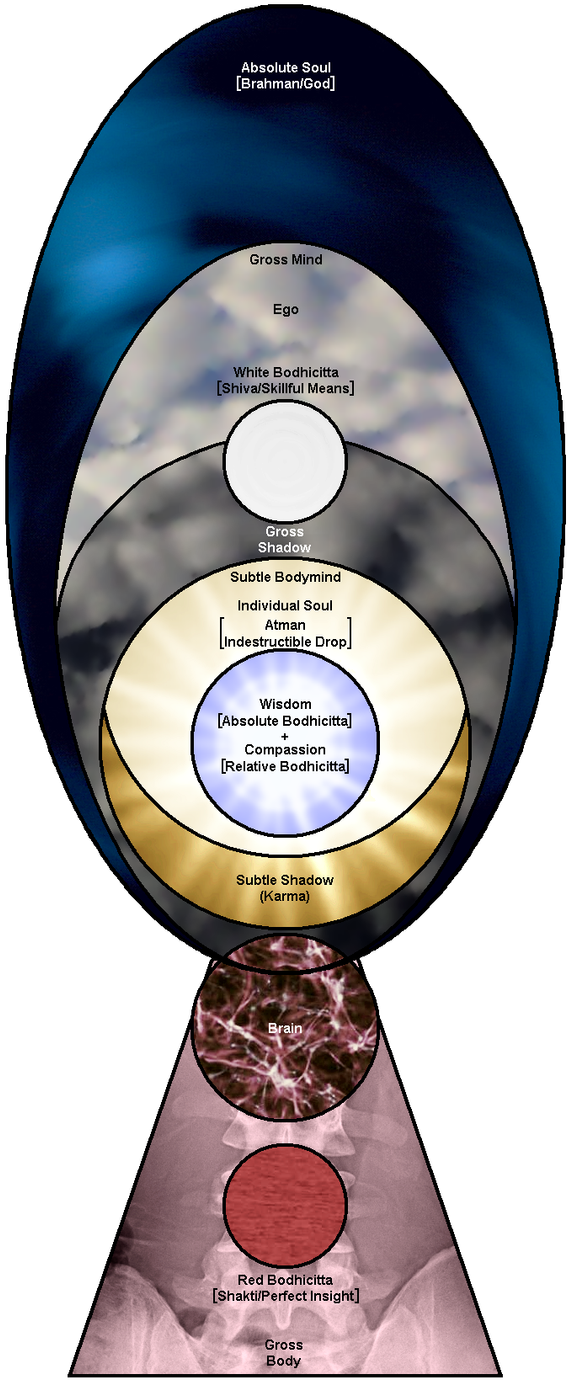
A Guide to Your Interiors

Absolute


Starting at the bottom, everyone knows what the Gross Body is. It's the thing we normally think of when we think of the body. Sometimes it is gross, but here it's referred to as gross because it is the most dense form of matter.

At the top of the Gross Body is the Brain. Everyone knows what the brain is. It's a vital organ and most people only use the stem. The brain is the seat of consciousness, most likely the microtubules.

Right below the brain is something called the Red Bodhicitta, located at the navel. It's part of the subtle anatomy, but it's more tied to the gross anatomy than it is to the subtle bodymind. It's located here in relation to the brain because it's relative location is important. The red bodhicitta represents perfect insight. It is one of two anchors that hold keep the soul attached to the body, and is the power source of the body. It provides the energy for meditation. We get the red bodhicitta from our mother.

Atop the brain is a series of elliptical forms.

I'll start with the white circle. It is the White Bodhicitta, and it is skillful means. It is said to be the mind of enlightenment. At the moment of death the white bochicitta descends from the crown of the head and presents us with the perfect opportunity to attain enlightenment. If not, we'll get several other chances later on, but that's a topic for another day. We get the white bodhicitta from our father.

The next biggest ellipse, with the pretty clouds, is the Gross Mind. That's what we think of when we think of the mind. The gross mind is almost constantly full of thoughts that arise and cease, represented here as clouds that obscure the clear blue sky. The gross mind contains two parts, the Ego, which is the frontal personality that we associate with, and the Gross Shadow (the darker part), which is all the stuff we have disidentified with and have repressed. The shadow is almost always unconscious, and it is much larger than the conscious ego. It is the seat of projection. Any bit of the shadow we do not reintegrate into the ego during this lifetime we must deal with either in the between life state or the next life. There is no getting around it.

Inside the gross mind is the Subtle Bodymind (a combination of the subtle body and the subtle mind). It is full of golden light, often encountered in the early stages of meditation. The subtle bodymind is what reincarnates. Any it of the gross shadow that we failed to deal with in life will accumulate in the Subtle Shadow, the darker part of the subtle bodymind. Sometimes it's called Karma, but that word has a lot of baggage associated with it. It's the aspects of our self that we do not want to deal with. It is all the unconscious tendencies that pull us through life, and pull us to the next life. It doesn't seem to be a sort of accountant that balances good deeds and bad deeds, it seems to be more like a magnet that draws us to a life we are most attune with. Fears, addictions, unresolved issues, all of that pulls us in certain directions. Usually directions the ego does not want.

Inside that, at the very center of the self, is the Individual Soul (sometimes called the Atman or the Indestructible Drop), represented here as a sphere of blue light (often encountered in deeper stages of meditation). The soul is the original self-contraction that started manifestation. It is made of two things: wisdom (absolute bodhicitta) and compassion (relative bodhicitta). Wisdom is our capacity to recognise emptiness, and compassion is our capacity to be moral. The soul is said to be absolutely indestructible. It is the very subtlest mind of enlightenment that anchors all other structures. The soul is indestructible even for perfectly enlightened buddhas. It is not an unchanging substance, or a thing, it is the very heart of the mind. If the soul never changed then enlightenment would be impossible!

At the very outside, the biggest ellipse, is the Absolute Soul (God or Brahman). It is Absolute Existence and Absolute Truth. It is clear light (clear meaning transparent, like pre-dawn twilight). Absolute freedom and fulfillment; the source and goal of all existence. The gross body is projected out from the Absolute and appears to us to be something outside and apart from it, but you can see from the overlap that the gross bodymind, like everything else, exists within the Absolute. At the moment of enlightenment the individual soul identifies with and abides as the Absolute Soul without any loss of individuality.

Monday, September 5, 2016

The Mystery Of The Shemitah

Jonathan Cahn explains what he calls "The Mystery Of The Shemitah" for 77 minutes. Basically, there's this Biblical injunction that every 7th year the Jews were supposed to stop working and erase all debts (I'm still wondering what they were supposed to eat), but the Jews always defy God's comands, so they ignored this injunction for 490 years. As a result the Babylonians came in and destroyed Jerusalem and sent the Jews into exile for 70 years - one year for every sabbath year ("shemitah") they had ignored. At the end of 70 years the Persians come in and wipe out the Babylonians and the Persian king Cyrus rebuilds Jerusalem and puts the Jews back in their homeland.


Rabbi Cahn says the same rule applies to the United States, because the US was unique in that it was the only modern state that was founded on the principles of God's word, in effect setting up a new covenant like the one the Jews had thousands of years ago.


1870 - shemitah year - the US surpasses Britain as the largest economy on the planet

1917 - shemitah year - the US becomes a superpower

1945 - shemitah year - a new financial world order is established based on the US dollar


As long as the US (this rule only applies to the US and Israel) stays right with God then every seventh year will be a blessing, but if the US defies God then every seventh year will be a curse.


1973 - shemitah year - the US legalises abortion, defying God

2001 - shemitah year - 9/11, the symbol of America's economic might - the World Trade Center, which was built in 1973 - is destroyed, followed by a huge financial collapse of the stock market

2008 - shemitah year - the Great Recession starts, the worst economic crisis since the Great Depression (which also started on a shemitah year)


What happens next? I don't know. The last shemitah year was September 2014 to September 2015, which passed, and while there weren't any further economic disasters or terror attacks, the Supreme Court did deem itself infinite power over all aspects of everyone's lives allegedly to protect the "rights" of maybe one tenth of seven tenths of one percent of the population, but really it was a naked power grab that followed 30 years of public indoctrination to move the overton window.


Is there anything to this? I don't know. This might all just be coincidence. It is an interesting hypothesis, and it is an interesting lecture.


Monday, June 6, 2016

The Gods Themselves

"Eyewitness reports of human encounters
with "supernatural beings" have been documented as far back
as the painted caves of Upper Paleolithic Europe 35,000 years ago and
brought right up to date with bizarre accounts of abductions by
aliens in the twenty-first century. Such reports include powerful
common themes... that science is unable to explain."


Supernatural: Meetings with the
Ancient Teachers of Mankind
, Revised Edition, Graham Hancock,
page 269


What are the gods? Could billions of people from pre-history have believed in lies, founded on nothing but the hollow words of priests? Or were the gods based on some truth, some genuine metaphysical intelligence that humans contacted and communed with?


The gods, or the germ of the gods, began as extensions of the Truth. For whatever reason they fragmented; were rent from Truth and thrust into contact with the world: Dionysus, Anubis, Azazel, Quetzalcoatl, Huitzilopochtli*, and others. Not all the gods, most are just myth; the personification of abstract thought. Did the average Greek believe in Zeus, or Athena, or Ares? Probably not. They represented aspects of human psychology and served as a means of learning these truths, just as ego, superego, and id centuries later.


Ares and Athena are both gods of war - personifications of abstract
ideas - but they signify different approaches to war. Ares represents
the old style of fighting, like Achilles or barbarians; men who fight
for personal glory and bloodlust. Athena represents civilised warfare,
with strategy and tactics and allegiance to the city-state. Stories involving the two were commentaries on societal evolution, from archaic to classical; from tribes and kinship groups to political entities that united multiple disparate families.


However, some gods represent genuine aspects of Truth that can be approached through transpersonal experience: the original teachers of mankind. Millions of people, from all times and all nations, speak of meeting the same entities through the use of drugs, fasting, or rhythmic dance. They cannot all be sharing in the same hallucination, or else be imitating one another from reading past accounts. No, these experiences must point to a genuine reality.


Over the countless eons, psychic garbage has accumulated around these fragments and they've taken on lives of their own. What began as projections of Truth were, through prolonged exposure to the collective shadow of humanity, rendered into entities with thoughts and personalities all their own. Wise and powerful beyond all conception, yet totally dependent upon humans for their existence. This is the condition of the gods. A lack of prayers cannot starve them, as in Aristophanes' The Birds, or has commonly been believed throughout the centuries. They do not need us to believe. Our beliefs merely give definition to their form. They have appeared in every culture under many names. All they require is the continuation within the collective unconscious of the same thought patterns, the same vortices, that created them. And so it does not matter if you believe in Anubis per se, it is the psychopomp, the one who delivers souls from this world to the next. Call it Yama, or the Grim Reaper, or Charon, or the Being of Light, it is still the same entity by whatever name you give it, and so long as the need remains for such a being, so shall it continue to exist, in all the different guises disparate cultures have given it.


That is the folly of man, thinking himself Adam, with the power to change the essence of a thing by changing its name. Water is still the same whether it is in a pot, or a towel, or on the floor, or in a cloud, or ice. A man is still a man, whatever mask he wears, by whatever name he refers himself. You cannot change a horse into a cow by changing the definition of "cow" to include horses, nor can you affect the gods by believing, or disbelieving, or by granting them different titles. You can lie to all the world, but in the pure light of Truth you cannot lie to yourself, and you will find, when you die, the lies you've told become chains and anchors preventing you from ascending to the Truth.


These gods are not the God, and though they live a long time, they are not immortal, and must return to the Truth eventually, when humanity has evolved and there is no further need for this world. On the contrary, a true immortal, though his body may die, his soul will remain as the unique expression of his being, even when his identity shifts from the individual to the Truth itself, dissolving the illusion of separation. The soul of the immortal is indestructible, even if he does not see himself as the individual.


In part two I will look at the nature of that which we call God.


*The god of human sacrifice. The Aztecs were unique in all the world for the sheer brutality and the numbers of their victims. Something, very dark and diabolical, had to compel the Aztecs to commit ritualised murder on such an enormous scale.

Wednesday, March 16, 2016

The Purpose-Guided Universe

Dr. Bernard Haisch, astrophysicist and UFO enthusiast, author of The God Theory and The Purpose-Guided Universe, talks about God, physics, the anthropic principle, and the meeting of science and religion. This talk is a little dated, as the Higgs boson has since been discovered (or, more accurately a Higgs boson has been discovered, there might be more than one), but it is still very good. Runs 2 hours.


Tuesday, March 15, 2016

Richard Rose

Richard Rose
Do things for the sake of a higher power, and it will correctly guide your every step. There is a god within every man... that finds his contact with the Chief Engineer of this scenario... the Absolute God that has everything planned or is able to at least enable us to see that everything is for the best. And the best includes eternal contentment at the cost of momentary inconvenience.

Yesterday was Richard Rose's birthday. He would have been 99 years old.

The American Buddha. The last unquestionably enlightened being of the 20th century. Mr. Rose, as he was called, was only ever interested in one thing his whole life: the Truth. He got special permission to enter a Capuchin seminary at age 12, believing the way to Truth was to become a Catholic monk. He was disillusioned with the worldliness and lack of critical thinking within the Church, so he left at age 17 to find the Truth through science. He studied chemistry and physics and worked in a laboratory and on submarines, but was again disillusioned by the whole system of science as just another ego trip. Rose then decided to embark on the path of mysticism, making his body "a laboratory, not a cesspool." He became a vegetarian, stopped drinking alcohol, coffee, and tea, and became completely celibate, later remarking "Those years of celibacy and solitude were the most joyful of my life."

At the age of 30, in a hotel room in Seattle, Richard Rose had an experience of death as had Ramana Maharshi half a century earlier, wherein the last of his ego was dropped and he experienced God Realization. For years he lived a quiet, unassuming life afterward, not speaking about his experience until 1972, when he gave his first public lecture. The next year he would publish The Albigen Papers, a book outlining the system he had used 26 years earlier to gain enlightenment. Rose would continue to give talks and teach a handful of students at his ranch in West Virginia, until the 1990s when his health began to decline from Alzheimer's.

When asked if consciousness survives death Mr. Rose said "Yes. If it did not, I wouldn't talk to you. If oblivion were what is waiting for you, I would keep my mouth shut. It would be better for your peace of mind. It's better to have peace of mind if you're going no-place. If I had discovered that oblivion were the answer, I wouldn't talk."

But immortality is not all it's cracked up to be. You have to cultivate the enlightened mind in this lifetime in order to prepare for very real prospect of continuing forever: "You have to go through these traumas in life--now, while you're on Earth--in order to improve your situation after death. Everyone may be immortal, but we don't all go to the same place when we die. Awareness may not terminate for anyone, but you can't expect to advance into a dimension that you haven't mentally vaccinated yourself to beforehand. If the average mind--with its convictions and limitations--landed in an Absolute dimension, it would think it was either in oblivion or hell."

And about his own death, he said: "My life is no longer tied to this planet. This place is a stage, and when you leave, you turn out the lights."

After his death the teachings of Richard Rose have been kept alive by the TAT Foundation (Truth and Transmission), in West Virginia.

If you want you can buy his book The Albigen Papers at the link to the right.

Thursday, December 24, 2015

A Letter from Michael

A letter from a young Marine named Michael who was wounded during the Korean War. Runs 10 minutes. Transcript below.


Merry Christmas everybody! My name is Lee Allan, and the story you are
about to hear has become a Christmas tradition. It's been broadcast for
over 25 years on radio stations all over America. The story was given
to me by Ed Harding, news director of a radio station much like this
one. It was a copy of a letter, written by a young Marine named
Michael, who was hospitalised after being wounded on a Korean
battlefield. The letter was written home to his mother, but it was
first seen and read by a Navy Chaplin. In the letter, Michael describes
what happened to him on that lonely, frozen battlefield. When the
Chaplin first saw the letter, he talked with the boy's mother, the
sergeant in charge of the boy's patrol, and the patrolled members
themselves. Privately, they will all still tell you that what you are
about to hear is a true story. Recently read the letter at Christmas
time and let it stand on its own merit. The sergeant, the patrol
members, and Michael are real people. The story is a letter, a copy of
the original. A letter from Michael.


Dear Mom,


I wouldn't dare write this letter to anyone but you because no one else
will believe it. Maybe even you will find it hard. But I've got to
tell somebody. First off, I'm in a hospital. Now don't worry. You
hear me? Don't…don't worry. I…I was wounded, but I'm okay. You
understand? Okay. The doctor says I'll be up and around in a month,
but that isn't what I want to tell you. Remember when I joined the
Marines last year? Remember when I left, how you told me to say a
prayer to St. Michael everyday? You really didn't have to tell me that.
Ever since I can remember, you always told me to pray to St. Michael
the Arc Angel. You even named me after him. Well I always have. When I
got to Korea, I prayed even harder. Remember the prayer you taught me?
"Michael, Michael of the morning. Fresh court of heaven adorning."
You know the rest of it. Well I said it everyday. Sometimes when I was
marching. Sometimes, resting. But always before I went to sleep. I
even got some of the other fellas to say it. Well, one day I was with
an advance detail, way up forward, in the front lines. I was plotting
along, in the bitter cold. My breath was like cigar smoke. I thought I
knew every guy on the patrol, but along side of me comes another Marine
I had never met before. He was bigger than any Marine I had ever seen.
He must have been six foot four, and built in proportion. It gave me a
feeling of security to have such a buddy near. Anyway, there we were,
trudging along, rest of the patrol spread out. Just to start a
conversation I said, "Cold! Ain't it?" And then I laughed. Here I was,
with a good chance of getting killed any minute, and I'm talking about
the weather. My companion seemed to understand. I heard him laugh
softly. I looked at him. "I've never seen you before. I thought I
knew every man in the outfit." "I just joined at the last minute," he
replied. "The name is Michael." "Is that so?" I said. "That's my
name, too." "I know," he said. "And then we're on, "Michael, Michael
of the morning." I was too amazed to say anything for a minute. How
did he know my name? And the prayer that you had taught me. Then I
smiled to myself. "Heh". Every guy in the outfit knew about me. Hadn't
I taught the prayer to anyone who'd listen? Why now and then, they
even referred to me as St. Michael. Neither of us spoke for a time, and
then he broke the silence. "We're gonna have some trouble up ahead.
He must have been in some fine physical shape, for he was breathing so
lightly, I couldn't see his breath. Mine poured out in grape clouds.
There was no smile on his face now. Trouble ahead, I thought to myself.
Well, with the enemy all around us, that's no great revelation. Snow
began to fall, in great thick globs. In a brief moment, the whole
countryside was blotted out and I was marching in a white fog of wet,
sticky particles. My companion disappeared. "Michael!" I shouted in
sudden alarm. I felt his hand on my arm. His voice was rich and
strong. "This will stop shortly." His prophecy proved to be correct.
In a few moments the snow stopped as abruptly as it had begun. The sun
was a hard shining disc. I looked back for the rest of the patrol.
There was no one in sight. We lost them in that heavy fall of snow. I
looked ahead as we came over a little rise. Mom, my heart stopped.
There were seven of them and their padded pants and jackets and funny
little hats, only there wasn't anything funny about them now. Seven
rifles were aimed at us. "Down Michael!" I screamed and hit the frozen
earth. I heard those rifles fire almost as one. I heard the bullets.
But there was Michael. Still standing. Mom, those guys couldn’t have
missed. Not at that range. I expected to see him literally blown to
bits. But there he stood, making no effort to fire himself. He was
paralysed with fear. It happens sometimes, mom, even to the very
bravest. He was…he was like a bird, fascinated by a snick. At least,
that's what I thought then. I jumped up to pull him down, and felt a
sudden flame in my chest. I often wondered what it felt like to be hit.
Now I know. I remember feeling strong arms above me. Arms that laid
me, ever so gently, on a pillow of snow. I opened my eyes for one last
look. I was dying. Maybe I was even dead. I remember thinking well,
this isn't so bad. Maybe I was looking into the sun. Maybe I was in
shock. But it seemed I saw Michael standing erect again, only this
time, his face was shining with terrible splendour. As I say, maybe it
was the sun in my eyes, but he seemed to change as I watched him; he
grew, bigger. His arms stretched out wide. Maybe it was the snow
falling again, but there was a brightness around him; like the wings of
an angel. In his hand was a sword. A sword that flashed with a million
lights. And that’s the last thing I remember until the rest of the
fellas came up and found me. I don't know how much time had passed, but
now and then, I had a moment's respite from the pain. I remember
telling them that the enemy was just ahead. "Where's Michael?" I asked.
I saw them look at one another. "Where's who?" asked one. "Michael".
"Michael, that big Marine that I was walking with just before that big
snow squall hit us". "Kid," said the sergeant. "You weren't walking
with anyone. I had my eyes on you the whole time. You were getting too
far out. I was just gonna call you in when you disappeared in the
snow." He looked at me, curiously. "How'd you do it kid?" "How'd I do
what?" I asked, half angry, despite my wound. "This big Marine named
Michael and I were just…" "Son," said the sergeant kindly. "I picked
this outfit out myself, and there just ain't another Michael in it.
You’re the only Mike in it." He paused for a moment. "Just how'd you
do it, kid? We heard shots. There hasn't been a shot fired from your
rifle. And there isn't a bit of lead in them seven bodies over the hill
there. I didn't say anything. What could I say? I could only look,
open-mouthed, with amazement. It was then the sergeant spoke again.
"Kid," he said gently. "Every one of those seven bodies over the hill
there was killed, by a sword stroke." That's all I could tell you mom.
As I say, it may have been the sun in my eyes. It may have been the
cold, or the pain. But that’s what happened.


Love,


Michael

Tuesday, September 29, 2015

The Mystery of Death

Kriyananda expounds upon Yogananda's teaching of death, suicide, and the three worlds: gross, subtle, and causal. He talks about how desires become karma that keep us trapped in a cycle of rebirth. Runs 21 minutes.


Monday, July 13, 2015

Evil and God (Post 600)

Supposedly what I call the Non-Problem of Evil is the strongest argument against the existence of God. Boston College Professor of Philosophy Peter Kreeft explains that the concept of evil, both human willed action and natural evil, only makes sense in the context of God's existence. Without God setting a benchmark for goodness evil is reduced to nothing more than personal preference. Rather than serving as an argument against the existence of God, the existence of evil is an argument for the existence of God.


Runs 4:50


Tuesday, April 21, 2015

God and Buddha

Robert Thurman and Deepak Chopra rap for an hour and a half on Buddhism, Vedanta, God, primordial awareness, suffering, liberation, contradiction, and everything in between. A lovely dialogue.


Sunday, April 5, 2015

Integral Christ

UPDATE: Integral Christ is now available in PDF format complete with additional pictures and about three errors corrected. 


 If the crucifixion took place in 33 AD then the day was today, 3 April. The last time Holy Week took place at the same time as the first Holy Week was 1942. The next time it will happen again is 2026. If my calculations are correct Jesus was killed 2 weeks before his 39th birthday.


On such an auspicious occasion, the first in the lives of probably most people who have ever visited The Urban Mystic (though I love my septuagenarian readers just as much, probably more), I will take this time to write a very special piece about the most famous man who ever lived.


Who was Jesus Christ? I've already written about his birth, about his life, the conspiracy to kill him, the resurrection, and the possibility that he visited India during those missing 18 years. What is left to write about?


How about the ways in which we interpret Jesus.


I listened to an audio program from Integral Life that was little more than a 45 minute commercial, but it got me thinking about the way people at different developmental levels interpret Jesus and what part of his life and teaching they may focus on.


We hear about magic stage Christianity focuses on Jesus as personal savior who can miraculously alter the world. A child's view of Jesus as a superhero who is there to save you. The miraculous is the focus at this stage; it is what convinces the believer.


Mythic Christianity would focus on Jesus as the Way the Truth and the Life. Jesus prescribes behavior and you have to obey, you have to accept Jesus as your personal savior or you'll go to Hell forever. This is the Christianity of the Crusaders and most of medieval Europe and even going into the Reformation. The difference between the old Catholic church and Luther's church was the interpretation of whether Jesus' Law included belief only or if acts of charity were needed to cement one's place in Heaven.


Rational Christianity, the Christianity of Thomas Jefferson, John Locke, Rene Descartes, and Isaac Newton. We have a God who is grand designer of the universe, and while Jesus is fully divine he is also fully human. Jesus is a wisdom teacher.


There's a pluralistic Christianity would deconstruct Jesus. It would be seen as unchristlike to say Jesus is the only way to God. Belief no longer needs to have any connection with truth, if truth even exists; belief is my own feeling about something and everyone has different, equally valid beliefs.


But what is integral Christianity? Who is the integral Jesus? This question may be too large even for this massive essay. To scale it back I'll focus on a much smaller scale.


The dialogue did ask four interesting questions about what would be included in an integral version of Christianity: Do you need the virgin birth? Do you need miracles? Do you need Jesus dying on the cross? and Do you need the resurrection?


Remember, the key feature of second tier is supposed to be to integrate all of first tier. We're supposed to look at everything that has come before and work it all together. Ken Wilber's working hypothesis is that no one is entirely wrong. Every level is right about some aspect of reality in some way. What I try to do is find what works at each level and put it all together, bridging the gaps, to create a unified whole. What the people over at Integral Life seem to do is talk about the lower levels and then take whatever Green-Post Modern says and declare it the truth of everything. There seems to be a very strong Green bias in the supposedly second tier integral community. But that's a topic for a different discussion. Right now what I will attempt to do is integrate all of first tier into a second tier version of Christianity. I will start by answering the four questions presented in the dialogue.


Now, I have absolutely no idea if Mary was a virgin or not prior to Jesus' birth. Mentioned in Matthew and Luke, the virgin birth went relatively unquestioned for most of the history of Christianity. Matthew makes reference to a prophecy from Isaiah that the messiah would be born of a virgin and he sees Jesus as fulfilling that prophecy. Why did Matthew and Luke tell different versions of the same story, and why did Mark and John not mention the virgin birth at all? We can excuse Paul because his central focus was the resurrection as the singular event in history in which sin and death were overcome, but is the silence from Mark and John any indication of anything?


It is not impossible for such an event as a virgin birth to occur. It has never been observed in mammals in the wild, but scientists have been able to tinker around with mice and rabbits, and in 2007 human embryos were created this way for use in stem cell research. God can do anything that a human can do, so technically God could turn the reptilian gene on and make a fatherless Jesus as a demonstration of sovereignty over nature. The biggest problem is that the offspring of such an event is always female. Again, however, it is possible to tinker with an X chromosome in the lab and create a Y chromosome from it, since they have homologous genes. It is technically possible for a scientist today to create a male embryo from the cells of just the mother, but no one has ever done this before and it doesn't happen in nature, which really would make it a miracle par excellence.


Did it happen? We can't say. Are we required to believe it happened? Well, if we follow what Paul says then technically no. A virgin birth is not a requirement for an integral Christianity.


Do we need miracles? Surprisingly they seem to agree that events that might be considered miraculous actually do happen. There are healers who use methods such as laying on hands and other energetic methods, and not only do they produce statistically significant results, but these alternative methods are sometimes even covered by insurance, so energy healing is not something on the fringe, it is acceptable medicine. Phenomena such as ESP and psychokinesis have been demonstrated to exist with greater scrutiny than any other field of science ever. Double-blind protocol was invented to study psychic phenomena, starting with Mesmerism (a form of hypnotism). Just as ancient people would consider an airplane magic if it were somehow transported back in time, it is safe to say that they would have considered psychic powers to be a form of magic or miracles.


Richard Rose, an iconoclastic physicist and engineer as well as a mystic, certainly accepted what he called "magic," which appears to include psychic phenomena. Looking at Ken Wilber's classification of the developmental levels it is possible that Richard Rose would have been considered third tier, meaning permanently ensconced in states of transpersonal awareness. Rose would almost certainly have been considered integrally developed, and he not only accepted the existence of psychic phenomena, but also demonic possession.


A lot of miracles in the New Testament definitely could be explained through psychic phenomena, albeit at a larger scale than what is seen in a laboratory setting. Miracles can indeed be a part of integral Christianity, and if we're using the word "miracle" as a pre-scientific term to mean "psychic phenomena" then the existence of miracles is already an established fact.


What about the crucifixion? Does integral Christianity need a crucifixion? Well, what exactly is the alternative? The dialogue brings up the swoon hypothesis. They say that people in the Gospels acted like Jesus was still alive. They say he was taken off after only six hours, his body was put in a tomb instead of left on the cross to rot like typically happens with criminals, that the herbs used to anoint the body were typically used to revive people and not to anoint the dead. People are acting like he isn't dead? Really? Only John mentions anything put on Jesus' body, and he says myrrh, aloe, and unnamed spices. Aloe is certainly used in medicine, and so is myrrh, but myrrh is also used in embalming the dead. But what about the swoon hypothesis? I have to say it is the most ridiculous alternative to crucifixion anyone has come up with. People have suggested it was a double who was crucified, some people say that the whole story was made up, some people even say that God replaced Jesus' body on the cross with Judas, but anyone who believes in the swoon hypothesis knows absolutely nothing about medicine.


Let us look at the Shroud of Turin, an object that realistically depicts what is mentioned in the Gospels. Jesus was scourged by a Roman flagrum. The man on the shroud has 120 such marks on his body. There have been people who have died from a few lashes from a regular whip back when capital punishment was legal in the West, in the British navy for example. A flagrum is about 50 times worse than a whip. A flagrum is like a whip with three strips of leather with iron barbells, nails, or broken glass tied to it, wielded by a professional killer. He had a crown of thorns placed on his head. His eye is swollen shut from the beating he received, his nose is broken. His shoulders were dislocated when he was crucified. The nails used in the crucifixion would have rendered his hands nonfunctional, not to mention the excruciating pain from putting pressure on the median nerve in the wrist. After six hours on the cross Jesus' heart would have been beating over 140 beats per minute, he would be near suffocating, dehydrated, exhausted, between 10-20% of his blood would have been lost. Then the Roman centurion thrust a spear through Jesus' side and "blood and water" poured out of the wound. This is a very telling remark from John. The heart is surrounded by a cushion of clear fluid. When the spear pierced Jesus' heart that clear fluid came out with the blood. It is doubtful that even professional executioners in the first century would have known about the existence of pericardial fluid. The fact that John mentions this is strong indication that he witnessed an actual event.


In order to complete the swoon hypothesis the Apostles would have needed to fool professional executioners that Jesus was dead. In the tomb they would have needed to treat wounds that would probably have been fatal even with modern emergency surgery. Jesus would have needed an emergency heart transplant, a blood transfusion, his shoulders would have had to been put back in place and his nose would have had to have been set. 36 hours later Jesus would have needed to roll an enormous stone away using his nonfunctional hands, overpower the guards standing outside the tomb, walk seven miles from outside Jerusalem to Emmaus, sneak into a locked room with no evidence of forced entry, and fool people including his Apostles and his own mother that he was resurrected and had conquered death and not a bloody and beaten mess who had barely escaped death. He would have had to convince people so thoroughly that 11 of the 12 Apostles would overcome their fear of the Romans and go to their death as martyrs to preach a Gospel they knew was a lie.


The swoon hypothesis is absolutely impossible. One thing is certain, the Romans were experts at killing people. If they said Jesus was dead then he was dead. He wasn't in a coma, he wasn't faking, he was absolutely dead.


The dialogue also mentions a supposed lack of documentary evidence of the crucifixion. Lack of documentary evidence? Josephus and Tacitus both say that a man named Jesus was crucified by the Romans. What do you want, a CNN video from 33 AD actually showing the nails going in?


The crucifixion is as close to an historical fact as we can get. We know from historical sources that a man named Jesus preached in Judea in the first century and he was crucified by the Romans. That is fact. If the crucifixion isn't part of integral Christianity that's just plain denying fact. That would be like integral chemistry denying the existence of atoms.


Now we come to the big one. Does integral Christianity need the resurrection? The men in the dialogue dodge produce yet another flippant response. They say something like "Well I don't care, 'he died for my sins', that doesn't mean anything to me." Not only did they dodge the question, I also suspect they enjoy sinning. I mean sinning is fun, at the time, but I suspect they don't repent afterward.


But the answer to the question is an unequivocal yes. You don't need to believe in the resurrection to practice Jesus' teachings, you don't need to believe to accept the existence of an historical Jesus, but to be a Christian the central tenant is belief in the resurrection. That is nonnegotiable. Paul says that there can be no Christianity without the resurrection and that if the resurrection did not happen we should immediately through Christianity out because it is false:


But if there be no resurrection of the dead, then is Christ not risen: And if Christ be not risen, then is our preaching vain, and your faith is also vain. Yea, and we are found false witnesses of God; because we have testified of God that he raised up Christ: whom he raised not up, if so be that the dead rise not. For if the dead rise not, then is not Christ raised: And if Christ be not raised, your faith is vain; ye are yet in your sins. (1 Cor 15:13-17)


Who am I going to believe, Paul, the inventor of Christianity, as the man who took a small following of an obscure Jewish teacher and made it a world religion everyone can belong to, or some guy in 2015 who doesn't even care about the concept of sin?


Here's what Richard Rose has to say:


"Evidently Jesus was able to come back and get his body, since the body disappeared from the grave, and later reappeared on the road to Emmaus. This does not prove that Jesus escaped physically from the grave, but could imply that the spirit of Jesus was able to simulate a body and to discard the mask at will.

"To say that a personality has found a means to travel from one dimension to another and to be seen in both is not unreasonable, although it implies a special talent. The SRF (Self Realization Fellowship) movement claims that some of its masters were avatars who had the ability to come and go between the spiritual planes and they were also reputed to have extensive creative ability. This brings us to the word illusion, for many believe this world to be one of illusion and that some liberated spirits are able to evoke the illusion at will." (The Albigen Papers, p. 84)


Rose is speaking of chapter 43 from Autobiography of a Yogi. Yogananda's guru Yukteswar Giri had died and his body was buried and then a few days later he reappeared in physical form before Yogananda to console him and teach a valuable lesson about life and death:


"Angelic guru," I said, "your body looks exactly as it did when last I wept over it in the Puri ashram."

"O yes, my new body is a perfect copy of the old one. I materialize or dematerialize this form any time at will, much more frequently than I did while on earth. By quick dematerialization, I now travel instantly by light express from planet to planet or, indeed, from astral to causal or to physical cosmos." My divine guru smiled. "Though you move about so fast these days, I had no difficulty in finding you at Bombay!"
(Quote taken from the original public domain version, which I have as a text file, so I unfortunately can't say what page it came from.)


What about A Course in Miracles? If we look at the unpublished "Special Messages" section the Voice (identified as Jesus Christ) says the following about the resurrection:


My body disappeared because I had no illusion about it. The last one had gone. It was laid in the tomb, but there was nothing left to bury. It did not disintegrate because the unreal cannot die. It merely became what it always was. And that is what “rolling the stone away” means. The body disappears, and no longer hides what lies beyond. It merely ceases to interfere with vision. To roll the stone away is to see beyond the tomb, beyond death, and to understand the body’s nothingness. What is understood as nothing must disappear.

I did assume a human form with human attributes afterwards, to speak to those who were to prove the body’s worthlessness to the world. This has been much misunderstood. I came to tell them that death is illusion, and the mind that made the body can make another since form itself is an illusion. They did not understand. But now I talk to you and give you the same message. The death of an illusion means nothing. It disappears when you awaken and decide to dream no more. And you still do have the power to make this decision as I did.


Is resurrection even possible? Resurrection, not mere revival of the body. Both Richard Rose and Paramhansa Yogananda seem to think so. And you may think to yourself, sure Rose and Yogananda may, may, have had a center of gravity in third tier, but Yogananda could still have been cognitively at amber and Rose at orange, or whatever. You might say that the Course was written by Hellen Schucman subconsciously, and she might have been at orange or maybe green, who knows.


Someone with a cognitive level of teal or turquoise, even someone at green, would see this is all a myth, it's impossible, the resurrection is a holdover from a mythic consciousness and it's really symbolic of our spiritual resurrection within Christ consciousness. The death of the separate self sense and the resurrection into nondual spirit as such. This also achieves the conquest of sin, because from a nondual perspective there is no sin. Nonduality transcends good and evil (unfortunately most people today misinterpret the nondual traditions and instead of transcending anything just act egotistically and think they are transcending good and evil). Sin is entirely a product of the separate self, so when we die to the separate self we are eliminating sin. And that's fine. I don't disagree with that interpretation. It is lovely symbolism and capable of producing profound spiritual experiences.


But my question is is it possible for an integral Christianity to include a bodily resurrection of Jesus? I've presented eye-witness testimony of resurrection and spiritual communication. Now let's take another look at the Shroud of Turin. I keep bringing up the Shroud because I think it is strong evidence in favor of the resurrection of Jesus Christ. If we are able to overcome the speculation that it is a forgery then we are left with what appears to me to be two possibilities: that the Shroud was formed through some unknown natural process related to the decomposition of a body that has never been seen before or since, or that the Shroud is a relic of a miracle, a physical testimony to the the ultimate event in history.


The evidence that the shroud is not a forgery is very strong. The first piece of evidence is the dating. One sample from the Shroud of Turin was taken and dated. First off, testing one sample proves nothing. Second, the sample was taken from a corner where a repair was made. The radio carbon date of the sample is off because it did not come from an original part of the cloth.


Next we have an illumination from a Hungarian manuscript the Pray Codex.

Pray Manuscript

The illumination depicts a crucified man who looks like the man in the Shroud with his thumbs retracted (because the nails damaged the nerve) – medical knowledge a medieval monk would not have known. The picture also depicts the man on a cloth with a similar weave as the Shroud, and an L-shaped series of burn marks in the same place as on the Shroud. Crucially, this manuscript was made almost a century prior to the earliest date attested to by the carbon 14 testing of the Shroud. This is strong evidence against the Shroud being a medieval forgery.


Then comes the list of high improbabilities; things that no medieval artist should know or would even think about.


 ● The blood stains – which have been tested and are real human blood – have no image underneath them. That means the blood was placed on the cloth first and the image created afterward. The forger would need to know exactly where to place the blood, correctly depicting the flow of gravity around a three dimensional body, both when held vertical during the crucifixion, and then later when the body was horizontal within the tomb, and then paint over it.


 ● The forger would need to know what an authentic Roman scourging looked like to produce an accurate representation.


 ● The forger would need to know what an authentic Roman crucifixion looked like, including putting the nails in the wrists and not the palms, as was the tradition during the middle ages. The forger would have needed to know that the thumbs would retract from the injury.


 ● The forger would need to put Jerusalem pollen on the cloth to fool 20th century scientists who would conduct microchemistry on the Shroud.


 ● The forger would need to paint using an unknown medium (no paint, no dye, no pigment of any kind was ever discovered on the cloth, there are no indication of brush strokes or any application of any material) in perfect negative of an image that is almost invisible up close and does not become visible until many 40 feet away, in order to produce a positive image only after the invention of photography many centuries later.


 ● The forger would need to encode 3D information within the image so that 20th century computers could extract a full 3D life-sized image of a man.


If the Shroud is a forgery then the forger would need to be the greatest artist who has ever lived and will likely ever live, and yet the forger would have to have produced absolutely no other work during his lifetime.


Now that the idea that the Shroud is a forgery has been refuted it is up to you to decide whether the Shroud of Turin is the natural byproduct of an unknown process of decomposition that has never before or since been observed, or a genuine miracle.


Integral Christianity certainly can include a bodily resurrection. We certainly can have room for interpretation and experiences. It is possible to have visions of Christ, just like deathbed visions of relatives. I'll say this for the first time, I have had a vision of Christ. He reached through my body, touched my spine, and instantly healed a childhood injury that had filled most of my life up to that point with constant pain. No hallucination can do that, that was a genuine miracle. (Unfortunately, six years later I re-injured my back at work. I don't expect Jesus to come back and heal me every time I get hurt, that was a one off event with spiritual ramifications.) Could the Apostles have had such a vision? I certainly think Paul did. But a mere vision does not explain the empty tomb. Remember, people at different levels can interpret the empty tomb and the resurrection differently, but when reading the Gospels we must take into account the writer's original intent. We can read interpretations into the Gospels that the writers could never have imagined, about Christ consciousness and symbolism of this and that, but to know what they were talking about we must take into account their own level of development. First and second century Jews would not have a clue what you're talking about if you start speaking in postmodern terminology.


When Paul was writing his letter to the Corinthians he was not talking about some experience you can have and gee isn't that swell, but other people can interpret things their own way. The Gospel writers were not using the empty tomb as a metaphor for anything. They do not paint themselves as particularly bright within their own Gospels. Jesus has to constantly explain himself in ever more details before the Apostles finally get it in John at the Last Supper. The Gospel writers depict events that would have been embarrassing for a first century Jew. If they were writing metaphor they would not have put so many inconvenient details within the text, they would have presented Jesus as Superman.  These people were writing what they thought was the true account of real events. If Paul says that Christianity cannot exist without the resurrection, he's not talking about an experience he had on the road to Damascus, he's not using the empty tomb to talk about shunyata, they really found a tomb with no body and they explain it by saying Jesus physically rose from the dead. Without that, without the resurrection, there can be no Christianity.


So where does that leave integral Christianity? Well, I've certainly demonstrated that miracles exist, whether we use the word "miracle" or "psychic phenomena," I've shown that the crucifixion was a real historical event, and, most controversially, I have presented evidence in favor of the resurrection, and have argued that our own interpretation, while important, should not be read into the minds of the Gospel writers.


You can certainly love Jesus at any level. You can practice Jesus' teaching in the manner interpreted at any level and have that practice be appropriate for that level. However interpretations should not trump facts. Postmodernism deconstructed the world, and integralism is supposed to reconstruct it, taking what works at every level and synthesizing it into a seamless whole. It is not enough to say every level has its own interpretations, its own value structures, and just leave it at that. While true, that is not the whole picture. Our own interpretation must go hand-in-hand with the interpretations of the Gospel writers and with the facts of Jesus' life in order to complete the picture and create a truly integral Christianity. We must live the teachings of Jesus body, mind, and spirit, exercising our charity and compassion, our rationality, and our prayer and contemplation so that we too may "die daily" to our separate self as Paul did 2000 years ago.


It is Easter Sunday. Rejoice! Christ is risen!