
I've written about things like dragons and gods before. I was thinking about unicorns and lo and behold found a video on unicorns in the Bible. This video explains what exactly the Bible means when it talks about unicorns, refuting all objections naytheists like to bring up.
Showing posts with label Judaism. Show all posts
Showing posts with label Judaism. Show all posts
Thursday, January 4, 2018

Thursday, September 14, 2017
The Crossing of the Red Sea
Hurricane Irma's incredible power drew all the water from this beach at Long Island in the Bahamas, leaving behind only dry land.
In the story of the Exodus, Moses raises his staff and the Red Sea (Yam Suph, sometimes translated as the Sea of Reeds) empties of its water. God caused the sea to recede with a powerful east wind (Ex. 14:21). The water was piled up in a great wall to the side of the dry land, and this phenomenon lasted long enough for allegedly 600,000 Israelites to cross. When the Egyptians followed in their chariots the wind stopped and the sea returned, drowning them.
This is exactly what was seen at the Bahamas, minus the drowning Egyptians. Hurricane Irma's powerful winds and low pressure caused a huge bulge of water in the center of the storm, draining the beach, and the beach was dry for many hours, apparently. When the hurricane hit land the huge storm surge caused tremendous waves to crash on shore and caused massive flooding.
The mechanism exists for a powerful wind (hurricane or other storm) to drain a shallow body of water long enough for people to cross, and for huge waves to arrive to drown masses of people. The narrative account exists that says that just such an event happened somewhere in Egypt over 3,000 years ago during the Exodus. You could argue that such an occurrence was purely natural, and that it was one hell of a coincidence, or maybe it really was a miracle, but the crossing of the sea is definitely plausible. We can't prove that it happened, but it definitely could have happened, and this is what it would have looked like.
In the story of the Exodus, Moses raises his staff and the Red Sea (Yam Suph, sometimes translated as the Sea of Reeds) empties of its water. God caused the sea to recede with a powerful east wind (Ex. 14:21). The water was piled up in a great wall to the side of the dry land, and this phenomenon lasted long enough for allegedly 600,000 Israelites to cross. When the Egyptians followed in their chariots the wind stopped and the sea returned, drowning them.
This is exactly what was seen at the Bahamas, minus the drowning Egyptians. Hurricane Irma's powerful winds and low pressure caused a huge bulge of water in the center of the storm, draining the beach, and the beach was dry for many hours, apparently. When the hurricane hit land the huge storm surge caused tremendous waves to crash on shore and caused massive flooding.
The mechanism exists for a powerful wind (hurricane or other storm) to drain a shallow body of water long enough for people to cross, and for huge waves to arrive to drown masses of people. The narrative account exists that says that just such an event happened somewhere in Egypt over 3,000 years ago during the Exodus. You could argue that such an occurrence was purely natural, and that it was one hell of a coincidence, or maybe it really was a miracle, but the crossing of the sea is definitely plausible. We can't prove that it happened, but it definitely could have happened, and this is what it would have looked like.
Monday, March 25, 2013
Dating Creation
Taking the geneologies found in the Masoritic Text and fitting them together with an estimate of when the Exodus occured, we might be able to figure out when the Bible places the creation of the world. From Adam to Moses, we can construct the following chart:
Patriarch Born Died
Adam 1* 931
Seth 131 1043
Enosh 236 1141
Kenan 326 1236
Mahalalel 396 1291
Jared 461 1423
Enoch 623 988 ("Walked with God")
Methuselah 688 1657 (Died seven days before the flood)
Lamech 875 1652
Noah 1057 2007 1657 = The Flood
Shem 1557 2157
Arphaxad 1657 2095
Shelah 1692 2125
Eber 1722 2195
Peleg 1756 1995
Reu 1786 2025
Sherug 1818 2048
Nahor 1848 1996
Terah 1877 2152
Abraham 1947 2222
Isaac 2047 2267
Jacob 2107 2254
Some interesting things appear when we view this data in chart form. Lamech was the last patriarch to see Adam alive (he died 126 years before Noah was born). Noah not only outlived his great-great-great grandson, he also outlived his great-great-great-great-great-great grandson Nahor, who died quite young (relatively speaking). Abraham also had 215 years to get to know Noah, and so he had a direct testimony of the flood. Key events from creation to when the Israelites enter Egypt are not more than two people removed.
Moses was 80 years old when the Exodus happened, which took place exactly 430 years after the Israelites (Jacob's family) entered Egypt, when Jacob was age 130. Meaning:
2237 = Israelites enter Egypt
2667 = Exodus
Time spent in Egypt = 430 Years (to the day)
Moses died at age 120. From this we can calculate the dates of Moses' life:
Moses 2587 2707
I've estimated before that the Exodus** happened around 1550 BC. 1550 BC now becomes 2667 after the beginning of the sixth day (yom).This would mean Adam was created in the year 4217 BC. The world, according to this calculation, would be 6,230 years and 5 unspecified yom old.
Solomon's temple was supposedly built exactly 480 years after the Exodus, or year 3147 AA (After Adam), or 1070 BC according to my estimate. This was the fourth year of Solomon's reign, so he became king in 3143 AA, or 1074 BC. His father, David, reigned for 40 years with Solomon being his immediate successor. David became king at age 30, so he lived a total of 70 years. This places his life at 3073 - 3143 (he had Solomon the year of his death, apparently) or 1144 - 1074 BC. This is about a hundred years before he is traditionally placed.
Of course, all this rests on the accuracy of one date: the date of the Exodus. That said, I think it is fairly accurate. I don't know if there was an Adam who lived 6,000 years ago (pretty close to the start of the Egyptian calendar), or what event from 2560 BC would count as the flood (around the time when the Great Pyramid was supposed to have been built). I have no idea what any of this is actually calculating. Sure, there was an Abraham, and the Israelites did settle in Egypt, but what happened before is anyone's guess. It does, however, make for an interesting day's work.
*For some reason many people seems to start counting with a year zero. I have no idea how to count zero years. The current Jewish calendar starts counting with year one (the first five days of creation) and says Adam was created on the first day of year two. Since there is no way to know how long, exactly, those first five days were, I'm going to put Adam's creation at the start of year one.
**Going by the Hebrew calendar, which currently places us in year 5773, Exodus happened 1126 BC,
Patriarch Born Died
Adam 1* 931
Seth 131 1043
Enosh 236 1141
Kenan 326 1236
Mahalalel 396 1291
Jared 461 1423
Enoch 623 988 ("Walked with God")
Methuselah 688 1657 (Died seven days before the flood)
Lamech 875 1652
Noah 1057 2007 1657 = The Flood
Shem 1557 2157
Arphaxad 1657 2095
Shelah 1692 2125
Eber 1722 2195
Peleg 1756 1995
Reu 1786 2025
Sherug 1818 2048
Nahor 1848 1996
Terah 1877 2152
Abraham 1947 2222
Isaac 2047 2267
Jacob 2107 2254
Some interesting things appear when we view this data in chart form. Lamech was the last patriarch to see Adam alive (he died 126 years before Noah was born). Noah not only outlived his great-great-great grandson, he also outlived his great-great-great-great-great-great grandson Nahor, who died quite young (relatively speaking). Abraham also had 215 years to get to know Noah, and so he had a direct testimony of the flood. Key events from creation to when the Israelites enter Egypt are not more than two people removed.
Moses was 80 years old when the Exodus happened, which took place exactly 430 years after the Israelites (Jacob's family) entered Egypt, when Jacob was age 130. Meaning:
2237 = Israelites enter Egypt
2667 = Exodus
Time spent in Egypt = 430 Years (to the day)
Moses died at age 120. From this we can calculate the dates of Moses' life:
Moses 2587 2707
I've estimated before that the Exodus** happened around 1550 BC. 1550 BC now becomes 2667 after the beginning of the sixth day (yom).This would mean Adam was created in the year 4217 BC. The world, according to this calculation, would be 6,230 years and 5 unspecified yom old.
Solomon's temple was supposedly built exactly 480 years after the Exodus, or year 3147 AA (After Adam), or 1070 BC according to my estimate. This was the fourth year of Solomon's reign, so he became king in 3143 AA, or 1074 BC. His father, David, reigned for 40 years with Solomon being his immediate successor. David became king at age 30, so he lived a total of 70 years. This places his life at 3073 - 3143 (he had Solomon the year of his death, apparently) or 1144 - 1074 BC. This is about a hundred years before he is traditionally placed.
Of course, all this rests on the accuracy of one date: the date of the Exodus. That said, I think it is fairly accurate. I don't know if there was an Adam who lived 6,000 years ago (pretty close to the start of the Egyptian calendar), or what event from 2560 BC would count as the flood (around the time when the Great Pyramid was supposed to have been built). I have no idea what any of this is actually calculating. Sure, there was an Abraham, and the Israelites did settle in Egypt, but what happened before is anyone's guess. It does, however, make for an interesting day's work.
*For some reason many people seems to start counting with a year zero. I have no idea how to count zero years. The current Jewish calendar starts counting with year one (the first five days of creation) and says Adam was created on the first day of year two. Since there is no way to know how long, exactly, those first five days were, I'm going to put Adam's creation at the start of year one.
**Going by the Hebrew calendar, which currently places us in year 5773, Exodus happened 1126 BC,
Tuesday, October 2, 2012
God, Evil, and the Childish Fantasy
In Isaiah chapter 45, God is speaking to Cyrus, the king of kings, ruler of the Persian empire. God tells Cyrus that He will prepare the way for Cyrus to conquer the world, remove all obstacles from his path, and provide him with opportunities he could not dream of. In so doing, God is doing what is necessary to create the conditions of a future where everyone will know of God. Then comes the real heart of the message, "I am the Lord, and there is no other. I form the light and create darkness, I bring prosperity and create disaster; I, the Lord, do all these things."
Eli Rips, the scientist who discovered the Bible code, brings up this verse to Michael Drosnin, self-aggrandising journalist from the Washington Post and the Wall Street Journal. This encounter covers roughly one whole page of the first Bible code book:
Even within a world created by an
all-powerful and benevolent God, there can be a struggle between good
and evil, whose outcome is uncertain," says Eli Rips.
The Bible code may be a set of
probabilities. The sealed book might hold all our possible futures.
Each predicted event appears to be encoded with at least two possible
outcomes.
Rips agrees that the Bible code might
have a positive and a negative strand, two opposing statements of
reality intertwined: "As in court, an Advocate, and an Accuser."
"Possibly there are two opposing
statements always encoded to preserve our free will, and it may be
that the Bible code is written as a debate," says Rips.
"According to the Midrash, the world was created twice – it
was first conceived from the point of view of absolute judgment,
right and wrong. Then God saw that the world could not exist this
way, that there was no room for human imperfection, and he added
mercy.
"But it's not like mixing hot and
cold water and getting luke-warm, it's like mixing fire and snow and
each preserves its separate existence. That may be the two strands in
the Bible code."
Rips, however, does not believe that
there are two encoders. "The Bible must have been encoded all at
once by one mind," he insisted. "But it may encode two
different points of view."
He opened the Bible to Isaiah 45:7,
and read it to me: "I am the Lord and there is none else, I form
the light, and create the darkness; I make peace and create evil; I,
the Lord, do all these things."
For Rips, as a mathematician and as a
devout Jew, there is no need to ask the question, Who is the encoder?
The answer is obvious. The encoder,
the Advocate and the Accuser are all one. It is God.
For me, it was not that simple. I had
proof there was a code, but not proof there was a God. If the Bible
code came from an all-powerful God, he would not need to tell us the
future. He could change it himself.
The code seemed, instead, to be from
someone good, but not all-powerful, who wanted to warn us of a
terrible danger so we could prevent it ourselves.
The Book of Revelation states that the
Final Battle will come by surprise, like a thief in the night. In
fact, the words that come right before Armageddon are, "Behold,
I come as a thief."
The Bible is a warning of sudden and
inevitable doom.
But the real message of the Bible code
is just the opposite. A warning is encoded in the Bible so that we
can prevent the threatened Apocalypse.
The truth is hidden in the last
chapter of Daniel, the verses that describe the "sealed book."
They reveal that the secret book was
designed to be found now. This year, 1997, in the ancient Hebrew
calender 5757, is encoded with the words, "He sealed the book
until the time of the End." Right above that the hidden text
states, "for you, the hidden secrets." And crossing "5757,"
again those same words, which also mean "for you, it was
encoded."
But who was the encoder?
[86-7]
Again and again Drosnin returns to his mantra "the code is just probabilities," so he can write off bad predictions and sell more books, or maybe there's something more to it. Absent God (he advocates a computer writing the code in book one and aliens writing the code in book two), Drosnin must find some way to fudge the existence of the code and its foreknowledge. If it is aliens then that explains perfectly why there are missed predictions, because while these aliens may be hyper intelligent they certainly are not omniscient, so they can get stuff wrong occasionally. Of course, he never addresses the question (raised in the documentary I posted here) why would aliens use their ability to see the future to record highly specific events about human history and put these predictions in the holy book of a small nomadic tribe 3000 years ago encoded in such a way that no one would know about it until 3000 years later? If God created the code, then it makes perfect sense why the code would exist in the Bible, but if aliens did it, why should they care? It would be like me seeing the future of an ant colony and giving encoded messages to the ants in a form they couldn't understand. Why should I care what ants do anymore than aliens should care what I do?
The Hebrew word being translated as "computer" in the book (the original encoder, before the alien theory in the sequel) is the word "thought." When the code says "made by computer" it really says "made by thought," which makes perfect sense if God created the code, but that doesn't work if you have to fudge the existence of the code into an atheistic framework, so you need alternate translations.
All this is very interesting, but the heart of the matter is found in the second section: "If the Bible
code came from an all-powerful God, he would not need to tell us the
future. He could change it himself.
"The code seemed, instead, to be from
someone good, but not all-powerful, who wanted to warn us of a
terrible danger so we could prevent it ourselves."
That's a pretty powerful theological assumption underpinning Drosnin's desire to write God out of the picture. As I said in a video I made in 2007, the standard argument is something along the lines of "If God exists why doesn't he turn my hangnail into an orgasm? Since my hangnail isn't an orgasm, therefore God doesn't exist." At the time I called it "the non-problem of evil."
Since this is an election year that is a referendum of the welfare state I could just as easily call it "the problem of laziness." "If God exists then He could do things for me, so why should I have to? Since I have to do these things, therefore God doesn't exist." Michael Drosnin basically says the exact same thing "If the Bible code came from an all-powerful God, he would not need to tell us the future. He could change it himself." You can almost hear the author whining "But I don't wanna change the future, why can't God do it for me? Because he's stinky, that's why! I have to change the future myself, so God doesn't exist, aliens did it!"


So, who is the encoder? You might as well ask, "If the teacher already knows the answer why do I have to answer it? It must be because the teacher doesn't exist." Why do we have to do things instead of having God do everything for us? Why do we have to do things instead of having allmighty government do everything for us? For our own protection why don't we let the robots sequester us away where nothing bad can ever happen to us? Who is Keyser Soze?
Michael Drosnin is not the only one with trouble accepting the answer. From the back of the book:
The quote Rips read to me from Isaiah
45:7, in which God Himself clearly states He is both good and evil,
caused a nation-wide furor when it was quoted by a rabbi in Bill
Moyers' 1996 PBS series, "Genesis." It was striking that
the statement was such a surprise, and so controversial, because it
was not hidden, but openly stated in a 2500-year-old book of the
Bible, both in the original Hebrew, and in all standard English
translations including the King James Version. If after several
millennia most people still did not know, and could not accept, what
was plainly stated in the Bible as the words of God, how could they
accept a hidden code in the Bible?
[172-3]
If Michael Drosnin cannot get around his childish fantasy of God doing everything, thus freeing Michael Drosnin of all thought and responsibility, what hope does he have of accepting God as the author of the code? What hope do millions of people have if they cannot themselves accept God's message to king Cyrus in Isaiah?
Maybe we should look to Job before we can ask why evil exists. Where we there when God created the world? Can we comprehend things from God's perspective from our vantage point here on Earth in these finite bodies?
Who are we to demand answers from God?
Just as a parent wants their child to grow up one day, God wants us to grow up too. A parent lets go of a child's hands so the child can walk on their own. Sure, the child will fall, several times, before learning to walk, but the child will never learn to walk if the parent never lets go. Just like a teacher asking a question to a student, God asks us to do things He could easily do for us so that we can learn on our own. It is the most rewarding thing in the world to watch your child grow to become an adult, an experience made all the better because of the hardships faced along the way. If we are made in God's image why should it be any different for Him? The most rewarding thing for God would then be watching us overcome the problems we must face and grow into our full potential. Sure, God could do everything for us, but then what would be the point in creating us?
Eli Rips, the scientist who discovered the Bible code, brings up this verse to Michael Drosnin, self-aggrandising journalist from the Washington Post and the Wall Street Journal. This encounter covers roughly one whole page of the first Bible code book:
Even within a world created by an
all-powerful and benevolent God, there can be a struggle between good
and evil, whose outcome is uncertain," says Eli Rips.
The Bible code may be a set of
probabilities. The sealed book might hold all our possible futures.
Each predicted event appears to be encoded with at least two possible
outcomes.
Rips agrees that the Bible code might
have a positive and a negative strand, two opposing statements of
reality intertwined: "As in court, an Advocate, and an Accuser."
"Possibly there are two opposing
statements always encoded to preserve our free will, and it may be
that the Bible code is written as a debate," says Rips.
"According to the Midrash, the world was created twice – it
was first conceived from the point of view of absolute judgment,
right and wrong. Then God saw that the world could not exist this
way, that there was no room for human imperfection, and he added
mercy.
"But it's not like mixing hot and
cold water and getting luke-warm, it's like mixing fire and snow and
each preserves its separate existence. That may be the two strands in
the Bible code."
Rips, however, does not believe that
there are two encoders. "The Bible must have been encoded all at
once by one mind," he insisted. "But it may encode two
different points of view."
He opened the Bible to Isaiah 45:7,
and read it to me: "I am the Lord and there is none else, I form
the light, and create the darkness; I make peace and create evil; I,
the Lord, do all these things."
For Rips, as a mathematician and as a
devout Jew, there is no need to ask the question, Who is the encoder?
The answer is obvious. The encoder,
the Advocate and the Accuser are all one. It is God.
For me, it was not that simple. I had
proof there was a code, but not proof there was a God. If the Bible
code came from an all-powerful God, he would not need to tell us the
future. He could change it himself.
The code seemed, instead, to be from
someone good, but not all-powerful, who wanted to warn us of a
terrible danger so we could prevent it ourselves.
The Book of Revelation states that the
Final Battle will come by surprise, like a thief in the night. In
fact, the words that come right before Armageddon are, "Behold,
I come as a thief."
The Bible is a warning of sudden and
inevitable doom.
But the real message of the Bible code
is just the opposite. A warning is encoded in the Bible so that we
can prevent the threatened Apocalypse.
The truth is hidden in the last
chapter of Daniel, the verses that describe the "sealed book."
They reveal that the secret book was
designed to be found now. This year, 1997, in the ancient Hebrew
calender 5757, is encoded with the words, "He sealed the book
until the time of the End." Right above that the hidden text
states, "for you, the hidden secrets." And crossing "5757,"
again those same words, which also mean "for you, it was
encoded."
But who was the encoder?
[86-7]
Again and again Drosnin returns to his mantra "the code is just probabilities," so he can write off bad predictions and sell more books, or maybe there's something more to it. Absent God (he advocates a computer writing the code in book one and aliens writing the code in book two), Drosnin must find some way to fudge the existence of the code and its foreknowledge. If it is aliens then that explains perfectly why there are missed predictions, because while these aliens may be hyper intelligent they certainly are not omniscient, so they can get stuff wrong occasionally. Of course, he never addresses the question (raised in the documentary I posted here) why would aliens use their ability to see the future to record highly specific events about human history and put these predictions in the holy book of a small nomadic tribe 3000 years ago encoded in such a way that no one would know about it until 3000 years later? If God created the code, then it makes perfect sense why the code would exist in the Bible, but if aliens did it, why should they care? It would be like me seeing the future of an ant colony and giving encoded messages to the ants in a form they couldn't understand. Why should I care what ants do anymore than aliens should care what I do?
The Hebrew word being translated as "computer" in the book (the original encoder, before the alien theory in the sequel) is the word "thought." When the code says "made by computer" it really says "made by thought," which makes perfect sense if God created the code, but that doesn't work if you have to fudge the existence of the code into an atheistic framework, so you need alternate translations.
All this is very interesting, but the heart of the matter is found in the second section: "If the Bible
code came from an all-powerful God, he would not need to tell us the
future. He could change it himself.
"The code seemed, instead, to be from
someone good, but not all-powerful, who wanted to warn us of a
terrible danger so we could prevent it ourselves."
That's a pretty powerful theological assumption underpinning Drosnin's desire to write God out of the picture. As I said in a video I made in 2007, the standard argument is something along the lines of "If God exists why doesn't he turn my hangnail into an orgasm? Since my hangnail isn't an orgasm, therefore God doesn't exist." At the time I called it "the non-problem of evil."
Since this is an election year that is a referendum of the welfare state I could just as easily call it "the problem of laziness." "If God exists then He could do things for me, so why should I have to? Since I have to do these things, therefore God doesn't exist." Michael Drosnin basically says the exact same thing "If the Bible code came from an all-powerful God, he would not need to tell us the future. He could change it himself." You can almost hear the author whining "But I don't wanna change the future, why can't God do it for me? Because he's stinky, that's why! I have to change the future myself, so God doesn't exist, aliens did it!"
So, who is the encoder? You might as well ask, "If the teacher already knows the answer why do I have to answer it? It must be because the teacher doesn't exist." Why do we have to do things instead of having God do everything for us? Why do we have to do things instead of having allmighty government do everything for us? For our own protection why don't we let the robots sequester us away where nothing bad can ever happen to us? Who is Keyser Soze?
Michael Drosnin is not the only one with trouble accepting the answer. From the back of the book:
The quote Rips read to me from Isaiah
45:7, in which God Himself clearly states He is both good and evil,
caused a nation-wide furor when it was quoted by a rabbi in Bill
Moyers' 1996 PBS series, "Genesis." It was striking that
the statement was such a surprise, and so controversial, because it
was not hidden, but openly stated in a 2500-year-old book of the
Bible, both in the original Hebrew, and in all standard English
translations including the King James Version. If after several
millennia most people still did not know, and could not accept, what
was plainly stated in the Bible as the words of God, how could they
accept a hidden code in the Bible?
[172-3]
If Michael Drosnin cannot get around his childish fantasy of God doing everything, thus freeing Michael Drosnin of all thought and responsibility, what hope does he have of accepting God as the author of the code? What hope do millions of people have if they cannot themselves accept God's message to king Cyrus in Isaiah?
Maybe we should look to Job before we can ask why evil exists. Where we there when God created the world? Can we comprehend things from God's perspective from our vantage point here on Earth in these finite bodies?
Who are we to demand answers from God?
Just as a parent wants their child to grow up one day, God wants us to grow up too. A parent lets go of a child's hands so the child can walk on their own. Sure, the child will fall, several times, before learning to walk, but the child will never learn to walk if the parent never lets go. Just like a teacher asking a question to a student, God asks us to do things He could easily do for us so that we can learn on our own. It is the most rewarding thing in the world to watch your child grow to become an adult, an experience made all the better because of the hardships faced along the way. If we are made in God's image why should it be any different for Him? The most rewarding thing for God would then be watching us overcome the problems we must face and grow into our full potential. Sure, God could do everything for us, but then what would be the point in creating us?
Sunday, July 15, 2012
The Bible Code
Looking through a box of books I discovered Michael Drosnin's original The Bible Code. This got me thinking about a documentary film on the Bible code I had seen a few years ago. Here it is below:
It runs 45 minutes.
The above film includes interviews with charlatan Brendan McKay (who admits his stunt with Moby Dick was a stunt and that he didn't bother with the scrambling method that produces the real statistically significant results in the actual code, and despite this he is still touted as an expert all over the Internet) and Barry Simon (who believes that God would not create the code because then it would prove God's existance and then everyone would be forced to believe against their free will), both of whom reject a priori the possibility of the code and are therefore not scientists.
It also includes interviews with Eliyahu Rips, who discovered the code using computer technology.
Here is a brief (7 minutes) detailed explanation of the original experiment, it's supposed refutation, and the second study that the skep-dicks have ignored and remains unrefuted, presented by Moshe Zeldman.
It runs 45 minutes.
The above film includes interviews with charlatan Brendan McKay (who admits his stunt with Moby Dick was a stunt and that he didn't bother with the scrambling method that produces the real statistically significant results in the actual code, and despite this he is still touted as an expert all over the Internet) and Barry Simon (who believes that God would not create the code because then it would prove God's existance and then everyone would be forced to believe against their free will), both of whom reject a priori the possibility of the code and are therefore not scientists.
It also includes interviews with Eliyahu Rips, who discovered the code using computer technology.
Here is a brief (7 minutes) detailed explanation of the original experiment, it's supposed refutation, and the second study that the skep-dicks have ignored and remains unrefuted, presented by Moshe Zeldman.
Friday, April 6, 2012
The Conspiracy to Kill Jesus
Friday, 3 April AD 33. Jesus is tried by the Sanhedrin and sent to Pontius Pilate who asks him some questions and has Jesus beaten. The Sanhedrin does not relent. They demand Pilate execute Jesus. Pilate points to the Passover tradition of pardoning a criminal and lets the mob decide Jesus' fate and they choose to let Barabbas go free instead. Pilate washes his hands of the decision and the mob cries out that Jesus' blood will be on their hands and the hands of their descendants.
That's the story from the Gospels, but is it true? Is there really a conspiracy to kill Jesus and blame it on the Jews? The Gospel story has been used to justify antisemitism for over a thousand years, but is there a problem with the story?
To be sure the Sanhedrin wants Jesus dead. Jesus is challenging their claim to authority. The Sanhedrin wants people to believe that they are the only source of God's authority, the only mouthpiece for the Lord. They also want the vast sums of money worshipers spend at the Temple performing sacrifices and they like the cushy life they have in Rome's favour. However, as previously stated, just because the Sanhedrin wants Jesus dead does not mean the Jews want him dead. The people who benefited most from Jesus were the Jews, who had their hopes pinned to the coming Messiah. The Jews didn't like the status quo with Rome and the Sanhedrin, Rome's lapdog, keeping them under thumb.
What of Pilate? He cannot find fault in Jesus, right? Well, Pilate was a ruthless man who would find an excuse to kill Jesus if he wanted to. Pilate had no compunction killing Jews and Jesus was a Jew among many for Pilate. Worse still Jesus was a religious agitator. It didn't matter to Pilate if he was Messiah or not, as long as people believed he was that could lead to a rebellion and a rebellion would give Pilate a hard time. Pilate worked really hard rising the ranks to become prefect and he did everything he could to keep his job. Is it any wonder so many Messiah claimants ended up dead?
Didn't Pilate wash his hands of Jesus' death? Actually, no. That was a Jewish practice, not a pagan Roman practice. Pilate would not have washed his hands just like he would not have been circumcised just like he would not abstain from eating oysters (which Romans loved).
And the Passover pardon? Actually, there is no history of such a tradition outside the Gospels. Yes, a prefect did have the authority to pardon prisoners and there are sporadic examples of prefects who had pardoned prisoners, during Passover and other times throughout the year, but we have no evidence of a Passover tradition of pardoning someone. It appears nowhere in the Old Testament (so it wasn't a Jewish tradition), and it appears nowhere in Roman records, so it wasn't a Roman tradition. It's not in Josephus, or the Talmud, or in Philo. The idea of the pardon appears first in the Gospels associated with Pilate, and if we take into consideration Pilate's character we can doubt that a bloodthirsty man such as him would even consider pardoning a Jew at Passover. Remember, Pilate's job as prefect was to keep order, and part of keeping order is not to give in to the will of the mob. When there's a mob the prefect puts it down, he does not aquiesce to their demands. Pilate was recalled to Rome because of his brutality, not because he caved to the will of his subjects too often.
So Pontius Pilate does not free Barabbas and he does not wash his hands of the blood guilt, and it's not the Jews who hate Jesus but just the Sanhedrin. What in the world is going on?
We have to take two things into account, namely the time the Gospels were being written and the mindset of the Gospel writers. Mark, the first written canonical Gospel, was written in around AD 70, around the time of the Jewish revolt and the destruction of the Second Temple. Up until that time there was little difference between Jewish Christians and Christian Jews. The Gospel writers wanted to distance themselves from the Jews because the Jews were being systematically destroyed by the Romans at the time. There were far more Jews than Christians, so, as a matter of survival, the Gospel writers had to make the Jews look like the enemy and the good Roman Pontius Pilate look like he was reluctant to kill the Messiah. Jewish guilt was not created out of malice, but fear. Jesus' disciples hid and Peter in particular denied him three times out of fear of the Romans, and it was only witnessing the Resurrection that made them become fearless evangelists. The Gospel writers, living more than a generation after the Resurrection, had no such miracles to boost their confidence. Out of sheer pragmatism they tweeked the story of the trial of Jesus to try to keep Rome from lumping them in with the Jews.
Saying Pontius Pilate had much more to do with the death of Jesus and exhonorating the Jews does not mean what many people think it might mean. Saying the Gospel writers altered the true events of Jesus' life go without saying. Gospel means "good news" not "raw fact". There's no way the Gospel writers could have known what was said between Jesus and Pilate, the Sermon on the Mount is way too densely packed to have been delivered as a single sermon, and John even says at the end that he had to condense the material because Jesus did so much he couldn't fit it all. Saying that the Gospel writers were human and acted out of human motivation does not mean Jesus was fake and the Resurrection never happened - there is enough to say that the Gospels do point toward the truth, but a finger pointing toward the moon is not the moon. It also does not mean that the Gospel writers were acting sinisterly. They were making the story of the life of Jesus more accessible to a wider audience, and part of that includes maintaining the survival of the nascent movement that was Christianity in the First Century.
It is a double-edged sword. We can use the Gospels as a launching pad to grow in a relationship with Christ or we can use them to justify antisemitism. The choice, ultimately is up to us, and with the knowledge of history there is hope we can unravel the story of Jewish blood guilt and fix a wound that has festered for close to two thousand years. Then, at last, we can put this conspiracy to kill Jesus to rest.
That's the story from the Gospels, but is it true? Is there really a conspiracy to kill Jesus and blame it on the Jews? The Gospel story has been used to justify antisemitism for over a thousand years, but is there a problem with the story?
To be sure the Sanhedrin wants Jesus dead. Jesus is challenging their claim to authority. The Sanhedrin wants people to believe that they are the only source of God's authority, the only mouthpiece for the Lord. They also want the vast sums of money worshipers spend at the Temple performing sacrifices and they like the cushy life they have in Rome's favour. However, as previously stated, just because the Sanhedrin wants Jesus dead does not mean the Jews want him dead. The people who benefited most from Jesus were the Jews, who had their hopes pinned to the coming Messiah. The Jews didn't like the status quo with Rome and the Sanhedrin, Rome's lapdog, keeping them under thumb.
What of Pilate? He cannot find fault in Jesus, right? Well, Pilate was a ruthless man who would find an excuse to kill Jesus if he wanted to. Pilate had no compunction killing Jews and Jesus was a Jew among many for Pilate. Worse still Jesus was a religious agitator. It didn't matter to Pilate if he was Messiah or not, as long as people believed he was that could lead to a rebellion and a rebellion would give Pilate a hard time. Pilate worked really hard rising the ranks to become prefect and he did everything he could to keep his job. Is it any wonder so many Messiah claimants ended up dead?
Didn't Pilate wash his hands of Jesus' death? Actually, no. That was a Jewish practice, not a pagan Roman practice. Pilate would not have washed his hands just like he would not have been circumcised just like he would not abstain from eating oysters (which Romans loved).
And the Passover pardon? Actually, there is no history of such a tradition outside the Gospels. Yes, a prefect did have the authority to pardon prisoners and there are sporadic examples of prefects who had pardoned prisoners, during Passover and other times throughout the year, but we have no evidence of a Passover tradition of pardoning someone. It appears nowhere in the Old Testament (so it wasn't a Jewish tradition), and it appears nowhere in Roman records, so it wasn't a Roman tradition. It's not in Josephus, or the Talmud, or in Philo. The idea of the pardon appears first in the Gospels associated with Pilate, and if we take into consideration Pilate's character we can doubt that a bloodthirsty man such as him would even consider pardoning a Jew at Passover. Remember, Pilate's job as prefect was to keep order, and part of keeping order is not to give in to the will of the mob. When there's a mob the prefect puts it down, he does not aquiesce to their demands. Pilate was recalled to Rome because of his brutality, not because he caved to the will of his subjects too often.
So Pontius Pilate does not free Barabbas and he does not wash his hands of the blood guilt, and it's not the Jews who hate Jesus but just the Sanhedrin. What in the world is going on?
We have to take two things into account, namely the time the Gospels were being written and the mindset of the Gospel writers. Mark, the first written canonical Gospel, was written in around AD 70, around the time of the Jewish revolt and the destruction of the Second Temple. Up until that time there was little difference between Jewish Christians and Christian Jews. The Gospel writers wanted to distance themselves from the Jews because the Jews were being systematically destroyed by the Romans at the time. There were far more Jews than Christians, so, as a matter of survival, the Gospel writers had to make the Jews look like the enemy and the good Roman Pontius Pilate look like he was reluctant to kill the Messiah. Jewish guilt was not created out of malice, but fear. Jesus' disciples hid and Peter in particular denied him three times out of fear of the Romans, and it was only witnessing the Resurrection that made them become fearless evangelists. The Gospel writers, living more than a generation after the Resurrection, had no such miracles to boost their confidence. Out of sheer pragmatism they tweeked the story of the trial of Jesus to try to keep Rome from lumping them in with the Jews.
Saying Pontius Pilate had much more to do with the death of Jesus and exhonorating the Jews does not mean what many people think it might mean. Saying the Gospel writers altered the true events of Jesus' life go without saying. Gospel means "good news" not "raw fact". There's no way the Gospel writers could have known what was said between Jesus and Pilate, the Sermon on the Mount is way too densely packed to have been delivered as a single sermon, and John even says at the end that he had to condense the material because Jesus did so much he couldn't fit it all. Saying that the Gospel writers were human and acted out of human motivation does not mean Jesus was fake and the Resurrection never happened - there is enough to say that the Gospels do point toward the truth, but a finger pointing toward the moon is not the moon. It also does not mean that the Gospel writers were acting sinisterly. They were making the story of the life of Jesus more accessible to a wider audience, and part of that includes maintaining the survival of the nascent movement that was Christianity in the First Century.
It is a double-edged sword. We can use the Gospels as a launching pad to grow in a relationship with Christ or we can use them to justify antisemitism. The choice, ultimately is up to us, and with the knowledge of history there is hope we can unravel the story of Jewish blood guilt and fix a wound that has festered for close to two thousand years. Then, at last, we can put this conspiracy to kill Jesus to rest.
Saturday, March 17, 2012
A Timeline for Jesus
Using paleoastronomy, historical documentation, and the Gospel accounts here is my best guess at a reasonable chronology of the life of Jesus. People have been debating this for over a thousand years so I can't say this is complete with any finality, but it works for me so maybe it will work for you too. Jesus' own words are rendered here in red, as is tradition.
17 April 6 BC - Birth
Jesus was born during the reign of Herod the Great ("Great" for all the stuff he built; he was actually a lousy man), which was from roughly 37 to 4 BC, so Jesus could not have been born in 1 BC as was traditionally thought when the new Gregorian calender was constructed. Herod's reign falls within the Roman Warm Period. During this time global temperatures (not just European temperatures, we have climate records from China and Siberia too) show the Earth was 1-2 degrees warmer than it is today. Many people say that it would be too cold during Winter for shepherds to be grazing their flocks at night, as the Gospels say, but a much warmer climate might have allowed for that. What seems to seal the deal for me is the double occultation of Jupiter (the "star" of kings) by the Moon in the constellation Aires (sign of the Jews) in 6 BC. The Magi were astrologers and would be looking for stuff like this. Astronomer Michael Molnar explains this event in much more detail. Yes, he addresses the objection raised by the other wiki about the occultation happening near the sun.
The Bethlehem Jesus was born at was probably the one near Nazareth rather than the one near Jerusalem, which was much farther away.
Before December 6 BC - Flight to Egypt
Herod learns of the prophecy of the Magi and decides to kill any potential infant rival. He initiates the Massacre of the Innocents, killing all the male children in Bethlehem under age two (fewer than 100 in all). Receiving a warning from an angel Jesus' parents take him to Egypt. In Egypt they visited many holy sites marked by the Coptic Church, possibly including the then abandoned Jewish Temple at Elephantine Island near the border with Nubia (this temple is where the Ark was held after it was taken away from Jerusalem during the Babylonian invasion).
4 BC - Return to Nazareth
After Herod dies Jesus, now near age two (Herod is believed to have died between March and April), and his family return to Nazareth from Egypt. Not much is said about Jesus' childhood other than he lived in Nazareth and had many brothers and sisters (both from Joseph's previous marriage and his current marriage with Mary - I'm not convinced they never consummated their marriage and Mary was a virgin her whole life).
7 AD - Jesus at the Temple
The holy family visits Jerusalem for Passover and Jesus, age 12, wanders off. His parents find him after some time on the steps of the Temple discussing the Law with learned men, and impressing them with his own knowledge. This is the last event recorded in the Gospels before his Baptism as an adult.
8 AD - 25 AD - The Lost Years
Nobody knows what happened! Some people say he worked as a carpenter with his dad building ploughs and tables and other stuff. I can't see Jesus having a holy childhood and a holy ministry later in his life and yet spend 18 whole years as a normal person. He's always causing trouble for the establishment, no way he just layed low for close to two decades. I'm convinced that Jesus went to India.
26 AD - Jesus Returns!
Jesus, now age 31, returns to the Holy Land from whereever he was. He's spent his time finding himself and now he's grown the beard (figuratively and literally*) and he's back to stir things up with the Romans and the Jewish elite. When he comes back Jesus hears about John the Baptist, goes to meet him at the Jordan River, and is baptised there. The sky opens up and the Lord proclaims Jesus is His Son and he is very pleased. It was after late March, right after Pontius Pilate became Prefect of Judaea and when John began his ministry. Shortly thereafter Jesus meets two of John's disciples who will later become two of his own, Andrew and another man who is not identified.
Jesus then goes into the desert for 40 days and does battle with Satan. Just what the point of all this was we will never know. Satan knows how the story will end - with his own defeat - so he had to know he couldn't get Jesus to sin. What then was the point of the temptation in the desert? Maybe he was actually doing Jesus a favor by helping Jesus come to a better understanding of what his role would be in the coming years. It could have been a test, where if Jesus could sharpen his skills with the ultimate adversary before going head to head with the establishment. Satan demands Jesus prove he is the Son of God by turning stones into bread to relieve the hunger of his fast, to which Jesus replies that no one can live by bread alone, they need every word that God has spoken. Satan then takes Jesus to the highest spot on the Temple in Jerusalem and tells him to jump because scripture says angels will catch him and take him safely to the ground, to which Jesus replies that scripture also admonishes one not to test the Lord. Lastly Satan takes Jesus to a very high place (often a mountain) and shows him all the kingdoms of the world. Satan says that he will give Jesus dominion over all the world if Jesus will but kneel before him and worship him (a similar scene from the 2007 film 300 where a 9-foot-tall Xerxes says almost the same thing to Leonidas). Jesus demanded Satan leave him be and quoted scripture saying that God alone is to be worshiped and served.
27 AD - The Ministry Begins
Sometime in late 26, early 27, Jesus begins his own ministry. The Synoptic Gospels mention only one Passover (the Last Supper) but John mentions three, so Jesus' ministry lasted at least three years. In my chronology it lasts a total of six years. Jesus collects the twelve Apostles, feeds a lot of people, and gives the Sermon on the Mount, which was probably a Reader's Digest compilation of sayings from many sermons Jesus gave throughout his ministry (imagining anyone, let alone a huge group of people would sit through a very quick paced delivery of a whole lot of really heady stuff with no further explanation is unbelievable to me. Each of the beatitudes could be the topic of a discourse in itself. No one would have been able to understand it all at once.).
33 AD - Bringing It All Together
The last year of Jesus' time on Earth, now age 39, contains most of the important events in his life, beginning with the Transfiguration. Jesus and three apostles go to a mountain where Jesus rises up into the air. He glows brilliantly and Moses and Elijah appear beside him. Jesus is once again proclaimed to be Son of God (like the baptism) and the apostles are told to listen to him.
2 April 33 AD - The Last Supper
Thursday. Jesus and the apostles are gathered together to celebrate the Passover meal. It is here that he announces that one of them will betray him and that Peter will disown him three times that night. He begins the practice of the Eucharist. Jesus blessed the bread, broke it, and gave it to his apostles telling them eat, this is my body. Then he blessed the wine and gave it to them saying drink, this is my blood of the new covenant. Here he is reversing the traditional Passover order where whine is blessed before bread and he is instituting a new covenant, to replace the one with Abraham and Moses (which is why Gentiles can now become followers of Christ and not just Jews).
3 April 33 AD - The Crucifixion
Friday. Jesus is betrayed by Judas. He asks the Lord in a moment of weakness if it is not possible that he does not have to go through witht he crucifixion but then accepts his fate, saying Thy will be done, not my will be done. The Sanhedrin sets up a mock trial and convicts him. Pontius Pilate sends him to King Herod, son of the dead king also named Herod, who mocks Jesus and sends him back. Pilate has a tough time finding reason to condemn Jesus to death, giving him a savage beating at first, but gives in to the Sanhedrin's demands**. During this time we get the wonderful Latin anagram of Pilate's question "Quid est veritas?" (what is truth?), which becomes "Est vir qui adest" (it is the man who is here). Jesus and Pilate probably spoke Greek at the trial, not Latin.
Jesus is brought up to Golgotha in the morning after being beaten, where he is crucified. Above his head is a placard depicted with the inscription INRI, an acronym for the Latin "Jesus Nazarenus, Rex Iudaeorum," meaning "Jesus of Nazareth, King of the Jews" - his charge in the trial. He is being executed with two criminals. On the cross Jesus cries out Father, forgive them, for they know not what they do, expressing his forgiveness of the people who crucified him. One of the criminals mocks Jesus but the other one pleads with him "Remember me when you come into your kingdom," to which Jesus replies truly, I tell you, today you will be with me in paradise. By Noon Jesus is exhausted. He asks aloud My God, why have you forsaken me? Three hours later, Feeling a great pain in his chest he groans, it is finished. Jesus cries out one last time before the crowd Father, into your hands I commit my spirit, and dies. A Roman soldier pierces his side with a spear. Blood and clear fluid, identified as water at the time, come out (the pericardium - the sac containing the heart - is filled with light-coloured fluid to cushion the heart. Great physical trauma can cause too much fluid to fill the pericardium and crush the heart. When this happens you know it, and you know you're moments away from death.) and drip into the soldier's eyes, curing his poor vision. The body is taken down, anointed and dressed quickly before the sabbath, and left in the unused tomb of Joseph of Arimathea.
5 April 33 AD - The Resurrection
Sunday. Jesus conquers death. The guards at the tomb entrance are gone, the stone is rolled back, and the tomb is empty. The two Marys (Mary Jesus' mother and Mary Magdalene) go to do a proper job preparing Jesus' body and they're shocked to find it's gone! They then meet a man whom they do not recognise at first (it's Jesus) who tells them about the resurrection. They go back and tell the grieving apostles. This is important! The testimony of a woman was worthless in first century Judaea. To have the first witnesses to the resurrection be women is evidence for the event's historicity. If the resurrection were made up the Gospel writers would have put a man as the first witness, not two women. In time Jesus would appear before his apostles several times over the next 40 days, including before very large groups of people.
15 May 33 AD - The Ascension
Jesus rises up into Heaven before his apostles after telling them to go out and spread the Gospel. Jesus promises to return one day.
*"...the male beard communicates an heroic image of the independent, sturdy, and resourceful pioneer, ready, willing and able to do manly things."
You can buy a Jesus: Beard of Beards t-shirt for around $30 if you are an enthusiast of both Jesus and beards.
**Pilate had no compunction in killing Jews and was very successful in putting down revolts, so it doesn't matter how many Jews demanded Jesus be killed - if they started a riot Pilate would just slaughter them. Anyway, it was not the Jews who wanted Jesus killed, because Jesus was a Jew, his followers were Jews, and most of the people who benefited from his miracles were Jews. The Sanhedrin wanted Jesus killed probably for political reasons and used the religious crime of blasphemy as a cover, but saying the acts of the Sanhedrin condemns the Jews for Jesus' death is like saying the acts of Congress condemns all Americans for invading Iraq or Libya or insert negative event here. Why Pilate consented to the execution we will probably never know, but he may have had political reasons as well.
17 April 6 BC - Birth
Jesus was born during the reign of Herod the Great ("Great" for all the stuff he built; he was actually a lousy man), which was from roughly 37 to 4 BC, so Jesus could not have been born in 1 BC as was traditionally thought when the new Gregorian calender was constructed. Herod's reign falls within the Roman Warm Period. During this time global temperatures (not just European temperatures, we have climate records from China and Siberia too) show the Earth was 1-2 degrees warmer than it is today. Many people say that it would be too cold during Winter for shepherds to be grazing their flocks at night, as the Gospels say, but a much warmer climate might have allowed for that. What seems to seal the deal for me is the double occultation of Jupiter (the "star" of kings) by the Moon in the constellation Aires (sign of the Jews) in 6 BC. The Magi were astrologers and would be looking for stuff like this. Astronomer Michael Molnar explains this event in much more detail. Yes, he addresses the objection raised by the other wiki about the occultation happening near the sun.
The Bethlehem Jesus was born at was probably the one near Nazareth rather than the one near Jerusalem, which was much farther away.
Before December 6 BC - Flight to Egypt
Herod learns of the prophecy of the Magi and decides to kill any potential infant rival. He initiates the Massacre of the Innocents, killing all the male children in Bethlehem under age two (fewer than 100 in all). Receiving a warning from an angel Jesus' parents take him to Egypt. In Egypt they visited many holy sites marked by the Coptic Church, possibly including the then abandoned Jewish Temple at Elephantine Island near the border with Nubia (this temple is where the Ark was held after it was taken away from Jerusalem during the Babylonian invasion).
4 BC - Return to Nazareth
After Herod dies Jesus, now near age two (Herod is believed to have died between March and April), and his family return to Nazareth from Egypt. Not much is said about Jesus' childhood other than he lived in Nazareth and had many brothers and sisters (both from Joseph's previous marriage and his current marriage with Mary - I'm not convinced they never consummated their marriage and Mary was a virgin her whole life).
7 AD - Jesus at the Temple
The holy family visits Jerusalem for Passover and Jesus, age 12, wanders off. His parents find him after some time on the steps of the Temple discussing the Law with learned men, and impressing them with his own knowledge. This is the last event recorded in the Gospels before his Baptism as an adult.
8 AD - 25 AD - The Lost Years
Nobody knows what happened! Some people say he worked as a carpenter with his dad building ploughs and tables and other stuff. I can't see Jesus having a holy childhood and a holy ministry later in his life and yet spend 18 whole years as a normal person. He's always causing trouble for the establishment, no way he just layed low for close to two decades. I'm convinced that Jesus went to India.
26 AD - Jesus Returns!
Jesus, now age 31, returns to the Holy Land from whereever he was. He's spent his time finding himself and now he's grown the beard (figuratively and literally*) and he's back to stir things up with the Romans and the Jewish elite. When he comes back Jesus hears about John the Baptist, goes to meet him at the Jordan River, and is baptised there. The sky opens up and the Lord proclaims Jesus is His Son and he is very pleased. It was after late March, right after Pontius Pilate became Prefect of Judaea and when John began his ministry. Shortly thereafter Jesus meets two of John's disciples who will later become two of his own, Andrew and another man who is not identified.
Jesus then goes into the desert for 40 days and does battle with Satan. Just what the point of all this was we will never know. Satan knows how the story will end - with his own defeat - so he had to know he couldn't get Jesus to sin. What then was the point of the temptation in the desert? Maybe he was actually doing Jesus a favor by helping Jesus come to a better understanding of what his role would be in the coming years. It could have been a test, where if Jesus could sharpen his skills with the ultimate adversary before going head to head with the establishment. Satan demands Jesus prove he is the Son of God by turning stones into bread to relieve the hunger of his fast, to which Jesus replies that no one can live by bread alone, they need every word that God has spoken. Satan then takes Jesus to the highest spot on the Temple in Jerusalem and tells him to jump because scripture says angels will catch him and take him safely to the ground, to which Jesus replies that scripture also admonishes one not to test the Lord. Lastly Satan takes Jesus to a very high place (often a mountain) and shows him all the kingdoms of the world. Satan says that he will give Jesus dominion over all the world if Jesus will but kneel before him and worship him (a similar scene from the 2007 film 300 where a 9-foot-tall Xerxes says almost the same thing to Leonidas). Jesus demanded Satan leave him be and quoted scripture saying that God alone is to be worshiped and served.
27 AD - The Ministry Begins
Sometime in late 26, early 27, Jesus begins his own ministry. The Synoptic Gospels mention only one Passover (the Last Supper) but John mentions three, so Jesus' ministry lasted at least three years. In my chronology it lasts a total of six years. Jesus collects the twelve Apostles, feeds a lot of people, and gives the Sermon on the Mount, which was probably a Reader's Digest compilation of sayings from many sermons Jesus gave throughout his ministry (imagining anyone, let alone a huge group of people would sit through a very quick paced delivery of a whole lot of really heady stuff with no further explanation is unbelievable to me. Each of the beatitudes could be the topic of a discourse in itself. No one would have been able to understand it all at once.).
33 AD - Bringing It All Together
The last year of Jesus' time on Earth, now age 39, contains most of the important events in his life, beginning with the Transfiguration. Jesus and three apostles go to a mountain where Jesus rises up into the air. He glows brilliantly and Moses and Elijah appear beside him. Jesus is once again proclaimed to be Son of God (like the baptism) and the apostles are told to listen to him.
2 April 33 AD - The Last Supper
Thursday. Jesus and the apostles are gathered together to celebrate the Passover meal. It is here that he announces that one of them will betray him and that Peter will disown him three times that night. He begins the practice of the Eucharist. Jesus blessed the bread, broke it, and gave it to his apostles telling them eat, this is my body. Then he blessed the wine and gave it to them saying drink, this is my blood of the new covenant. Here he is reversing the traditional Passover order where whine is blessed before bread and he is instituting a new covenant, to replace the one with Abraham and Moses (which is why Gentiles can now become followers of Christ and not just Jews).
3 April 33 AD - The Crucifixion
Friday. Jesus is betrayed by Judas. He asks the Lord in a moment of weakness if it is not possible that he does not have to go through witht he crucifixion but then accepts his fate, saying Thy will be done, not my will be done. The Sanhedrin sets up a mock trial and convicts him. Pontius Pilate sends him to King Herod, son of the dead king also named Herod, who mocks Jesus and sends him back. Pilate has a tough time finding reason to condemn Jesus to death, giving him a savage beating at first, but gives in to the Sanhedrin's demands**. During this time we get the wonderful Latin anagram of Pilate's question "Quid est veritas?" (what is truth?), which becomes "Est vir qui adest" (it is the man who is here). Jesus and Pilate probably spoke Greek at the trial, not Latin.
Jesus is brought up to Golgotha in the morning after being beaten, where he is crucified. Above his head is a placard depicted with the inscription INRI, an acronym for the Latin "Jesus Nazarenus, Rex Iudaeorum," meaning "Jesus of Nazareth, King of the Jews" - his charge in the trial. He is being executed with two criminals. On the cross Jesus cries out Father, forgive them, for they know not what they do, expressing his forgiveness of the people who crucified him. One of the criminals mocks Jesus but the other one pleads with him "Remember me when you come into your kingdom," to which Jesus replies truly, I tell you, today you will be with me in paradise. By Noon Jesus is exhausted. He asks aloud My God, why have you forsaken me? Three hours later, Feeling a great pain in his chest he groans, it is finished. Jesus cries out one last time before the crowd Father, into your hands I commit my spirit, and dies. A Roman soldier pierces his side with a spear. Blood and clear fluid, identified as water at the time, come out (the pericardium - the sac containing the heart - is filled with light-coloured fluid to cushion the heart. Great physical trauma can cause too much fluid to fill the pericardium and crush the heart. When this happens you know it, and you know you're moments away from death.) and drip into the soldier's eyes, curing his poor vision. The body is taken down, anointed and dressed quickly before the sabbath, and left in the unused tomb of Joseph of Arimathea.
5 April 33 AD - The Resurrection
Sunday. Jesus conquers death. The guards at the tomb entrance are gone, the stone is rolled back, and the tomb is empty. The two Marys (Mary Jesus' mother and Mary Magdalene) go to do a proper job preparing Jesus' body and they're shocked to find it's gone! They then meet a man whom they do not recognise at first (it's Jesus) who tells them about the resurrection. They go back and tell the grieving apostles. This is important! The testimony of a woman was worthless in first century Judaea. To have the first witnesses to the resurrection be women is evidence for the event's historicity. If the resurrection were made up the Gospel writers would have put a man as the first witness, not two women. In time Jesus would appear before his apostles several times over the next 40 days, including before very large groups of people.
15 May 33 AD - The Ascension
Jesus rises up into Heaven before his apostles after telling them to go out and spread the Gospel. Jesus promises to return one day.
*"...the male beard communicates an heroic image of the independent, sturdy, and resourceful pioneer, ready, willing and able to do manly things."
You can buy a Jesus: Beard of Beards t-shirt for around $30 if you are an enthusiast of both Jesus and beards.
**Pilate had no compunction in killing Jews and was very successful in putting down revolts, so it doesn't matter how many Jews demanded Jesus be killed - if they started a riot Pilate would just slaughter them. Anyway, it was not the Jews who wanted Jesus killed, because Jesus was a Jew, his followers were Jews, and most of the people who benefited from his miracles were Jews. The Sanhedrin wanted Jesus killed probably for political reasons and used the religious crime of blasphemy as a cover, but saying the acts of the Sanhedrin condemns the Jews for Jesus' death is like saying the acts of Congress condemns all Americans for invading Iraq or Libya or insert negative event here. Why Pilate consented to the execution we will probably never know, but he may have had political reasons as well.
Wednesday, February 1, 2012
A Question About The Quran
I've studied the world's major religions for years but it was not until a couple days ago that the following question came to me. I was watching a documentary on H2 (previously History International) called "Secrets of the Koran" (1 hour 30 minutes), and aside from the fact that the illegible map they used and everything else was bathed in red hues making it difficult to see what was going on, and that it was a typical "hagiographic" documentary about Islam (I have yet to see a Western documentary on Islam that even has one person interviewed who is even willing to raise a single question regarding the orthodox Sunni position on the history of Islam and Muhammad), a couple of facts, or statements, piqued my curiosity. I'm sure I had heard all of these facts before but they never came together until the weekend.
For sake of argument, let us assume that the orthodox Sunni account is correct in all these facts (I have no objection to any of them). What is interesting is the possible interpretation that can be drawn.
1. Muhammad was illiterate. This is said to be one of the important facts concerning why the Quran is genuine revelation. It is argued that since Muhammad was illiterate he could not have copied stuff from other holy texts (or other texts in general, like all the medical knowledge from the Quran that was known by pagan doctors like Galen of Pergamon five centuries earlier). Okay, most people were illiterate back then (an even today) so it is no stretch of the imagination to suppose Muhammad was illiterate as well.
2. The text of the Quran was memorised perfectly by companions of Muhammad for around 30 years before it was compiled by Caliph Uthman (although the diacritical marks were added 50 or more years later, without which the Uthmanic text can be pronounced in a number of different ways, leading to different interpretations, because written Arabic, like Hebrew, has no vowels). Again, there's no problem here. People living in an oral culture are trained from a very early age to develop fantastic memories. Bramins in Kerala are trained to memorise the four Vedas twice, once as it is and once as one continuous sound. Poets memorised very long epic texts like the Illiad and Mahabarata.
Can you see what my question is yet? I'll give you a hint: Muhammad was a merchant before he became a prophet at age 40.
If we take as fact that Muhammad was an illiterate merchant and that people from his village (and certainly Muhammad himself, since he was the first person to memorise the text of the Quran!) were capable of fantastic feats of memory, how is fact number one proof again that the Quran is divine revelation? The Israelites, Greeks, and Romans travelled all over the western regions of the Arabian peninsula, and the Sassanid Persians controlled the east and south (present Yemen and Oman). Both cultures had advanced technological and scientific writings, and well developed and cosmopolitan religions (there were missionaries from many Christian and Gnostic sects as well as Jewish merchants and members of the Persian mystery religions). Arabia was bathed with knowledge, secular and religious. Muhammad would have encountered Jewish, Christian, Gnostic, Persian, and Greek religious and scientific ideas when he made his rounds trading salt or dates or whatever it was he made a living from. Since he, and many people, had very good memories, there is no reason to assume he could not have heard stories from Jews, Christians, Zoroastrians, and others and memorised them. Saying Muhammad was illiterate in no way demonstrates that the Quran is divine revelation.
If we look at the Quran we find a number of things: Greek medical and geological knowledge, Gnostic interpretations of Jesus (like that Jesus was not crucified, a look-alike was), "Reader's Digest" versions of stories about Abraham and other Jewish figures. It could be said that God revealed all this to Muhammad, I have no problem with that, but it means that evidence has to be brought up to cast doubt on the cryptomnesia hypothesis that Muhammad had heard all this stuff while he was a merchant, forgot about it, and then subconsciously reworked it together to form the Quran. Both scenarios are possible, and right now both have precisely the same amount of evidence.
As of now I do not have an answer to this question, nor do I forsee that I will at any time in the future. The most I can hope for is that more people will take this question to heart and ponder over it.
For sake of argument, let us assume that the orthodox Sunni account is correct in all these facts (I have no objection to any of them). What is interesting is the possible interpretation that can be drawn.
1. Muhammad was illiterate. This is said to be one of the important facts concerning why the Quran is genuine revelation. It is argued that since Muhammad was illiterate he could not have copied stuff from other holy texts (or other texts in general, like all the medical knowledge from the Quran that was known by pagan doctors like Galen of Pergamon five centuries earlier). Okay, most people were illiterate back then (an even today) so it is no stretch of the imagination to suppose Muhammad was illiterate as well.
2. The text of the Quran was memorised perfectly by companions of Muhammad for around 30 years before it was compiled by Caliph Uthman (although the diacritical marks were added 50 or more years later, without which the Uthmanic text can be pronounced in a number of different ways, leading to different interpretations, because written Arabic, like Hebrew, has no vowels). Again, there's no problem here. People living in an oral culture are trained from a very early age to develop fantastic memories. Bramins in Kerala are trained to memorise the four Vedas twice, once as it is and once as one continuous sound. Poets memorised very long epic texts like the Illiad and Mahabarata.
Can you see what my question is yet? I'll give you a hint: Muhammad was a merchant before he became a prophet at age 40.
If we take as fact that Muhammad was an illiterate merchant and that people from his village (and certainly Muhammad himself, since he was the first person to memorise the text of the Quran!) were capable of fantastic feats of memory, how is fact number one proof again that the Quran is divine revelation? The Israelites, Greeks, and Romans travelled all over the western regions of the Arabian peninsula, and the Sassanid Persians controlled the east and south (present Yemen and Oman). Both cultures had advanced technological and scientific writings, and well developed and cosmopolitan religions (there were missionaries from many Christian and Gnostic sects as well as Jewish merchants and members of the Persian mystery religions). Arabia was bathed with knowledge, secular and religious. Muhammad would have encountered Jewish, Christian, Gnostic, Persian, and Greek religious and scientific ideas when he made his rounds trading salt or dates or whatever it was he made a living from. Since he, and many people, had very good memories, there is no reason to assume he could not have heard stories from Jews, Christians, Zoroastrians, and others and memorised them. Saying Muhammad was illiterate in no way demonstrates that the Quran is divine revelation.
If we look at the Quran we find a number of things: Greek medical and geological knowledge, Gnostic interpretations of Jesus (like that Jesus was not crucified, a look-alike was), "Reader's Digest" versions of stories about Abraham and other Jewish figures. It could be said that God revealed all this to Muhammad, I have no problem with that, but it means that evidence has to be brought up to cast doubt on the cryptomnesia hypothesis that Muhammad had heard all this stuff while he was a merchant, forgot about it, and then subconsciously reworked it together to form the Quran. Both scenarios are possible, and right now both have precisely the same amount of evidence.
As of now I do not have an answer to this question, nor do I forsee that I will at any time in the future. The most I can hope for is that more people will take this question to heart and ponder over it.
Tuesday, March 1, 2011
Dreaming of Genesis
No, not that Genesis.
I was (still am) watching a debate regarding Genesis, and whether or not the six yom mentioned are six 24-hour days or six periods of unspecified duration. You may remember I posted a short audio clip of a talk DOD cryptographer Harold Gans did regarding Kabbalah and the age of the universe. He tells of medieval Kabbalists who calculated the age of the universe using scripture to 12.7 billion years. I did some thinking and came up with a way to defend the opposing view, that the six yom were six 24-hour days. As a purely philosophical exercise, I can explain how God could create the universe in six 24-hour days, or even in six seconds, and it's easy and doesn't rely on anything any of us are not already aware of and experienced with. I'm not saying this happened, or didn't happen, and you can take from it what you like. A fair warning though, this does go into detail of my personal life and research, so it is likely very boring.
From about 2003 to 2009 I dilligently recorded my dreams. I have moved on to only recording particularly important dreams because the process takes up too much time (recording one night's worth of dreams in detail actually takes an hour or more), and generates too much stuff with nowhere to put it all (large, heavy stacks of papers and notebooks filled cover to cover). I have generated a lot of data and, for a time, tried working out the physics, geography, history, and sociology of the, I have determined with fair accuracy, five different worlds I have visited in my dreams (including at least three different languages). After all this I can say that the different dream worlds I have encountered are very consistent and not because they mirror my waking life in any but the most minor of details. If you are curious, there are some details below (you can skip them if you like).
The process of transitioning from waking to dreaming can take anywhere from a few minutes to over an hour. Most of the time this transition period is forgotton. In general, what happens is that, slowly, seemingly disparate and random elements will come together to form a concrete world that is otherwise completely indistinguishable from the world experienced while awake in terms of internal consistency and what could be described as the "feeling of realness." Dreamers may notice that the dream world is inconsistent with the waking world, in which case they will have a lucid or pellucid dream (a lucid dream where the dreamer decides to watch the normal flow of the dream unfold with no desire to exercise the ability to change anything, as in a normal lucid dream). The phenomena of lucid dreaming does not mean that the dream world(s) itself is not internally consistent over the course of several dreams/years. The ability of lucid dreaming could be considered as the ability to notice the change from one world with one set of rules to another world with a different set of rules, not that rules themselves cease to apply just because the world encountered is within a dream.
I tend to experience one lucid or pellucid dream every month, or about once every 180 dreams, assuming an average of six dreams/night. I tend to be able to remember no more than four to six dreams per night, although I do not discount the possibility of more dreams that are not remembered. My ability to change the dream world while lucid has remained consistent over the years, e.g., I can fly up to certain speeds/altitudes; I can move faster only by slowing down everyone else, not speeding myself up. This implies that the dream world is structured and obeys rules not unlike the rules of the waking world uncovered by science.
If you have managed to get through all that you have probably figured out my argument, but if not, I will restructure everything so it becomes more clear.
A dream world can have incredibly detailed structure and rules, a detailed history, a full compliment of sensory perceptions, geography, climate, vegitation, animals, cities, people, and remain completely consistent over years, and yet it is all created every night in under 30 minutes, on average. Relationships can pick up from where they left off several dreams ago, people encountered in dreams can recall memories of events that happened in another dream several years ago (there is a consistent history, recreated every night). A consistent and "real feeling" world with thousands if not millions of years of history can be created in minutes, and is created in minutes, every single night. Most people don't even question the processes involved, they just take as given the fact that this can happen and is completely normal.
Someone might counter: yes, but it's just one person dreaming. While awake many different people experience the same world and can confirm their experience of the world with others. This confirmation of experience is the basis of science (experimental results must be confirmed by multiple experimenters, usually; it's a simplification but it works.).
To which I reply, yes and no. Yes, people while awake can confirm their own subjective experiences with others to get a sense of what the objective world is like, out there, but not really. There is no way, even in theory, to know whether or not those other people with whom we confirm our experiences of the world with actually exist because we only have our subjective experience of them as data. I'm not saying there aren't other people, but we can never prove there are other people, not in any absolute manner. Also, if confirmation of experiences with others is the standard of what is real or not, what is or is not reality becomes a consensus of subjective experiences. If that is the case, we can look to people who have had shared, or mutual, dreams, in which two or more people have encountered one another while dreaming, and describe their encounter afterwards, while awake, with high degree of concordance. If I recall correctly (sorry, I don't have any references), there has been at least one study where people sharing dreams displayed brain wave synchronization, which can be used as a physical correlate, adding evidence to the reality of mutual dreaming (this has been demonstrated in telepathy experiments; I'm not sure if it has been done with dreaming but I think it has; if I'm wrong I'll gladly admit it.).
So what does this mean? If we can create a consistent, "real feeling" world every night in under 30 minutes, where seemingly physical laws and world histories remain constant over several years, and have multiple people report upon waking encountering one another in the same world while asleep, we have everything needed to describe the creation of a world exactly like the physical world in terms of phenomenology, and can maintain the existence of multiple, independent minds (not having to resort to solipsism). If every person creates a world just like the physical world every night in under 30 minutes, it is entirely possible for God to do the same in six 24-hour days, or any amount of time for that matter.
After presenting the above exercise in the debate I was told that my scenario is similar to the plot of the film Inception, to which I replied that I have not seen, nor do I plan on seeing the film. For what it's worth, if you think my scenario is similar to the plot of Inception (I don't know if it is or not), and that helps you understand what I am trying to say, then that is very good.
Dream Details (See Above)
Events from one dream may be referenced in another dream years later by the same dream people (e.g. a little girl who was kidnapped in one dream was eventually returned several years later). I held the same dream job for three years (it was a political positiong). Dream countries remain enemies or allies over several years (Germany and Persia are allies, and, until recently, they have been in a long standing cold war with the United States), and dream governments remain consistent (the Mongols have run China since my first visit to my last, over several years). Dream people usually don't die, regardless of what injury they sustain, until I or someone else tells them they're dead. I've had two cars, a red one and a blue one, have been married to the same person since 2005 and have the same two children.
At least three senses are present in all dreams (there rarely is anything to taste or smell, so I don't know if these senses disappear or just remain unstimulated, although food never tastes like it's waking analogue), and I have experienced at least two extra senses (seismic sensing, like graboids have, I guess (good for "looking" through walls and around corners) and something called "extraordinary knowing," the specifics of which cannot be explained anymore than any of the five normal senses can be explained in terms of the others).
More frequently than I assume is normal, elements of my dreams will follow me into waking life. This usually happens with sounds, especially music, that I can still hear, often for several minutes after waking up, but sometimes smells and (seemingly) solid objects. I have woken up to find a model house floating in front of my face and a truck speeding toward me that slowly vanished the closer it got, as well as numerous others.
There can be incredible deviation from the flow of time experienced while awake. One dream I had covered over 30 years of time all within a single night.
I was (still am) watching a debate regarding Genesis, and whether or not the six yom mentioned are six 24-hour days or six periods of unspecified duration. You may remember I posted a short audio clip of a talk DOD cryptographer Harold Gans did regarding Kabbalah and the age of the universe. He tells of medieval Kabbalists who calculated the age of the universe using scripture to 12.7 billion years. I did some thinking and came up with a way to defend the opposing view, that the six yom were six 24-hour days. As a purely philosophical exercise, I can explain how God could create the universe in six 24-hour days, or even in six seconds, and it's easy and doesn't rely on anything any of us are not already aware of and experienced with. I'm not saying this happened, or didn't happen, and you can take from it what you like. A fair warning though, this does go into detail of my personal life and research, so it is likely very boring.
From about 2003 to 2009 I dilligently recorded my dreams. I have moved on to only recording particularly important dreams because the process takes up too much time (recording one night's worth of dreams in detail actually takes an hour or more), and generates too much stuff with nowhere to put it all (large, heavy stacks of papers and notebooks filled cover to cover). I have generated a lot of data and, for a time, tried working out the physics, geography, history, and sociology of the, I have determined with fair accuracy, five different worlds I have visited in my dreams (including at least three different languages). After all this I can say that the different dream worlds I have encountered are very consistent and not because they mirror my waking life in any but the most minor of details. If you are curious, there are some details below (you can skip them if you like).
The process of transitioning from waking to dreaming can take anywhere from a few minutes to over an hour. Most of the time this transition period is forgotton. In general, what happens is that, slowly, seemingly disparate and random elements will come together to form a concrete world that is otherwise completely indistinguishable from the world experienced while awake in terms of internal consistency and what could be described as the "feeling of realness." Dreamers may notice that the dream world is inconsistent with the waking world, in which case they will have a lucid or pellucid dream (a lucid dream where the dreamer decides to watch the normal flow of the dream unfold with no desire to exercise the ability to change anything, as in a normal lucid dream). The phenomena of lucid dreaming does not mean that the dream world(s) itself is not internally consistent over the course of several dreams/years. The ability of lucid dreaming could be considered as the ability to notice the change from one world with one set of rules to another world with a different set of rules, not that rules themselves cease to apply just because the world encountered is within a dream.
I tend to experience one lucid or pellucid dream every month, or about once every 180 dreams, assuming an average of six dreams/night. I tend to be able to remember no more than four to six dreams per night, although I do not discount the possibility of more dreams that are not remembered. My ability to change the dream world while lucid has remained consistent over the years, e.g., I can fly up to certain speeds/altitudes; I can move faster only by slowing down everyone else, not speeding myself up. This implies that the dream world is structured and obeys rules not unlike the rules of the waking world uncovered by science.
If you have managed to get through all that you have probably figured out my argument, but if not, I will restructure everything so it becomes more clear.
A dream world can have incredibly detailed structure and rules, a detailed history, a full compliment of sensory perceptions, geography, climate, vegitation, animals, cities, people, and remain completely consistent over years, and yet it is all created every night in under 30 minutes, on average. Relationships can pick up from where they left off several dreams ago, people encountered in dreams can recall memories of events that happened in another dream several years ago (there is a consistent history, recreated every night). A consistent and "real feeling" world with thousands if not millions of years of history can be created in minutes, and is created in minutes, every single night. Most people don't even question the processes involved, they just take as given the fact that this can happen and is completely normal.
Someone might counter: yes, but it's just one person dreaming. While awake many different people experience the same world and can confirm their experience of the world with others. This confirmation of experience is the basis of science (experimental results must be confirmed by multiple experimenters, usually; it's a simplification but it works.).
To which I reply, yes and no. Yes, people while awake can confirm their own subjective experiences with others to get a sense of what the objective world is like, out there, but not really. There is no way, even in theory, to know whether or not those other people with whom we confirm our experiences of the world with actually exist because we only have our subjective experience of them as data. I'm not saying there aren't other people, but we can never prove there are other people, not in any absolute manner. Also, if confirmation of experiences with others is the standard of what is real or not, what is or is not reality becomes a consensus of subjective experiences. If that is the case, we can look to people who have had shared, or mutual, dreams, in which two or more people have encountered one another while dreaming, and describe their encounter afterwards, while awake, with high degree of concordance. If I recall correctly (sorry, I don't have any references), there has been at least one study where people sharing dreams displayed brain wave synchronization, which can be used as a physical correlate, adding evidence to the reality of mutual dreaming (this has been demonstrated in telepathy experiments; I'm not sure if it has been done with dreaming but I think it has; if I'm wrong I'll gladly admit it.).
So what does this mean? If we can create a consistent, "real feeling" world every night in under 30 minutes, where seemingly physical laws and world histories remain constant over several years, and have multiple people report upon waking encountering one another in the same world while asleep, we have everything needed to describe the creation of a world exactly like the physical world in terms of phenomenology, and can maintain the existence of multiple, independent minds (not having to resort to solipsism). If every person creates a world just like the physical world every night in under 30 minutes, it is entirely possible for God to do the same in six 24-hour days, or any amount of time for that matter.
After presenting the above exercise in the debate I was told that my scenario is similar to the plot of the film Inception, to which I replied that I have not seen, nor do I plan on seeing the film. For what it's worth, if you think my scenario is similar to the plot of Inception (I don't know if it is or not), and that helps you understand what I am trying to say, then that is very good.
Dream Details (See Above)
Events from one dream may be referenced in another dream years later by the same dream people (e.g. a little girl who was kidnapped in one dream was eventually returned several years later). I held the same dream job for three years (it was a political positiong). Dream countries remain enemies or allies over several years (Germany and Persia are allies, and, until recently, they have been in a long standing cold war with the United States), and dream governments remain consistent (the Mongols have run China since my first visit to my last, over several years). Dream people usually don't die, regardless of what injury they sustain, until I or someone else tells them they're dead. I've had two cars, a red one and a blue one, have been married to the same person since 2005 and have the same two children.
At least three senses are present in all dreams (there rarely is anything to taste or smell, so I don't know if these senses disappear or just remain unstimulated, although food never tastes like it's waking analogue), and I have experienced at least two extra senses (seismic sensing, like graboids have, I guess (good for "looking" through walls and around corners) and something called "extraordinary knowing," the specifics of which cannot be explained anymore than any of the five normal senses can be explained in terms of the others).
More frequently than I assume is normal, elements of my dreams will follow me into waking life. This usually happens with sounds, especially music, that I can still hear, often for several minutes after waking up, but sometimes smells and (seemingly) solid objects. I have woken up to find a model house floating in front of my face and a truck speeding toward me that slowly vanished the closer it got, as well as numerous others.
There can be incredible deviation from the flow of time experienced while awake. One dream I had covered over 30 years of time all within a single night.
Thursday, December 16, 2010
Joshua, Jericho, and Hating Jews
Mahalia Jackson sings about Jericho, as it actually happened, in this 1964 video.
There is a gulf between archaeologists and the truth regarding all things biblical. Take the story of Joshua and the conquest of Canaan. The goal of archaeology seems to seperate the dates of the destruction of Jericho and other Canaan cities and the dates of Joshua and the Exodus as much as possible to discredit the whole story.
Kathleen Kenyon, a British archaeologist who excavated Jericho in the 1950s claims that the city was destroyed circa 1400 BC and that the Exodus occurred in 1250 BC, so the Israelites couldn't have destroyed the city. More recent dating puts the destruction of Jericho at 1550 BC, a full three centuries before the supposed date of the Exodus. The problem could be explained as followes: Suppose archaeologists a thousand years from now want to search for evidence of World War II, but they know with absolute certainty that the fiercest fighting of the war took place between 1744-45. They also don't believe in Nazis. So, when they look through the ruins of the old world they find a battle that took place in 1945, but none during 1745, so they conclude that the war in 1945 was some other war, certainly not World War II, and that the Nazis didn't exist because no evidence could be found for them in the ruins of the 18th century. Modern archaeologists, who don't believe in the Bible and who hate the Jews and Israel say that the Exodus happened in the 13th century BC (which they call BCE, but that's a whole other post) so when Jericho was destroyed in the 16th century it must have been someone else. Maybe it was the Syrians, oops, they call themselves Palestinians now, because we know they are the true and legitimate inhabitants of the land.
But what if the Exodus didn't happen in 1250? What if it did happen closer to 1550? After all, the grain at the city of Jericho and other sites was burned along with the cities, not plundered, just as Joshua told his army to do. Any invading army would plunder the cities they sack, but Joshua told his men not to plunder the sites. The goods of the city belong to God, not the Israelites, so they have to burn, not plunder them. This is exactly what we find, and exactly what would be expected if Joshua destroyed the city, not some fictional people hundreds of years prior. The dates of the destruction of the cities is based on hard evidence, the dates of the Exodus is based on speculation from texts. Speculation is far from evidence. Speculation can be wrong, and the Exodus can be a 16th century event. But why would anyone want to hide the truth?
Scholars claim that the story of the destruction of Jericho is etiological. The Israelites saw the cities, destroyed centuries before they arrived, and invented a fictional story to explain why those cities were destroyed. The story is fake, like all good biblical revisionists and fundamaterialists must believe, but the descriptions of the physical sites are accurate. But why should we believe that the Israelites excavated the cities, destroyed and buried three centuries before they arrived, found the broken walls, found the grain burned and not plundered, and invent a story to explain their finding? Why would a semi-nomadic people invent archaeology, undergo a huge excavation, and then write fiction about what they discovered? This is a far more complex explanation than saying the Exodus happened three centuries earlier than modern revisionists suppose.
The story has to be fake according to the revisionists. They believe there is a war between science and religion where such a war does not exist. They must debunk religion. But debunking isn't something science does, it's something the skep-dicks and TV magicians do. Science is open ended.
Debunking the conquest of Canaan deligitimises the Israelies' claim to the land. Modern liberal racists (~99% of academia) HATE Israel because it is the single light of freedom in the Near East. Liberal racists HATE freedom and every libertine idea. They are statists and Muslim theocracies are very statist regimes. Also, they hate "colonialism," which is what they see Israel as, for two reasons: 1. Israel was created by the British during the end of the colonial period, and 2. Israeli forces in the Syrian, oops, Palestinian territories is seen as a form of colonialism. Colonialism is much hated even though libocrats wouldn't exist without it. If not for colonialism there would be no academia because there would be no rich and powerful colonial powers to set up academies, as colonial powers get their power and wealth from their colonies. Before the rise of the colonial powers all academies were religious, and the libocrats HATE religion, except Islam because it is used by statist regimes, unlike other religions, and libocrats love statism, as all aristocrats do. Libocrats are willing to do anything, especially lie about science, to get rid of Israel and religion.
Well, there does exist an exception. One colony is good: Tibet. Why? Because the Chicoms are communist, and libocrats love communism above everything else in the whole world. China invading, conquering Tibet, and slaughtering one million Tibetans is wonderful to the Libocrats because it is part of the spread of communism.
The same can be said for the Muslim "archaeologists" who control the Temple Mount. They'll say there is no evidence of the Jews being in their "Palestine" at any point in history prior to 1923, the date the British Mandate went into effect. There is no evidence of David or Solomon, nothing to suggest anything but their mosques, designed in the style of the Roman temple to Jupiter at Baalbek, Lebanon, with its hexagonal structure exactly where the Dome of the Rock sits, and its rectangular structure exactly where the Al Aqsa Mosque sits, the space between the two being where the old Herodian Jewish temple was before it was destroyed (see diagram of how the two complexes, Roman and Islamic, look overlayed). These are the same Muslim "archaeologists" who say nothing existed in the Arabian peninsula before Islam, because they destroyed evidence of the Sassanid Persians, who controlled just about the whole area, as well as the countless sophisticated empires who occupied the area for millennia. When these discrepancies are pointed out they smile their asshole smile and laugh their asshole laugh and come up with some horseshit excuse and say "oh, we cannot let Jews onto the Temple Mount or build their temples between ours," leaving out the part where they think to themselves "because we want to exterminate them." You should take notice that 24% of Syrio-Palestinians, which I may start calling them, approve of terrorism against the US, with another 15% being somewhat ambivalent. Yes, the same people who claim the Jews never occupied Israel before 1923 support killing US civilians to achieve political goals. But they're good people, really.
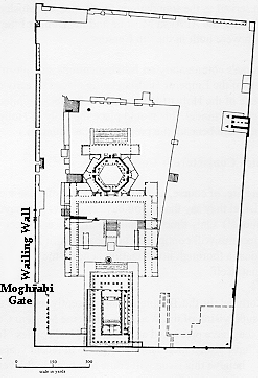
This is why there exists a gulf between mainstream archaeology, which is run by fundamaterialist libocrats, and the true story of the Exodus, which likely did occur in the 16th century. Both groups want to delegitimise Israel, one out of disgust for religion and "colonialism," the other out of a desire to conquer and convert the world. Both create fictitional archaeology to support their claims.
Video, "There was nothing before Islam!
Saturday, March 20, 2010
The Ark of What?
From 4 March 2008.
Professor Tudor Parfitt, from the University of London's School of Oriental and African Studies says he has found the Ark of the Covenant. Now if this is true he has just made the greatest archaeological discovery of all time and would probably become a multimillionaire overnight as every producer on the planet would want to turn his story into the latest Hollywood blockbuster. But not so fast.
What he claims is the Ark is not the same item described in the Bible. There are many refrences in the Bible that give a good description of what the Ark looked like, its size and decorations. Of course Parfitt can't accept that the ancient Israelites could make a chest that size and cover it with gold, ignoring the fact that they just came out of Egypt which led the world in gold working at the time, built similar chests for holding religious objects, and that given the rich history the Jews had in Egypt (starting with Joseph being Vizier and Moses being Crown Prince until he was exiled) it is likely that one of the 600,000 of them knew how to work gold.
He also brings up the fact that since Egypt had no gold coin then the Israelites would have to steal "huge" gold ritual objects to turn into the covering for the Ark. Never mind the fact that gold is the most malleable of all known metals. In fact as one source puts it "A single ounce of gold can be beaten into a sheet measuring roughly 5 meters on a side. Thin sheets of gold, known as gold leaf, are primarily used in arts and crafts for gilding." If a single ounce of gold can be beaten into a sheet that big there is no need for a huge amount of gold to cover the inner and outer surface of the Ark. Just a little bit will go a long way.
Don't forget that almost every royal tomb had been broken into and the vast stores of gold had been stolen from them. Stolen gold was a readily available comodity in ancient Egypt, that is, unless you got caught. With 600,000 people I'm sure at least one of them could have gotten away with enough gold to coat the Ark.
Parfitt instead looks to a passage from Deuteronomy (10:1-5) that doesn't mention gold or cherubim or anything like that. It is very brief and very vague and in line with Biblical scholars and lay people throughout history Parfitt decided to put his words into the mouth of Moses and uses this passage to justify something that the Bible doesn't say: namely that the Ark was not an elabourate chest covered in gold and such but was a simple wooden drum. Yes, it was a drum, not a chest, a drum. He claims that it was brought down to Africa after the first temple was destroyed and taken to a tribe of people called the Lemba (who have been shown to possess DNA from the Temple priests). He claims the drum that was the Ark decayed over time and was remade again and again and now exists as a broken wooden object in the warehouse of a museum in the middle of a war zone called the Ngoma Lungundu. He even had a two hour History Channel documentary (now called just "History" and not "The History Channel," which seems incredibly arrogant) that was an extreme disappointment just like with Zheng He who didn't discover America before Lief Ericson.
What he is doing is not archaeology. It is Biblical revisionism and an excuse to get grant money to fund his pet trips to Africa so he can have a good time with his Lemba friends and laugh at all serious scholars of the Bible. Maybe I'm just too attached to the notion that the Ark of the Covenant has inspired too many people to be a heap of wood and that the writers of the Bible just invented some fictional bill of materials for its construction, but why would there be so many refrences to gold that are fake and only one refrence not mentioning gold being correct? Why would there be design specifications if there was not an actual object (you can argue that Noah's ark was a fabrication but a simple gold inlayed chest the size of a large suit case seems tiny enough to grant something of the sort was actually built)? Maybe I just want there to have been a real Ark of the Covenant too much to accept that every time the Bible says it was a chest for holding objects that it was talking about a stupid musical instrument that bares no resemblance to what is described in the text. Anyway, I still say Prof. Parfitt is wrong and is making a mockery of serious archaeology in what he is suggesting.
Some quotes from the above most link.
"What Parfitt found cannot be described as a wooden box, roughly 4 ft. x 2 ft. x 2.5 ft., gold-plated and carried on poles inserted into ring. In fact, it an old drum with an uncharacteristic burnt-black bottom hole, the remains of carrying rings on its corners; and a raised relief of crossed reeds that Parfitt thinks reflects an Old Testament detail."
"A splinter has carbon-dated the drum to 1350 AD, making it probably the oldest wooden relic in sub-Saharan Africa, but far too new to be the Ark of the Covenant. Undaunted, Professor Parfitt declares, 'There can be little doubt that what I found is the last thing on earth in direct descent from the Ark of Moses.'"
"OK, I watched it. The 'scholarship' was so bad, my eleven-year-old son was correcting the professor. This is pure sensationalism."
"The professor will make a lot of money and gain a lot of notoriety, but there is not a serious scholar in the world who will respect his 'discovery'."
-Dee
Professor Tudor Parfitt, from the University of London's School of Oriental and African Studies says he has found the Ark of the Covenant. Now if this is true he has just made the greatest archaeological discovery of all time and would probably become a multimillionaire overnight as every producer on the planet would want to turn his story into the latest Hollywood blockbuster. But not so fast.
What he claims is the Ark is not the same item described in the Bible. There are many refrences in the Bible that give a good description of what the Ark looked like, its size and decorations. Of course Parfitt can't accept that the ancient Israelites could make a chest that size and cover it with gold, ignoring the fact that they just came out of Egypt which led the world in gold working at the time, built similar chests for holding religious objects, and that given the rich history the Jews had in Egypt (starting with Joseph being Vizier and Moses being Crown Prince until he was exiled) it is likely that one of the 600,000 of them knew how to work gold.
He also brings up the fact that since Egypt had no gold coin then the Israelites would have to steal "huge" gold ritual objects to turn into the covering for the Ark. Never mind the fact that gold is the most malleable of all known metals. In fact as one source puts it "A single ounce of gold can be beaten into a sheet measuring roughly 5 meters on a side. Thin sheets of gold, known as gold leaf, are primarily used in arts and crafts for gilding." If a single ounce of gold can be beaten into a sheet that big there is no need for a huge amount of gold to cover the inner and outer surface of the Ark. Just a little bit will go a long way.
Don't forget that almost every royal tomb had been broken into and the vast stores of gold had been stolen from them. Stolen gold was a readily available comodity in ancient Egypt, that is, unless you got caught. With 600,000 people I'm sure at least one of them could have gotten away with enough gold to coat the Ark.
Parfitt instead looks to a passage from Deuteronomy (10:1-5) that doesn't mention gold or cherubim or anything like that. It is very brief and very vague and in line with Biblical scholars and lay people throughout history Parfitt decided to put his words into the mouth of Moses and uses this passage to justify something that the Bible doesn't say: namely that the Ark was not an elabourate chest covered in gold and such but was a simple wooden drum. Yes, it was a drum, not a chest, a drum. He claims that it was brought down to Africa after the first temple was destroyed and taken to a tribe of people called the Lemba (who have been shown to possess DNA from the Temple priests). He claims the drum that was the Ark decayed over time and was remade again and again and now exists as a broken wooden object in the warehouse of a museum in the middle of a war zone called the Ngoma Lungundu. He even had a two hour History Channel documentary (now called just "History" and not "The History Channel," which seems incredibly arrogant) that was an extreme disappointment just like with Zheng He who didn't discover America before Lief Ericson.
What he is doing is not archaeology. It is Biblical revisionism and an excuse to get grant money to fund his pet trips to Africa so he can have a good time with his Lemba friends and laugh at all serious scholars of the Bible. Maybe I'm just too attached to the notion that the Ark of the Covenant has inspired too many people to be a heap of wood and that the writers of the Bible just invented some fictional bill of materials for its construction, but why would there be so many refrences to gold that are fake and only one refrence not mentioning gold being correct? Why would there be design specifications if there was not an actual object (you can argue that Noah's ark was a fabrication but a simple gold inlayed chest the size of a large suit case seems tiny enough to grant something of the sort was actually built)? Maybe I just want there to have been a real Ark of the Covenant too much to accept that every time the Bible says it was a chest for holding objects that it was talking about a stupid musical instrument that bares no resemblance to what is described in the text. Anyway, I still say Prof. Parfitt is wrong and is making a mockery of serious archaeology in what he is suggesting.
Some quotes from the above most link.
"What Parfitt found cannot be described as a wooden box, roughly 4 ft. x 2 ft. x 2.5 ft., gold-plated and carried on poles inserted into ring. In fact, it an old drum with an uncharacteristic burnt-black bottom hole, the remains of carrying rings on its corners; and a raised relief of crossed reeds that Parfitt thinks reflects an Old Testament detail."
"A splinter has carbon-dated the drum to 1350 AD, making it probably the oldest wooden relic in sub-Saharan Africa, but far too new to be the Ark of the Covenant. Undaunted, Professor Parfitt declares, 'There can be little doubt that what I found is the last thing on earth in direct descent from the Ark of Moses.'"
"OK, I watched it. The 'scholarship' was so bad, my eleven-year-old son was correcting the professor. This is pure sensationalism."
"The professor will make a lot of money and gain a lot of notoriety, but there is not a serious scholar in the world who will respect his 'discovery'."
-Dee
Sunday, January 17, 2010
The Age of The Bible
Yahoo News has put up an article about a piece of pottery discovered last year that includes parts of biblical verses. This finding, which took a year to discipher, indicateds that the Bible dates back to at least the tenth century BC, 400 years earlier than previously thought. It also indicates that the kingdom of Israel existed at least since the tenth century, and is the first clear use of the Hebrew language yet discovered. The text resembles portions of the books of Exodus, Psalms, and Isaiah, which, if they existed at the same time helps to discredit the documentary hypothesis, that say different people wrote the Torah (the five books of Moses which he is supposed to have recieved from God directly on Mt. Sinai) and some priest later put the differend books together and edited them to create a religion (Judaism) to basically make people fall in line.
-Dee
-Dee
Saturday, August 29, 2009
Kabbalah and Cosmology with Harold Gans
Monday, December 22, 2008
Jesus in India
I just saw the documentary Jesus in India, which examins the evidence that Jesus visited India during the 18 years of his life missing from the Gospels. While very good the producers made out on Coast to Coast AM the other night that whoever sees this program should be totally convinced that Jesus visited India after watching it. The documentary mainly consisted of interviews of people in the west saying that a document in a Buddhist monestary, The Life of Saint Issa, that was discovered by Nicolas Notovitch in 1894 is a fake and getting very angry for even bringing it up, and then there were people in India saying absolutely it's real but copies have to be protected so it can't be shown to anyone. Starting out as someone who already believes Jesus visited India I can say I am pleased that someone actually made a documentary dealing with the topic. However, watching this documentary is not likely to change anyone's opinions regarding the topic. Maybe the extra 80 minutes of footage on the DVD say something more convincing, but I don't yet know. If I can get my hands on a copy of the DVD I'll let you know how convincing or not it is.-Dee
Subscribe to:
Posts (Atom)