Ken_Wilber Socrates Padmasambhava Jesus Ramanamaharshi Bodhidharma Richard_Rose
Showing posts with label Mathematics. Show all posts

Sunday, April 7, 2013

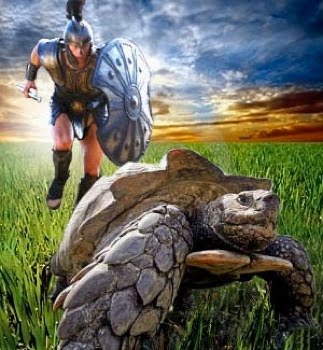
Achilles and the Tortoise

Brad_Pitt


Zeno's arguments about motion, which cause so much disquietude to those who try to solve the problems that they present, are four in number. The first asserts the non-existence of motion on the ground that that which is in locomotion must arrive at the half-way stage before it arrives at the goal. This we have discussed above.

The second is the so-called 'Achilles', and it amounts to this, that in a race the quickest runner can never overtake the slowest, since the pursuer must first reach the point whence the pursued started, so that the slower must always hold a lead. This argument is the same in principle as that which depends on bisection, though it differs from it in that the spaces with which we successively have to deal are not divided into halves. The result of the argument is that the slower is not overtaken: but it proceeds along the same lines as the bisection-argument (for in both a division of the space in a certain way leads to the result that the goal is not reached, though the 'Achilles' goes further in that it affirms that even the quickest runner in legendary tradition must fail in his pursuit of the slowest), so that the solution must be the same. And the axiom that that which holds a lead is never overtaken is false: it is not overtaken, it is true, while it holds a lead: but it is overtaken nevertheless if it is granted that it traverses the finite distance prescribed.

Aristotle, Physics VI:9


The first two paradoxes (the dichotomy and the Achilles) are directed against the opposite conception, that of the infinite divisibility of space and time, and are based upon the impossibility of conceiving intuitively the limit of the sum of an infinite series. The four paradoxes are, of course, easily answered in terms of the concepts of the differential calculus. There is no logical difficulty in the dichotomy or the Achilles, the uneasiness being due merely to failure of hte imagination to realize, in terms of sense impressions, the nature of infinite convergent series which are fundamental in teh precise explanation of, but not involved in our oubscure notion of, continuity.

C. B. Boyer, The History of the Calculus and Its Conceptual Development, p. 24-5


Of course Achilles wins. The distances and the times between each step get shorter.


Let's say Achilles and the tortoise are given a 1 kilometer track that they must race.


The
tortoise is given a 100 meter head start. Achilles travels that same
100 meters in 10 seconds (just under the world record). When he gets
there, the tortoise has travelled a farther 10 meters (we can already
see, the tortoise has a speed of 1 meter/second and Achilles has a speed
of 10 meters/second). No problem, this takes Achilles 1 second to
travel that 10 meters, by which time the tortoise has traveled only 1
farther meter. No problem, this takes Achilles 1/10 second to catch up
(we're now straining human reflex time to even notice these small
numbers). How far would the tortoise travel in that 1/10 of a second?
Less than 1 meter. So what? In the next 9/10 seconds the tortoise will
have travelled 1 meter from where it was 1 second ago while Achilles
will be 9 meters ahead of the
tortoise. Given a 100 meter head start it will take Achilles (assuming
he does not fatigue over the distance) 11.2 seconds to overtake the
tortoise.


Even if Achilles slows down from fatigue, he will be
much farther down the track than the tortoise. So far, in fact, that the
tortoise will have no chance of catching up unless Achilles decides to
stop and wait just to taunt the tortoise (Achilles was a notorious
braggart).


Not much of a paradox, is it?

Sunday, July 15, 2012

The Bible Code

Looking through a box of books I discovered Michael Drosnin's original The Bible Code. This got me thinking about a documentary film on the Bible code I had seen a few years ago. Here it is below:


It runs 45 minutes.


The above film includes interviews with charlatan Brendan McKay (who admits his stunt with Moby Dick was a stunt and that he didn't bother with the scrambling method that produces the real statistically significant results in the actual code, and despite this he is still touted as an expert all over the Internet) and Barry Simon (who believes that God would not create the code because then it would prove God's existance and then everyone would be forced to believe against their free will), both of whom reject a priori the possibility of the code and are therefore not scientists.


It also includes interviews with Eliyahu Rips, who discovered the code using computer technology.


Here is a brief (7 minutes) detailed explanation of the original experiment, it's supposed refutation, and the second study that the skep-dicks have ignored and remains unrefuted, presented by Moshe Zeldman.


Sunday, January 22, 2012

Why "The Walking Dead" Can't Happen

UPDATE: Everyone's infected! Problem solved. (18 March 2012)


Let's get it out first that this will be dealing only with the television series, not the comic book. The comic book nicely avoids this problem all together by having everyone who dies for any reason except brain injury reanimate.


Aside from the first half of season two being about two episodes stretched out to seven and not getting anywhere for no apparent reason (money?), and the improbable aiming skills the characters have (try making a head-shot every single time while both you and your target are moving top speed - bet you can't!)*, and the glaring inconsistencies with how the zombies work**, the whole business of zombification would render the story completely impossible from the start.


In the TV series "The Walking Dead" the only way someone becomes a zombie is to be bitten by a zombie, escape, die, and then reanimate. It doesn't help to be bitten and then devoured because there's nothing left to reanimate. You have to kill the zombie (kill, they're already dead!) or run away, and then go croak somewhere because a zombie bite is always fatal. Then when you die you have to be far enough away from the zombies to not have your body eaten, because reanimation isn't instantaneous. Dr. Jenner stated that it takes a few minutes to a few hours before the brainstem starts up again, so if you're eaten within that window you won't zombify.


Anyone who dies but is not bitten will not zombify, as the mess of bodies in the traffic pile up attest to. This leads one to wonder if the process of zombification takes so long and requires a bite from a creature that certainly won't say "he's dead, I'll attack a living now and leave his body to zombify," you're going to have a hard time reaching plague proportions. Consider next the fighting abilities of humans and zombies. Zombie to human kills are at least eight to one. Anyone with a gun will kill as many zombies as they have bullets, guaranteed. Unless a minimum of eight zombies attacks any person, no matter how big or strong or fast or smart or well armed, that person will survive. When we combine these two problems there is absolutely no way we can have a global zombie pandemic with only a handful of humans left. The mathematics just doesn't work. If zombies are so damn difficult to make and so damn easy to kill there is absolutely no way to get a zombie apocalypse going. Maybe a couple towns will be caught off guard, but not an entire country, and certainly not the whole planet.


Don't say that maybe one zombie bit ten or twenty people before being put down. They don't do that. A zombie will keep attacking someone until they eat the person or are destroyed. They are not smart enough to sacrifice themselves by biting several people to spread the plague before being killed. Zombiism doesn't spread fast enough for a zombie to bite someone, have them turn, and then move on to someone new. Unless we eliminate one or both of the above facts - the dificulty of zombification or the kill disparity - there is no way "The Walking Dead" can happen. That's what you get when you try to have dead zombies who spread like living zombies.


*Andrea is the only one that has ever missed, and only because missing was relevant to advance the story, and she still very nearly killed Daryl (with a head shot, as if I needed to mention it) at 200+ yards, from an unsupported prone position, facing the sun, with an unknown number of head winds, with five friendlies just feet away from Daryl, on the second time she's ever fired a gun. Damn! Now that's beginner's luck! Her stupidity could easily have killed one or more of six people. Even if there was a zombie there's no way a thinking person would have attempted a shot like that.


**Sometimes they hunt by smell, other times they don't; sometimes loud sounds like gunfire will attract them, other times you can teach people how to shoot all afternoon and attract no attention at all; whatever reanimates them only restartes the brainstem but people can hit them anywhere in the head and still bring them down, going so far as to have Daryl shoot one with his crossbow up through the jaw and hard palate into the nasal cavity and kill it after it started gnawing on his boot even though the bolt would have only gone through the frontal lobes, which were explicitly stated to not restart with zombification.

Monday, January 16, 2012

Balking Hawking Part 3: In The Beginning

Ever since the idea of the Big Bang was conceived cosmologists who hated God looked for a way around creation. The universe couldn't have a beginning; it would ruin the perfect harmony of an eternal universe. No beginning, no need for an explanation, right? To celebrate Hawking's 70th birthday here is a third installment in the series on him, his cosmology, and his theology.


See Also Balking Hawking Part 1, Part 2, and Georg Cantor's Infinities Part 2.


From NewScientist:


"Many physicists have been fighting a rearguard action against [the Big Bang] for decades, largely because of its theological overtones. If you have an instant of creation, don't you need a creator?


Cosmologists thought they had a workaround. Over the years, they have tried on several different models of the universe that dodge the need for a beginning while still requiring a big bang. But recent research has shot them full of holes (see "Why physicists can't avoid a creation event"). It now seems certain that the universe did have a beginning."


Lawrence Krauss in his new book A Universe From Nothing tries to deal a knock-out blow to the deity by replacing one metaphysical system with another. God is given up for the multiverse, a cacophony of quantum randomness belching out universes like Our Idiot Brother.


It is in vogue now to redefine "nothing" to mean "the quantum vacuum that has always existed," but in an interview on Coast to Coast AM, Krauss does his fellow metaphysicists one better. He admitted that you don't even need a quantum vacuum or quantum laws, as NewScientist explains:


"However, the laws of physics can't be conjured from nothing. In the end, the best answer is that they arise from our existence within a multiverse, where all the universes have their own laws - ours being just so for no particular reason.


Krauss contends that the multiverse makes the question of what determined our laws of nature "less significant". Truthfully, it just puts the question beyond science - for now, at least. That (together with the frustratingly opaque origins of a multiverse) means Krauss can't quite knock out those who think there must ultimately be a prime mover. Not that this matters too much: the juvenile asides that litter the first third of the book (for example, "I am tempted to retort here that theologians are expert at nothing") mean that, by the time we get to the fascinating core of his argument, Krauss will be preaching only to the converted."


[emphasis mine]


The multiverse: the great unknown and unknowable. A meta-space that is beyond our space-time and thus forever beyond our ability to test it. Being untestable the multiverse must surrender its claim to the title "science" and accept that it is now, and forever, metaphysics. To do away with the idea of a creation, an absolute beginning of the universe, Krauss throws science away and invents an untestable story. Even the Bible contains historical details that can be tested, the multiverse is just "bullshit metaphysics".


Metaphysicists have tried to propose systems where the universe (or multiverse) is eternal into the past, but Alexander Vilenkin of Tufts University has shot holes in all of them (even though he still believes in the multiverse, it had to have a beginning in the finite past).


Eternal inflation, the idea that the inflation that sped up the expansion of the early universe didnt' stop, it still continues in other regions of space beyond our cosmic horizon, spawning new bubble universes forever, was the first to go. Some thought inflation was eternal into the past too, but in 2003 Vilenkin and Alan Guth ran the calculations on Hubble's Constant and found that it doesn't work. Inflation may continue forever into the future, but it had to have a beginning in the past.


Next came the big bounce, the idea that after a long time, a trillion years or so, expansion slows and stops, eventually reversing until everything flys back into a single point called the Big Crunch. Then the shock of impact of everything on everything starts a new Big Bang, and the cycle continues forever. Unfortunately, disorder increases with time, so each new universe must be more disordered than the one that birthed it. If the cycle had been going on forever disorder would be infinite and the universe would be completely featureless. Since there's stuff in the universe the cycles couldn't have gone on forever. Some people then suggested that the universe just gets bigger with each bounce, so the disorder spreads out more so no one notices it (like in the M-Brane ekpyrotic model and possibly whatever the hell Penrose's new idea is - no one seems to understand his Aeons of time model, within the physics community or anywhere). But if the whole thing is getting bigger it had to start somewhere really really small, maximally small, and that means a finite beginning.


There's also an idea from the 1930s called the cosmic egg or primeval atom, where yes, there was a Big Bang 13.7 billion years ago, but the thing that banged was an uber-dense subatomic thing that existed forever until it got tired of existing as a tiny little particle and exploded. However, Vilenkin and a graduate student Audrey Mithani showed that quantum instability would have led to the egg's collapse after a finite time. The crack (the Big Bang) had to happen before the egg collapsed into oblivion so it couldn't have existed forever, even if it existed for a really, really long time before the Big Bang.


Vilenkin concludes[:] "All the evidence we have says that the universe had a beginning."


V.J. Torley of UD comments on the implications of a universe requiring a beginning. He reasons (muses, really), in line with William Lane Craig, that the cause of the universe, which cannot be within the universe itself, must be personal. Scientific and mathematic laws are just descriptions of observations. They are not Platonic furniture of reality, and they are causally inert. Only a person, an agent, can bring about the creation of the universe, acting for some reason. The evidence from fine tuning (not only of the universe, but if you read Georg Cantor's Infinities Part 2 and other links provided in the UD article, you'll see that the multiverse too must be fine tuned) is suggestive of a highly mathematical and aesthetic mind behind the constants of the universe.


There you have it, a birthday present, albeit a very bad one, from Alexander Vilenkin to Stephen Hawking: a universe with a definite beginning in the finite past.

Saturday, November 13, 2010

Georg Cantor's Infinities (Part Two)

Continuing the last post on Cantor and how he overturned the entire world, this story comes from UD and is called "Infinitely Wrong."


Cantor demonstrated that some infinities are bigger than others (infinitely so). Robert Sheldon, in the post linked above, attempts to demonstrate that cardinality can be used to show how the multiverse can't save Darwinism.


As Roger Penrose pointed out, in order to avoid conflicting with the second law of thermodynamics, the Big Bang had to be insanely precise. According to Penrose (who now believes that after all the matter in the universe is swallowed up by black holes, and after they evapourate leaving behind nothing but photons, everything gets bigger and somehow the universe starts over again, forever, but that's a different story), the force causing the expansion of the universe has to match the force of gravity to at least one part in 10^(10^123) or the universe would have either exploded into nothing or collapsed back right after it banged. I'm not sure just how many zeroes are in that number, but think of it like this: if the universe had one more or one less proton (or probably less mass than that) at the Big Bang it wouldn't be here right now for us to talk about (or me to bore you about). Hawking, who was balked in September, places the ratio at a more reasonable one part in 10^60.


The Hawking solution to this seemingly fine-tuned feature? Infinite time + infinite space. Hawking et al. propose universes popping into existence all the time in their bubble multiverse. With infinite universes being created in a process that has infinite duration anything that can happen will happen, no matter how improbable, including gravity matching the expansion of the universe to that whole stack of tens. However, at least one part in 10^(10^123) does not mean that the fine-tuning is exactly that precise, just that that is the minimum precision of the fine-tuning. It could be more. It could even be infinite.


To deal with this, according to Sheldon, the anti-design folks ask Hugh Everett for help with creating infinitely more universes. Doing some fancy mathematics, if I'm reading it right, the anti-design folks can get an Aleph-naught infinite number of universes out of their quantum fudgery to solve a design problem with an Aleph-one cardinality, something that is impossible because the fine-tuning is now infinitely larger than the attempts at explaining it away by chance.


So, if all that made sense to you, it should have clearly been demonstrated that an infinite multiverse cannot solve the problem caused by the fine-tuning of the physical constants.


-Dee

Tuesday, November 9, 2010

Why The Multiverse Is A Disaster For Atheists

Vjtorley, UD contributor, has written an enormous thing about an article that explains how it is consistant to be a young earth creationist and still have millions of years old stars. In it he says that invoking a multiverse, a scenario in which there are an infinite number of "universes" in which everything that can happen does happen, does not disprove the existence of God. The number of universes where everything was created in 6,000 years is infinitely greater than the number of 13.7 billion year old universes. When you're dealing with infinities, the number of nonparsimonious universes is infinitely larger than the number of parsimonious universes, so the likely hood that we inhabit a nonparsimonious universe, like say one that's 6,000 years old yet has seemingly billion year old stars, is infinitely greater than the likelihood we inhabit a parsimonious universe. When you deal with infinities you have to throw parsimony out the window. Also, having a multiverse that's been around for 6,000 years yet still has infinitely many universes that were all created 6,000 years ago still has that pesky infinity problem to get around.


The whole UD piece is monstrously long and involves many more points than I could possibly add to this summary, so I'll just skip to the end: "I conclude that a skeptic who wishes to deny the reality of God by positing a multiverse containing an infinite number of universes is engaging in scientific and intellectual suicide. Such a skeptic no longer has a reason to believe in a 13.7 billion-year-old universe which unfolded in an orderly fashion, without any changes in either the laws of Nature or the constants of Nature. Indeed, the multiverse destroys the skeptic’s arguments against a 6,000-year-old universe. And finally, the multiverse fails to rule out God anyway – for you could always say that God created it." (bold and italics in original)


-Dee

Friday, November 5, 2010

Georg Cantor's Infinities (Part One)

From Uncommon Descent comes a wonderful video linked to by a poster bornagain77 (the one known for posting many thousands of words in the comments section). In the video very British people explain the history of infinity, Georg Cantor, and how he overturned the world.