Ken_Wilber Socrates Padmasambhava Jesus Ramanamaharshi Bodhidharma Richard_Rose
Showing posts with label Buddhism. Show all posts

Sunday, December 10, 2017

God and the Bogey Man

Most people don't understand God. The idea of God within the minds of most people is some super version of the ego (not Freud's super-ego, just the regular ego super-sized). They project their own values onto God, judging reality based on their own preferences. Since reality does not conform to their own preferences, and morality is egocentric, that means God must be an asshole for causing reality to deviate from egocentric morality. If God was good then God would be like Superman.

SUPERGOD

Super God would automatically intervene in every instance where reality deviates from the preferences of the individual. Super God is the ultimate incarnation of the nanny state. Super God negates all free will because free will implies a freedom to harm others, and if God conformed to individual preferences of egocentric morality then we couldn't have something like that, could we? That's why the robots need to imprison us, because humans are too irresponsible to take care of themselves.


This mistaken view of God as Superman, or Super God, can lead to one of two conclusions for people: atheism, in the form of the problem of evil, or misotheism, the hatred of God.


I've spoken about the problem of evil, or as I call it the non-problem of evil, because I just don't see what the problem is. The real problem is lack of wisdom and maturity (and perhaps imagination) on the part of the person assuming the problem.


We can see a good example of how the idea of God as Superman leads to atheism in Michael Drosnin's book The Bible Code. Michael Drosnin is speaking with an Israeli mathematician who originally discovered the code Eliyahu Rips. Assuming the code exists, Rips believes that the author is God, while Drosnin does not. Rips is an Orthodox Jew and believes in the God of the Torah. Drosnin is an atheist because he believes in Super God.


"For me, it was not that simple. I had proof there was a code, but not proof there was a God. If the Bible code came from an all-powerful God, he would not need to tell us the future. He could change it himself. The code seemed, instead, to be from someone good, but not all-powerful, who wanted to warn us of a terrible danger so we could prevent it ourselves." (P. 87)


That's a pretty powerful theological assumption underpinning Drosnin's desire to write God out of the picture.


For Michael Drosnin one could just as easily call the problem of evil "the problem of laziness." "If God exists then he could do things for me, so why should I have to? Since I have to do these things, therefore God doesn't exist." Michael Drosnin basically says the exact same thing "If the Bible code came from an all-powerful God, he would not need to tell us the future. He could change it himself." You can almost hear the author whinging: "But I don't wanna change the future, why can't God do it for me? Because he's stinky, that's why! I have to change the future myself, so God doesn't exist, aliens did it!"


So, who is the encoder? You might as well ask, "If the teacher already knows the answer why do I have to answer the question? It must be because the teacher doesn't exist." Why do we have to do things instead of having God do everything for us? Why do we have to do things instead of having almighty government do everything for us? For our own protection why don't we let the robots sequester us away where nothing bad can ever happen to us?


If Michael Drosnin cannot get around his childish fantasy of Super God doing everything, thus freeing Michael Drosnin of all thought and responsibility, what hope does he have of accepting God as the author of the code (assuming the code exists)?


The solution to the problem of evil is called theodicy. People have been writing theodicy for thousands of years, beginning perhaps with the Book of Job. God in Job gives us a sort of non-answer, basically saying Who are we to demand answers from God? Where we there when God created the world? Can we comprehend things from God's perspective from our vantage point here on Earth in these finite bodies?


This makes sense on one level, because just as a dog cannot comprehend why a human might do seemingly cruel things, like a vet performing an operation or something, from the wiser perspective of the human the operation makes perfect sense. The human has the dog's best interests in mind when performing the operation that will cause pain and discomfort because it corrects some life-threatening problem that the dog was facing. The little pain the human induces is better than the alternative, which is much greater suffering and death. We might not understand the purpose of suffering, from our limited, finite perspectives, but an omniscient God does, and sees that it is for the best.


That might make sense on one level, but it doesn't really like a satisfying answer, because we could basically say the same thing about anything. Why does anything exist instead of nothing? Why the sky blue? Why is gravity the weakest of the fundamental forces? Literally any question can be answered with "That's for God to know and don't ask questions, mortal." Philosophy vanishes at that point (and leaves me with nothing to do). That's why theodicy evolved beyond the Book of Job, not because the answer is distasteful, but because it's boring.


The existence of God was taken as given only until maybe the seventeenth century. People suffered deeply, but they didn't question the existence of God. They had a more mature view of God. The idea of Super God hadn't been invented yet. People pursued theodicy as philosophy, as love of wisdom, as a mystical practice, not in order to answer David Hume or Michael Drosnin. Philosophers wanted to get into the mind of God. "This is why you suffer, now what are you going to do about it?" That was the original purpose of theodicy. It's a more mature view than sitting in an armchair and trying to defend the idea that God is not Super God, because you're actually doing something with your life. You're actually progressing toward a goal, not just resting in a sense of smug self-assurance.


Jesus said "In the world you will have to suffer." John 16:33 is what I call the heart of the Gospels. "These things I have told you, that in me you might have peace. In the world you will have to suffer, but cheer up, I have overcome the world." It can't get any more simple than that. Suffering is an intrinsic part of life in this world. The Apostles not only believed that, they also believed God exists and that Jesus is God.


These weren't stupid people. Ancient people were not stupid. In a lot of ways they were smarter than people living today, because ancient people had to live side-by-side with death and privation on a daily basis. Knowing how to use a smart phone or the names of all 57 genders won't save you if the apocalypse happens and an EMP destroys all electronics, but knowing how to plant crops and make fire will. The Apostles could be transported to the modern world and in a relatively short amount of time (especially the ones who spoke Greek like Matthew and Paul, although Paul came later) they could use their skills to find jobs and survive.


On the contrary, if you were transported back to the first century you would almost certainly die of exposure or be killed by bandits in a week. Machines and other people do most of the living for you. You just need to show up at your job inserting tab A into slot B, if you have one, or maybe just sit on your ass and collect welfare and all your needs are met for you. The world has become so integrated that people have become specialised to a degree even people living two generations ago could not fathom. It's led to boredom, laziness, and a lack of wisdom and morality. Furthermore, it led to the creation of the idea of Super God.


Buddha too said in the first Noble Truth that life is full of suffering. He also said that suffering comes from desire (pride in the Christian tradition*), that there is an end to suffering, as Jesus alluded to, and we even have his solution to escaping suffering: the eightfold path. In Christianity we had hints of this path mentioned in the Gospel of Thomas and in the monastic practices of the Desert Fathers, but those teachings were lost for a millennium due to the meddling of Athanasius of Alexandria.


*As a side note, nowhere in Buddhism, not even its most advanced teachings found in Tibet, explains the origin of suffering as far as I can tell. Christianity does mention the origin of suffering, and, unlike the new age spiritualist teachings, Christianity makes recourse to known human psychology rather than assuming the potential motives of omnipotent, omniscient, eternal, indestructible beings. Suffering, in Christianity, arose out of pride, which is a specific desire, the desire to be special. God loves us all equally, but Lucifer wanted special love, thinking himself better than the rest of creation. Since God refused him special love he decided to poison creation by introducing pride into the hearts of humans and angels, leading to the war in Heaven and the fall of man.


C. S. Lewis had a brilliant thing to say about the non-problem of evil. He noted that the problem is based around a contradiction. If the world was as bad, even half as bad, as people who use the problem of evil believe, then there's no way the idea of a good God could have ever arisen. If the world was so filled with evil and suffering that it could prove God does not exist then no one would have ever thought up the idea of God in the first place. The only way the idea of God could exist is if the world is nowhere near as bad as the problem of evil people believe it to be.


As if the idea of Super God leading to atheism wasn't bad enough (at least there are rational atheists, and atheistic arguments aside from the problem of evil, which is a very poor argument), what's even worse is the idea of Super God leading to misotheism. Misotheism is absolute laziness. It is absolute narcissistic infantile histrionic personality disorder. And I mean that in the technical sense. People who hate God have highly unstable and exaggerated emotions, are attention-seeking, have excessive pride, an unshakable belief in one's own rightness, and at the same time an unshakable belief that their own problems are absolutely unique in the history of the world and that no one has ever suffered to anywhere near as great a degree that they have, are unwilling to accept personal responsibility and have a need to blame others for one's own mistakes, are often hypochondriacs, and often perceives relationships as more intimate than they actually are.


Hating God or being angry with God is a form of idolatry. It is replacing God with a Bogey Man of your own ego. The idea of Super God leading to atheism makes sense, because Super God doesn't exist. Self-evidently, because otherwise there would be no problem of evil. The problem of evil exists because God isn't Super God. Super God doesn't go around solving other people's problems. Not believing in something that self-evidently doesn't exist is rational. It's poor theology, but it's still rational thinking. Misotheism, on the other hand, is completely irrational. Misotheism is seeing that Super God doesn't exist and then turning around and creating an evil counterpart to Super God. Misotheism is turning God into the Bogey Man. [The evil counterpart to Super God – the Bogey Man – is technically an extreme version of dystheism, the idea that God is not entirely good. In its extreme form dystheism supposes an entirely evil deity. The hatred of God – misotheism – naturally supposes that this extreme form of dystheism is true.]


The Bogey Man is a fictional entity whose purpose is to terrorise mainly children, because, let's face it, a lot of adults are assholes. Super God as the Bogey Man is a fictional entity for histrionic people to project their anger onto for being inadequate, because histrionic people are assholes.


Super God as the Bogey Man (who I will hereafter refer to simply as the Bogey Man) would not only be less good and moral than regular God, the Bogey Man would be evil. The Bogey Man would be the antithesis of God.


The Bogey Man must suspend free will in order to intervene in all situations. People want Super God to intervene to stop criminals from committing crimes, for example. People don't ask for Super God to prevent criminals from thinking about committing crimes, but for Super God to intervene only in the act of preventing crimes. Since Super God (the Bogey Man) is also believed to be the cause of all things then that means the Bogey Man must have placed the thought to cause the crime into the mind of the criminal and then is supposed to intervene in stopping the criminal from committing the crime. The criminal is just a puppet in the Bogey Man's hands. The criminal's mind is shackled to a body that it has no control over. The Bogey Man is making the criminal commit the crime and then prevents the crime as it is happening. The Bogey Man chooses to make some people sinners, destined for Hell just to have people to send to Hell.


If the Bogey Man exists then nothing you do has any meaning, because the Bogey Man is pulling all the strings. The Bogey Man controls all your actions, causes all of your suffering (even suffering caused by your own choices, because you have no free will, which conveniently relieves you of any responsibility), and then hands out punishment or reward on fiat.


The existence of the Bogey Man is even worse than that. Not only are you being made to suffer in life and rewarded or punished at random, you don't even control your own body. At the very least your mind is locked into a body that you have no control over (in some extreme cases even your mind is controlled by the Bogey Man, freeing histrionic misotheists from responsibility even for their own thoughts). That's absolutely terrifying. At best you are a prisoner of a body you do not control. At worst even your anger itself is caused by the Bogey Man.


If the Bogey man exists not only is your life meaningless, your life is nothing but entertainment for an omnipotent sadist. That's even worse than Descartes' evil demon, who can only trick you. With Descartes' evil demon you can still realise that the world is an illusion and come to know the true God through reason. The Bogey Man directly controls you, absolutely. While it is possible to outsmart the evil demon the Bogey Man is totally unbeatable.


Super God as the Bogey Man must be evil. That's why belief that Super God actually exists leads to misotheism.


Why someone would believe in the Bogey Man I've already explained. People who believe in the Bogey Man have to believe in the Bogey Man. Not because the Bogey Man forces them to believe, but because the Bogey Man frees them from responsibility and makes their problems out to be totally unique in the history of the universe.


Of course God is not Super God, or the Bogey Man. Belief in Super God or the Bogey Man is stupid and childish. The same God who gave us reason did not intend for us to forgo its use. That line of thinking will lead us eventually to Blaise Pascal, Rene Descartes, and into using our reason and contemplation to reach a better understanding of the mind of God and the origin of and solution to suffering.

Wednesday, August 23, 2017

Ken Wilber: Only Religion Can Save The World

Ken Wilber explains why only religion provides the structures and tools necessary for both growing up and waking up. Nothing else can create a cohesive community that gives meaning to our lives, or provide the means of escaping suffering and discovering our true identity.


Thursday, January 19, 2017

A Guide to Your Interiors

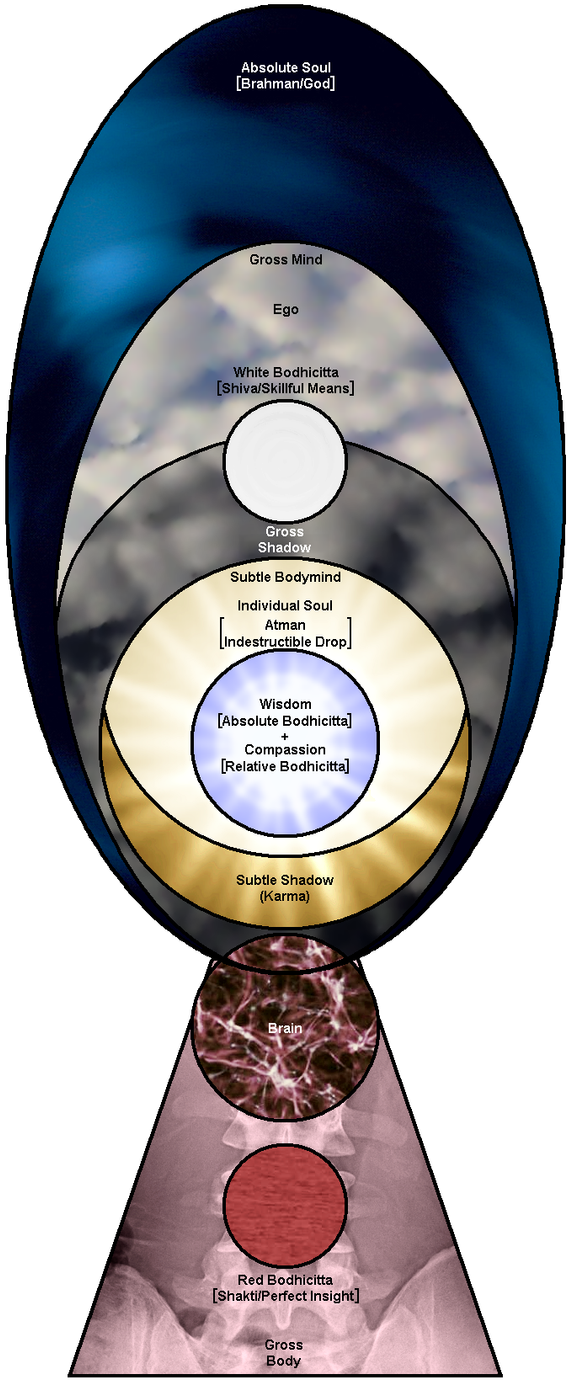
Absolute


Starting at the bottom, everyone knows what the Gross Body is. It's the thing we normally think of when we think of the body. Sometimes it is gross, but here it's referred to as gross because it is the most dense form of matter.

At the top of the Gross Body is the Brain. Everyone knows what the brain is. It's a vital organ and most people only use the stem. The brain is the seat of consciousness, most likely the microtubules.

Right below the brain is something called the Red Bodhicitta, located at the navel. It's part of the subtle anatomy, but it's more tied to the gross anatomy than it is to the subtle bodymind. It's located here in relation to the brain because it's relative location is important. The red bodhicitta represents perfect insight. It is one of two anchors that hold keep the soul attached to the body, and is the power source of the body. It provides the energy for meditation. We get the red bodhicitta from our mother.

Atop the brain is a series of elliptical forms.

I'll start with the white circle. It is the White Bodhicitta, and it is skillful means. It is said to be the mind of enlightenment. At the moment of death the white bochicitta descends from the crown of the head and presents us with the perfect opportunity to attain enlightenment. If not, we'll get several other chances later on, but that's a topic for another day. We get the white bodhicitta from our father.

The next biggest ellipse, with the pretty clouds, is the Gross Mind. That's what we think of when we think of the mind. The gross mind is almost constantly full of thoughts that arise and cease, represented here as clouds that obscure the clear blue sky. The gross mind contains two parts, the Ego, which is the frontal personality that we associate with, and the Gross Shadow (the darker part), which is all the stuff we have disidentified with and have repressed. The shadow is almost always unconscious, and it is much larger than the conscious ego. It is the seat of projection. Any bit of the shadow we do not reintegrate into the ego during this lifetime we must deal with either in the between life state or the next life. There is no getting around it.

Inside the gross mind is the Subtle Bodymind (a combination of the subtle body and the subtle mind). It is full of golden light, often encountered in the early stages of meditation. The subtle bodymind is what reincarnates. Any it of the gross shadow that we failed to deal with in life will accumulate in the Subtle Shadow, the darker part of the subtle bodymind. Sometimes it's called Karma, but that word has a lot of baggage associated with it. It's the aspects of our self that we do not want to deal with. It is all the unconscious tendencies that pull us through life, and pull us to the next life. It doesn't seem to be a sort of accountant that balances good deeds and bad deeds, it seems to be more like a magnet that draws us to a life we are most attune with. Fears, addictions, unresolved issues, all of that pulls us in certain directions. Usually directions the ego does not want.

Inside that, at the very center of the self, is the Individual Soul (sometimes called the Atman or the Indestructible Drop), represented here as a sphere of blue light (often encountered in deeper stages of meditation). The soul is the original self-contraction that started manifestation. It is made of two things: wisdom (absolute bodhicitta) and compassion (relative bodhicitta). Wisdom is our capacity to recognise emptiness, and compassion is our capacity to be moral. The soul is said to be absolutely indestructible. It is the very subtlest mind of enlightenment that anchors all other structures. The soul is indestructible even for perfectly enlightened buddhas. It is not an unchanging substance, or a thing, it is the very heart of the mind. If the soul never changed then enlightenment would be impossible!

At the very outside, the biggest ellipse, is the Absolute Soul (God or Brahman). It is Absolute Existence and Absolute Truth. It is clear light (clear meaning transparent, like pre-dawn twilight). Absolute freedom and fulfillment; the source and goal of all existence. The gross body is projected out from the Absolute and appears to us to be something outside and apart from it, but you can see from the overlap that the gross bodymind, like everything else, exists within the Absolute. At the moment of enlightenment the individual soul identifies with and abides as the Absolute Soul without any loss of individuality.

Saturday, July 9, 2016

Judging Judgment

Twice this past week I've read, in two different books, that judgment gives you power over people, or at least it gives you the illusion of power, and that's why you should never do it. I don't believe either of those statements.


First off, Jesus commands us to judge. Idiots, or lazy people, or narcissists, or sybarites read "Judge not..." and then black out the rest of the chapter because they satisfied their craven desire to avoid judgment. But if you actually read it, and you're not using one of the modern pussy "translations", what Jesus is telling us is not to judge others by a different standard than the one we use to judge ourselves. He flat out says "Don't be a hypocrite" (a Greek word that only a Greek-speaking audience would understand, indicating that Greek was Jesus' native language, which makes perfect sense since it was the official language of the whole eastern Mediterranean for the previous three hundred years and the language spoken in all the big cities where Jesus worked), not "Don't judge anyone under any circumstances ever".


Later in Matthew Jesus says if you see your brother trespass against you tell him so he can correct his action.


Then we have in John where Jesus says to "Judge righteously".


And Paul continues reasserting the need for right judgment by rebuking the Corinthians for not judging one of their own who had sinned.


It becomes a matter of who am I going to believe, Jesus or some pop culture writer? Not that difficult a choice.


The whole idea of not judging comes from the perverted anything goes "If it feels good do it" mentality that poisoned a generation in the 60s and has been used to brainwash children in the schools for the past 30 years. And the people who say not to judge almost always do so ironically, because they are judging while they admonish judging! The statement is self-defeating, like the assertion that Absolute Truth does not exist. If you judge people for judging then you are the very thing you allege (it's a lie) to despise, which is itself a judgment and is itself what Jesus rebuked in the part of the verse you blacked out!


And second, I don't think judging others puts you in a position of power, at least perceived, over that person. Not if you're using right judgment as you are commanded to. If you're judging everyone, including yourself, by the same standard then how does that put you in a position of power? You are also among the group being judged, and the standard of judgment is not based on your own caprice but on what is True.


I know I fall short of the standards by which I judge. Does that mean I'm placing myself in a position of power over myself? Does that even make sense? How can I have power over myself other than through willed action? In order to exert power there must be a self and an other, but if there is just a self then there can be no exertion of power, and no relationship of any kind.


If you see someone with an untied shoe and you say "Your shoe's untied," you don't have power over that person, you just have a different perspective, and you're using that perspective to help that person. That's compassion, not power. You would want the other person to do the same for you. That's right judgment. If you're doing something stupid and self-destructive you would want, at least subconsciously, someone to tell you, just as you would tell someone who you see doing something self-destructive, out of compassion, not power.


People today have the wrong view of sin. Sin is not about angering God or about anyone holding power over anyone else, it's natural law. If you do this, you will get this. If you try to unbalance the universe the universe will take steps to rebalance itself. And you can never win. Sin should be thought of like causality. If you smoke heroin you destroy your body and have to face the physical consequences regardless of whether you're a good person or not (unless you're Keith Richards, then your body is indestructible); if you rape children you destroy your soul and you face the metaphysical consequences. I picked a particularly obvious example, but it gets subtler than that. Sin says that actions (and thoughts) have consequences because the mind works in a certain way and garbage accumulates over a lifetime and there's no way to escape that no matter how good we are at ignoring it or rationalising it away. At death we are exposed to the clear light of Absolute Reality, and it becomes impossible to lie to ourselves. Beliefs go out the window and then the shadow has free reign to torment you mercilessly.


It's true from an Absolute perspective to say not to judge, but that's because 1. from the perspective of the Absolute NOTHING is happening, there is no manifestation, so there is literally nothing to judge, and 2. the people who say not to judge aren't speaking about the Absolute, they're sybarites who don't want to feel bad about smoking crack and having lots of anonymous sex. 1 out of 1,000 people who say not to judge even believe in the Absolute. The other 999 are materialists who believe that when you die you rot, in which case judging still wouldn't be wrong because there would be no truth at all. Not only would judging not be wrong, if you took the view of the materialists to its logical conclusion, but absolutely nothing would be wrong, including raping and murdering the person who told you not to judge just for the lulz, and furthermore there would be no free will so it wouldn't even make sense to speak of right and wrong anyway.


There's a reason why the noble eightfold path begins with right views and moves on to right speech, right action, and right livelihood. If we just take a purely Absolute view when looking at spiritual practice (like the Course, which is 100% Absolute and ignores the relative completely), then we can say not to judge. It can be done, just as it's possible to climb a sheer cliff, but taking the steepest possible path isn't very useful if your aim is to get as many people to Absolute realisation as possible. That's why great teachers throughout history have given us morality, which is relative bodhicitta, because our minds have been trapped in the relative world for so long that we need relative practices to break down our barriers. We need to exhaust the relative mind so the clear light of Absolute awareness can shine through. Morality does not get us enlightenment, because nothing can. Nothing can take us to where we always already are. Morality serves as a means of making us more likely to see that we already are enlightened. Morality reduces the obstacles within our relative minds and the relative world.


You can say that judgment makes no sense from the Absolute perspective, but you can't build a society in the relative world based on the Absolute. Talk of judgment, sin, and morality have meaning in the relative world. They are relative practices for the relative world, because the alternative is close to impossible. We can take the Absolute view all we want, but until we are fully enlightened we are still at the mercy of our relative mind, and we will still have to deal with fear, doubt, regret, shame, etc. And until we are enlightened we still need judgment in order to overcome the relative mind.

Saturday, April 9, 2016

Reincarnation Questions and Hypotheses

There are a few reasons I suspect reincarnation is both possible and exists:


1. As a child I had past life memories (I don't remember anything now). I stopped talking about it when no one believed me.


2. It is the best explanation for other children who have veridical past life memories.


3. It explains certain things about human development that we don't understand.


4. It makes sense mechanically, working as a sort of metaphysical version of gravity.


5. It's fair.


6. Pretty much everyone believed in reincarnation in some form until the 14th century. (Reincarnation, of at least certain individuals who suffer traumatic deaths, is still a part of orthodox Judaism today.)


The main questions that exist surrounding the idea of reincarnation are as follows:


1. Which of the two suggested mechanisms for reincarnation is accurate, the individual soul coming back life after life as all the world's religions suggest, or the new age model where different souls incarnate that are connected through an "over-soul"?


2. How long is the typical duration between successive incarnations on Earth?


There seems to be a great deal of leeway with this, depending on the belief of the person. Some people who believe in instantaneous reincarnation may indeed instantaneously reincarnate. In the Tibetan model rebirth takes place after 45 days, ideally, though with reincarnated lamas it looks like it usually takes 2 or 3 years. With a lot of people from the Second World War and the Holocaust they seem to have started coming back after 50 or 60 years. Yogananda suggests 200 years is a normal time. I suspect that people wait to reincarnate until after the whole family has died, so they can all meet up again before departing once more for Earth, although with sudden horrific deaths the wait time seems to be a lot shorter.


An enlightened being can reincarnate at will, but with the average person I suspect something akin to the Hindu system is in place where a person spends time in one of the astral heavens until the merit they accrued in the previous lifetime has expired (which may take hundreds or even thousands of years) before having to come back. This makes sense, metaphysically.


3. How many souls are there that are incarnating? Let's for the moment just talk about humans. (I suspect more advanced animals like apes and dolphins also reincarnate like humans, but we can't ask them so it's impossible to know. Also animals who have spent a great deal of time with humans, like pets, also may have individual rebirths. Generally it is said that wild animals, and I suspect plants too since recent studies with tomatoes and trees reveal that at least certain plants are conscious too, tend not to have individual souls, but I have no idea.) There are at least 8 billion human souls, and since the maximum number of humans possible on the Earth is assumed to be about 12 billion let's say that's the minimum number of individual souls. That would mean that the time between incarnations would necessarily be very short. If, on the other hand, there were 100 billion souls then the time between incarnations would be very long, since there have only been 108 billion people who have ever lived, so only a handful would have ever reincarnated. If there are 1 trillion souls then no one will ever need to reincarnate because it will take millions of years to run out and hopefully humanity will all reach enlightenment before then and we can be done with the Earth permanently.


4. Why are all, or most, of the faculties lost in the interim between incarnations? Babies, even of enlightened beings, still have to learn to walk and talk all over again, and very few people come here knowing calculus (reincarnation is, I think, the only explanation for genius as seen in people like Freeman Dyson who knew more about mathematics as a very young child than most people ever learn in a lifetime). You would think someone like the Dalai Lama who has come back 14 times now would be born knowing how to walk and talk, because he has that much more experience than an ordinary mortal.


It does seem that some memories sneak through, at least at the beginning. Young children exhibit xenoglossy, speaking languages they never learned, but they knew from a previous life. This universally disappears after 4 or 5 years. And with genius and rapid development of certain faculties there seems to be some degree of anemnesis at play. If you learned something ten times already then relearning it in your next life will be very easy.


These lists are in no way exhaustive. Rather, they serve as a useful summary of the situation.

Saturday, August 1, 2015

Suffering and The Meaning of Life

Fitting in with what I've written two weeks ago about reincarnation, I'll talk here about the meaning of life.


Michael Prescott has some speculations about why there is suffering in the world where an intelligent but not omniscient God created the world to gain life experience. Here's what I left as a comment.


I don't like the idea of God creating the universe to experience things. That seems like a cosmic version of the TV show Jackass. "Wouldn't it be cool to see what it would be like to get burned alive in a car crash? Maybe I could get out before getting killed? Wouldn't that be fun to see if I could?" It's a bit of an oversimplification, but it seems to reduce God or Spirit or even individual souls to adrenaline junkies, or at the very least people who are extremely bored with too much free time. Seeking experience for the sake of experience seems so very underwhelming to me. In its absolute worst form, as seen in some versions of "new age" literature, souls plan their lives beforehand in minute details, so you end up with a scenario where souls are basically masochists. A group of souls floating around planning their next life together when one soul says to the others "I'll be the child and you'll be my parents. At age five, no four and a half, I'll get cancer and die and break your hearts. Then, fifty years of misery later, you'll die and we'll meet up back here and I'll point and laugh and say 'fooled ya!' Then, the next go around I'll be the parent and you two can be the children who die. It will be rousing great fun!"

There are two explanations for this world of suffering that I see merit to. They both say primarily that our purpose here is to escape the world and only really differ in explaining how we got stuck here in the first place, to a degree.

In the perennial traditions and in A Course in Miracles, we individual souls exist because God needed someone to love. It's not loneliness in the everyday sense, because God lacks nothing. This is a higher level need based on over-abundance. God is so overflowing with love that it wanted someone to share it with. The world itself is seen as illusory, but even if it's not there need be no problem with suffering at all.

"Natural suffering" like volcanoes and asteroids and having to kill other creatures to survive is an easy one. The world is pretty close to as optimal as one can get. The photoreceptors in the eye can detect single photons, so they can't get any better, for example. There are trade-offs to everything because of the physical constraints of the world (which need to be unimaginably precise to permit the universe and life to exist). Humans have easily injured backs and knees, and narrow hips make childbirth painful, but those are offset by the greater benefits that are gotten through walking upright. So natural suffering can be explained through utilitarianism. Certain unpleasant situations must exist to permit much greater benefits.

The much bigger problem is human caused suffering, like rape and murder and war. That is traditionally explained through the free will defense. God wants us to share in the divine love voluntarily. Forcing us to love would be a form of metaphysical rape.

Even if the world is to an extent "real", more good is wrought through the way the world is than the bad caused by the suffering. We can share in love in more ways, even if we choose not to. Suffering then is no longer God's problem, it is a problem of our own refusal to be moral and treat one another as we should.

Of course, if the world is illusory, then we are tricking ourselves into thinking this suffering exists and our goal is to realize this and get out and back to the perfection into which we were created.

A Course in Miracles explains this wonderfully. God did not create the world, we did, and suffering exists because of our fear and guilt. Unsatisfied with the equal love God was giving to all of us in perfection, we (who find ourselves in this universe) demanded special love. We wanted to be loved more. When God refused to give in to our egoistic demands we then imagined this world up where we could be special. The dream of suffering and death "prove" we are more powerful than the God who refused us the special status we "deserve". Knowing we can't really hurt ourselves, God permits us to sulk in the corner until we get over our upset. At the same time God descended into the dream to remind us that we are dreaming and can wake up at any time when we are ready to return to the perfection into which we were created.

It makes sense because real people do this all the time. There is nothing new that we can't test about what may or may not be the motivations of spirits who want to experience horrible things just to see what it's like. The psychology of the Course is real world human psychology and can be seen in child development all over the world. Children sulk. Adults sulk. We project our emotions and delusions onto the world. We punish ourselves unnecessarily out of misplaced guilt. It makes sense to suppose that if we do this on Earth than we would do the same on a grander scale in some higher dimension. There's nothing in it that resembles speculation about what stunts Superman would pull to see if he could jump off the Empire State Building or whatever.

Suffering acts also as a motivation to escape the world. It acts as a motivation to do good to others so that we can grow in wisdom and compassion. So we move up the evolutionary ladder from plants to animals on to humans, and while the capacity for suffering increases so too do the benefits increase at a much faster rate. So a plant suffers less than a cow but it gets less out of life than the cow, and the cow suffers less than a human but it gets less out of life than the human. And this continues until we realize that the world is illusory and then we can either leave it forever or we can take the path of the bodhisattva and deliberately return to the world and choose to suffer more to alleviate the suffering of others. We can grow into perfect expressions of morality rather than just being bored and bouncing around the universe to see what it's like.

And as I've written over a thousand words by now I'll end here.

Tuesday, June 30, 2015

Mind in Tibetan Buddhism

At death you can no longer lie to yourself. You cannot rationalise away all the negative aspects of your life and your personality. The state of mind you have at the moment of death determins what you will experience, so it is vitally important to prepare now, while you are in this body, for what is to come. Lama Ole Nydahl of the Karma Kagyu tradition of Tibetan Buddhism explains the mind and the bardos.


Tuesday, April 21, 2015

God and Buddha

Robert Thurman and Deepak Chopra rap for an hour and a half on Buddhism, Vedanta, God, primordial awareness, suffering, liberation, contradiction, and everything in between. A lovely dialogue.


Monday, February 23, 2015

The Man From Heaven 2

A few years ago I told you about Dashi-Dorzho Itigilov, a Siberian Lama whose body has been preserved for 87 years. Itigilov's body remains in the state just following death, with soft skin, flexible joints, and liquid blood still in his veins. Recently a new body was discovered, on the black market (I found the black market once, but that's a different story). The man is currently unidentified, but there is speculation that he might have been Itigilov's teacher. The new body appears to be in much worse condition, very dessicated with dark grey skin, but still in a fantastic state of preservation for a body believed to have died 200 years ago. Buddhist art professor from Ulaanbaatar Ganhugiyn Purevbata says that the man is not dead, simply in a deep state of meditation. I'm not ready to say that this unidentified man, or Itigilov for that matter, will spring to life at any moment, but it does allow us to look at the fine line between life and death.


New research from Dr. Sam Parnia is showing that death is not a moment in time, it is a process, and a process that can be reversed many hours, or sometimes days, after a person is traditionally classified as dead. When the 16th Karmapa, Rangjung Rigpe Dorje died in 1981 his heart remained warm for three days following the time he was legally classified as dead. Lama Surya Das, American Dzogchen Buddhist master, says that this state is called tukdam, a period of a few days after death during which the body remains in the same position and does not begin to decay. The mind is said to be in such a deep state of absorption that the body remains preserved, neither dead nor alive, until the person leaves the body behind. After a few days the body will fall over and begin to decay like normal. Up to this point we have hard documented evidence of bodies remaining preserved for a few days, but the idea that a monk can remain in this state for a century or more, according to Surya Das, is just mythology.


The idea of self-mummification (sokushinbutsu in Japanese) to create a "living Buddha" that will last forever might seem at the outset to be a contradiction of impermanence (anicca), but it is better understood in terms of skillful means (upaya). The mummified body, lasting for hundreds of years, serves as a symbol to future generations. The laity need their symbols of hope, their totems, to worship and keep them going in this world of suffering. Some may aspire to become monks, and future monks may themselves may aspire to study the dharma more diligently, and may even take on the difficult practice of self-mummification to serve as inspiration to still future generations.


If you would like to know more there is a documentary floating around the ether somewhere called Mystery of the Tibetan Mummy which tells of a 500 year old self-mummified Tibetan lama and goes into a little detail of Dzogchen practices and the history of sokushinbutsu. If you manage to find a copy feel free to leave a link in the comments section. (I have it on my computer, but I'm not about to incur the wrath of the youtubes for uploading copyrighted material, even if it aired only once and Discovery Channel has no intention of making any more money off of it.)

Friday, July 25, 2014

Searching for a Miracle

A few months ago I showed you a video about doing hard time in a Zen monastery. Now here is a look at a Tibetan monastery in Russia where Dashi-Dorzho Itigilov had entered suspended animation nearly a century ago.

You're born, go to school, get a job, make money, get old, and die. Is that all there is to life? Two students disagree and decide to learn the ways of the Buddha to find more in life. Runs 24 minutes.

Thursday, July 17, 2014

Ask a Monk: Friendship

Caring, attachment, and relationships in the Theravada tradition. Runs 14 minutes.

Wednesday, July 16, 2014

The Lost World of Tibet

Old colour films, from the 1930s to the 1950s, combined with interviews of survivors, detail the history of Tibet and the Chinese conquest. Runs 49 minutes.


Wednesday, May 14, 2014

Holding On To Realizations

A realisation is just that. It is momentary, fleeting. Just like all phenomenal things it arises and ceases. You should not hold onto it,  you should not cling to it. Feelings, thoughts, states, they all come and go, they are not your original face. Only what remains throughout all states is real.


Thursday, March 20, 2014

Life at a Japanese Zen Monastery


This is what the West is missing. You can't live like that, you have to pay "property tax" which means you rent the land you live on from the government. The existence of "property tax" binds you to the wage slave economy. You cannot escape and become self-sufficient. You cannot have true monasticism and simple living with the economic system of the West.

"Peter Barakan interviews Muho Noelke, the German abbot of Antaiji, a Zen monastery that is located deep in the mountains, close to the Japanese sea. The community commits itself to the practice of zazen and the study of the Buddha's teaching, while cultivating the fields around the temple, cutting grass and trees and doing construction work to keep self-sufficient. Muho explains about zazen, community life and the relation between teacher and student."

Sunday, June 10, 2012

Maitreya - A New Perspective (Repost - 25 July 2006)

For centuries hundreds of people have claimed to be Maitreya, the next Buddha to enter into our world. So far none of them have shown any reason for us to believe their claim. They have never exhibited any of the Buddha's transcendental powers or boundless wisdom. Claimants include the laughable, such as L. Ron Hubbard, some guy (he has no name aside from Maitreya) from Share International, Suma Ching Hai, and a whole host of others.


While there are undoubtedly many spiritually advanced people on the Earth at this time and even some fully enlightened beings (until someone comes up with at least some kind of evidence that Sai Baba is a fake I won't even entertain the idea; millions of people say he's the real deal but there are only a few "unconfirmed reports" (the actual words used) of his misdeeds), it doesn't seem as if Maitreya has come yet. There is a slim possibility that a Buddhist monk, Palden Dorje, could possibly be Maitreya awaiting to awaken. The prophecies say that Maitreya will come at a time when the oceans have decreased in size, allowing him to travel across the world quicker (could this be an allusion to jet airplanes?) and that he will come as a bodhisattva who will achieve Buddhahood in seven days. Certainly Palden Dorje exhibits the qualities of a bodhisattva. Between 2005 and 2006 he sat in meditation for six months without eating or drinking or using the head. Scientists sent to study him reported that he breaths only three times an hour. He was bitten by a cobra twice and shows no ill effects and once he burst into flames and burnt his clothes off to prove his powers to doubters. Not too long ago (some time in March I think) he left the spot where he was meditating to venture further into the wilderness because a media circus sprouted around him. He said it will take six years to reach Buddhahood, but with all this distraction could it be seven? This is interesting because I'm not well versed in Pali (the language of the Buddhist canon) and have to rely on the English translations. Noting that Biblical English sometimes uses the word "day" in place of "year" it's no stretch that Maitreya could realize enlightenment in seven days where each day is equal to a year and not a literal day. Admitedly this is a stretch but still, it's an interesting potential correlation. Definitely something to write about. Well, I guess the only way to know is wait until 2011 when Palden Dorje returns. Hopefully the world will be ready for the new Buddha by then, though it would have to take a miracle (further proof of Maitreya's arrival?).

Tuesday, January 10, 2012

An Exercise In Debunking Documentaries

A program called "5th Dimension" does an hour show on debunking reincarnation. It includes a case study of Shanti Devi, a girl born in India in 1926 who was tested by Gandhi and Ian Stevenson and became a media sensation in her time. Next is a segment with Stevenson's research, followed by a story from Pueblo, USA, of Bridey Murphy. It ends with a segment about the Dalai Lama.


Of course people like the head of the Indian (ir-)Rationalist Association Sanal Edamaruku like to say it's all fake (he actually does say that). He says that belief in reincarnation was created to explain the caste system, and, by extension, "takes away the sense of enterprise in people." Does it? Untouchable (Dalit) K. R. Narayana became President of India, and fellow untouchable K. G. Balakrishnan became Chief Justice of India. That's about as far from having their sense of enterprise taken away as you can get. Pandit Jawaharlal Nehru, the highest level Brahmin, strove to destroy the caste system, as did Gandhi, another Brahmin. If the lowest of the low and the highest of the high can work together, both achieving great things, how is it that belief in reincarnation destroys their desire to strive and better their lives? In light of that it is safe to say that Edamaruku's criticism falls apart.


As a side note, the term "rationalist" means someone who believes true knowledge cannot be attained through the senses, only through the rational mind. This is in sharp contrast with people like Edamaruku who believes that the mind doesn't exist, that everything is dead matter, and that knowledge can only come from the senses. Fundamaterialist skep-dick debunkers like to hijack the word "rationalist" and "rational" to mean its opposite, just like they like to hijack the word "nothing" to mean "the quantum vacuum that has existed forever into the past".


There's also Prof. Phillip Sharp (or Shar or something, the narrator has a thick accent and no spelling is given and none of the people interviewed are acknowledged in the credits!), a white guy who uses a version of Bob Couttie's argument against Devi's case (see page 14 in my Forbidden Knowledge). Couttie said that just because a record of a chemical plant's bad safety existed somewhere several hours before the plant exploded (the report was filed on the same day it exploded) coupled with fear of chemical plants that a housewife some distance away having a premonition of the explosion can be explained away by cryptamnesia of her hearing about this report. Even though there's no evidence that the housewife or indeed anyone in the town in which she lived or anyone she knew had any knowledge of this report, and no evidence that even existence of this report got out before the accident, Couttie says that the mere existence of the report justifies the extreme likelihood of a Rube Goldberg nonpsychic explanation for how the housewife had the premonition. Similarly Prof. Sharp says that just because Devi's husband in a former life visited her neighborhood in Delhi to do business means that Devi likely overheard the man and that's how she got the idea of her past life, and correctly identified people she never met, and made a great deal of correct statements of a city she never went to. For skep-dicks as long as a non-psychic explanation is not impossible that means there is at least a 99.999% chance that the non-psychic explanation is the correct one. Actual scientists, on the other hand, like Ian Stevenson, conduct huge amounts of actual research to produce cases suggestive of reincarnation.


Archskep-dick Chris French chimes in, saying children with past life memories are all cultural dependent, which conveniently ignores children with past life memories who come from cultures that are neutral or hostile to belief in reincarnation. If pressed he would come up with some bullshit response.


Overall if a student gave me this to grade I would give it a D+, maybe a C- but only because of the stuff at the end with the Dalai Lama and Robert Thurman. This should serve as an example of how NOT to do a documentary.

Sunday, November 20, 2011

Buddha Loves That Mean Green

By which I mean money, not weed (although Shiva would care to disagree).


Golden_Buddha

At current gold prices Buddha's net worth is estimated at $30,4367,085 - not bad for a guy who lived as a wandering ascetic for 51 years.


Trump_The_Global_Superbrand

Meanwhile, Donald Trump continues to Think Big and Kick Ass at $2.7 billion.


Up at UD is a story about the difference between Buddhist meditators (yo) and ordinary mortals. Whereas an ordinary mortal would only accept a crappy gift from a rich friend 25% of the time, a Buddhist meditator would accept the same crappy gift 50% of the time. The reason, according to the article, is that meditation changes the way the brain works so people use reason instead of emotion. A reasonable person would think "hey, better than nothing," whereas an emotional person would think "son of a bitch could afford more, screw their gift!"


It's a short story and that's pretty much all it says.

Thursday, May 26, 2011

Madhyamika: A Very Brief Introduction

This is from a rather rare and lengthy book (all of one used copy is available on Amazon for $49), An Introduction to Indian Philosophy (Eighth Edition), by Satischandra Chatterjee and Dhirendramohan Datta (University of Calcutta, 1984). It's one and a half pages out of 428, or three tenths of a percent of the total text, from a book that is such an obscure intellectual curiosity, and this is for educational purposes, so I'm calling this fair use. I tried to fix the typographical errors wherever possible. Pages 146-7:


The positive side of the Madhyamika doctrine; there is reality behind phenomena: it is unconditional and free from change.


     The conditionality of things which makes their own nature (svabhava) unascertainable, either as real or unreal, etc., may be regarded as a kind of relativity. Every character of a thing is conditioned by something else and therefore its existence is relative to that condition. Sunya-vada can therefore also be interpreted as a theory of relativity which declares that no thing, no phenomenon experienced, has a fixed, absolute, independent character of its own (svabhava) and, therefore, no description of any phenomenon can be said to be unconditionally true.

     To this philosophy of phenomena (or things as the appear to us), the Madhyamikas add a philosophy of noumenon (or reality in itself). Buddha's teachings regarding dependent origination, impermanence, etc., apply, they hold, only to the phenomenal world, to things commonly observed by us in ordinary experience. But when nirvana is attained and the conditions of sense-experience and the appearance of phenomena are controlled, what would be the nature of the resultant experience? To this we cannot apply the conditional characters true of phenomena. The Madhyamikas, therefore, hold that there is a transcendental reality (noumenon) behind the phenomenal one and it is free from change, conditionality and all other phenomenal characters. As Nagarjuna says: "There are two truths, on which Buddha's teaching of Dharma depends, one is empirical (sath-brti-satya) and meant for the ordinary people, another is the transcendental or the absolutely true one (paramartha-satya). Those who do not know the distinction between these two kinds of truths, cannot understand the profound mystery of Buddha's teachings."*

     The truth of the order is only a stepping-stone to the attainment of the higher. The nature of nirvana-experience which takes one beyond ordinary experience cannot be described, it can only be suggested negatively with the help of words which describe our common experience. Nagarjuna, therefore, describes nirvana with a series of negatives, thus: "That which is not known (ordinarily), not acquired anew, not destroyed, not eternal, not suppressed, not generated is called nirvana."** As with nirvana so also with the Tathagata or one who has realized nirvana. His nature also cannot be described. That is why, when Buddha was asked what becomes of the Tathagata after nirvana is attained, he declined to discuss the question.

     In the same light the silence of Buddha regarding all metaphysical questions about non-empirical things can be interpreted to mean that he believed in a transcendental experience and reality, the truths about which cannot be described in terms of common experience. Buddha's frequent statements that he had realized some profound truth which reasoning cannot grasp, can be cited also to support this Madhyamika contention about the transcendental.***

     It may be noted there that in its conception of twofold truth, its denial of the phenomenal world, its negative descriptions of the transcendental, and its conception of nirvana as the attainment of unity with the transcendental self, the Madhyamika approaches very close to Advaita Vedanta as taught in some Upanisads and elaborated later by Gaudapada and Sankaracarya.


* Madhyamika-sastra, chapter 24, karikas 8-9.

** ibid. Chap. 25, karika 3.

*** Vide Prof. Radhakrishnan's article, "The teachings of Buddha by speech and silence," Hibberi Journal, April 1934 for a fuller discussion.